The July sun was merciless, a relentless hammer baking the suburban pavement until the air itself shimmered with heat. Cicadas screamed in the oak trees, a frantic, deafening chorus. Yet, despite the sweltering ninety-degree afternoon, seven-year-old Leo sat quietly on the porch swing engulfed in a thick, navy-blue turtleneck sweater.


I wiped a bead of sweat from my collarbone and handed him a cherry popsicle. My brow furrowed as I looked at the heavy knit wool clinging to his small, fragile frame.
“Aren’t you roasting in that, buddy?” I asked, keeping my voice gentle. I had known Leo since the day he was born. As a childless woman whose maternal instincts ran deep and fierce, I loved him as if he were my own flesh and blood. “Let’s go inside and get you a t-shirt. You’re going to melt all over the cushions.”
Before Leo could answer, his pale blue eyes darted frantically past me, fixing on the screen door.
Jessica stepped out. My best friend of ten years. She was the undisputed queen of our cul-de-sac, a woman whose life was meticulously curated for an audience of thousands on social media. Her blonde hair was perfectly blown out, her white linen sundress entirely unwrinkled. She smiled, radiant and camera-ready, but as always, the warmth failed to reach her eyes.
“Oh, you know Leo, Sarah,” Jessica laughed softly, casually stepping behind the boy and resting a manicured, diamond-clad hand on his small shoulder. “He’s just self-conscious about his scrawny little arms. We’re working on his confidence, aren’t we, sweetie?”
I watched, a cold, heavy knot forming in the pit of my stomach. As Jessica’s fingers dug slightly into his sweater, Leo’s entire body went rigid. It wasn’t just a flinch; it was the petrified stillness of a prey animal hoping the predator would pass. His small knuckles turned stark white as he gripped the wooden popsicle stick.
Something is wrong, a voice whispered in the back of my mind. Something is deeply, fundamentally wrong.
But I pushed the thought away. This was Jessica. We had shared college dorms, bridesmaids’ dresses, and a decade of secrets. My absolute trust in her became the blind spot that nearly destroyed my life.
Later that afternoon, the suffocating heat drove us inside to the pristine, white-carpeted living room. Leo, trembling slightly, accidentally dropped his half-melted popsicle. The red syrup splattered across the spotless rug. Jessica’s breath hitched, a sharp, terrifying intake of air that made the hairs on my arms stand up.
“I’ve got it!” I said quickly, dropping to my knees with a handful of paper towels. Leo was frozen, staring at the stain in absolute horror. I reached out to gently pull him away from the mess. As my hand caught his wrist, the heavy sleeve of his turtleneck pushed up to his elbow.
For a fraction of a second, I saw it.
Etched into the tender skin of his forearm was an angry, blistered, raw red shape. It wasn’t a scrape. It was a perfect, horrifying geometric triangle.
“Wow, Leo, what kind of rash is that?” I murmured, reaching to inspect it.
Before I could touch his skin, Jessica was there. She yanked his sleeve down with startling violence, her perfectly painted lips stretched into a thin, bloodless line. “It’s just eczema,” she snapped, her voice carrying a serrated edge I had never heard before. “Come on, Leo. We’re going to the park. Now.”
I stood up, dismissing the shape as a bizarre allergic reaction. It was a fatal, naive mistake. I had no idea that as we walked to the car, we were driving straight into a nightmare from which one of us would not return.
Chapter 2: The Severed Bond
The playground was a chaotic blur of screaming children and blinding afternoon sun. I sat on a bench, my eyes trained on Leo as he slowly climbed the metal ladder toward the monkey bars. He was clumsy in the heavy sweater, his movements hesitant and deeply uncoordinated. Jessica was twenty feet away, her back turned to her son, aggressively filtering a selfie on her phone.
“Careful, buddy,” I called out, standing up.
He reached for the first metal rung. His small hand slipped.
The sound of the fall will haunt my nightmares until the day I die. It wasn’t a thud; it was a sickening, hollow crack of bone hitting packed dirt.
“Leo!” I screamed, sprinting across the woodchips. I fell to my knees beside him. His left arm was bent at a gruesome, unnatural angle. He wasn’t crying. He was just gasping, his eyes wide with a terrifying, silent shock.
Jessica finally looked up from her screen. She didn’t drop her phone. She walked over, her face a mask of calculated annoyance. “Oh, for god’s sake. Get him up, Sarah. He’s just being dramatic.”
“His arm is broken, Jessica! We need to go to the emergency room right now!”
I didn’t wait for her permission. I scooped Leo up, mindful of his shattered limb, and practically carried him to my car. Jessica followed in silence, her demeanor suspiciously distant, her eyes darting around as if calculating her next move.
The emergency room was a sensory assault of glaring fluorescent lights and the smell of rubbing alcohol. They rushed Leo into pediatric surgery immediately. While Jessica sat in the waiting room, weeping into her hands for the benefit of the triage nurses, I stood at the billing desk. I eagerly handed over my credit card to cover the massive out-of-pocket deductible, desperate to ensure Leo got the absolute best care without delay.
I was signing the receipt when I felt a heavy presence behind me.
“Sarah Jenkins?”
I turned. Two uniformed police officers stood there, their faces grim. Before I could process the question, one of them grabbed my arm, spun me around, and slammed my wrists together.
The cold metal of the handcuffs bit brutally into my skin, the ratcheting click echoing through the sterile hospital lobby.
“You have the right to remain silent,” the officer droned, his grip tightening.
Across the hall, Jessica was dramatically collapsing into a nurse’s arms, sobbing hysterically, pointing a shaking finger directly at my face.
“She pushed him!” Jessica shrieked, her voice echoing off the linoleum floors. “She’s always been jealous of my family! I saw her shove my baby off the platform with my own eyes!”
My vision blurred. The betrayal was so sudden, so unfathomably profound, that the air left my lungs. I couldn’t form words. The woman I considered a sister was framing me for a violent felony. I was completely broken, staring at the floor, ready to let them drag me away to a cell.
But suddenly, the swinging double doors of the pediatric trauma unit burst open.
Dr. Evans, the lead trauma surgeon, marched out. He was a tall, imposing man, but his face was currently a mask of absolute, terrifying fury. He walked right past Jessica’s wailing display, ignoring her entirely, and stopped directly in front of the police officers.
“Take those cuffs off her,” the doctor commanded, his voice trembling with a volatile mixture of rage and sorrow.
The arresting officer frowned. “Doctor, we have an eyewitness statement from the mother—”
“I said take them off,” Dr. Evans growled. He turned slowly toward Jessica, who had suddenly stopped sobbing, her face draining of all color. Dr. Evans reached into a plastic biohazard bag he was holding and pulled out Leo’s thick, navy-blue turtleneck. It was cut down the middle, stained with sweat and iodine.
He held it up for the silent, crowded lobby to see.
“The boy just woke up from anesthesia,” Dr. Evans announced, his voice ringing with absolute clarity. “He told us he wore the long sleeves today on purpose. He wore them to hide the fresh, third-degree iron burns his mother branded into his chest yesterday afternoon.”
Chapter 3: The Iron and the Alibi
The interrogation room at the precinct smelled of stale coffee, floor wax, and sheer desperation. I sat in a plastic chair, sipping from a styrofoam cup, watching through the two-way glass as Jessica executed the most chilling pivot I had ever witnessed.
She didn’t confess. She didn’t break down. Without missing a single beat, she weaponized the legal system.
“She’s a sociopath!” Jessica screamed at the Child Protective Services detective, slamming her palms flat on the metal table. Her tears were gone, replaced by a terrifying, predatory indignation. “Sarah babysat him on Tuesday! She’s the one who burned my boy! She’s always been obsessed with him, and now she’s brainwashed him into blaming me to steal him away!”
The detective rubbed his temples. It was a brutal, textbook “he-said-she-said.” Leo was just a seven-year-old child, highly traumatized, and currently pumped full of painkillers. His testimony alone, against a wealthy, prominent suburban mother, wouldn’t be enough for an immediate criminal indictment. Until the investigation was complete, CPS had no choice but to place Leo into a neutral, emergency foster home.
They were going to give him to strangers. And if Jessica’s high-priced lawyers spun the narrative, they might just give him back to his torturer.
I was released from custody uncharged, but the shadow of suspicion hung heavy over me. As I walked out into the humid evening air, a profound transformation took root in my soul. The shock evaporated, burning away to leave only a cold, hard, unyielding resolve. I wasn’t going to be a victim. I was going to be the architect of her destruction.
I needed undeniable, physical proof. I needed the weapon.
At 2:00 AM, under the heavy cover of a torrential thunderstorm, I parked my car three blocks away from Jessica’s subdivision. I pulled up the hood of my dark rain jacket and slipped through the shadows of the manicured lawns. My hands shook as I retrieved the spare emergency key from inside the hollow, ceramic garden frog by her porch.
I slid the key into the deadbolt. It turned with a soft click.
I slipped into her dark, silent house. It smelled of expensive vanilla diffusers and bleach. My heart hammered against my ribs like a trapped bird, the adrenaline making my vision sharp and narrow.
I crept past the flawless white living room, heading straight for the back of the house. The laundry room.
I turned on my small penlight. I systematically tore through the meticulously organized cabinets. I checked the hampers, the utility sink, the high shelves. Nothing. Panic began to claw at my throat. Think, Sarah, think. Where do you hide the things you don’t want the maid to see?
I dropped to my knees and opened the cabinet beneath the utility sink, reaching far into the back, behind a heavy stack of industrial bleach bottles. My fingers brushed against thick, braided plastic cord.
I pulled it out.
It was a heavy-duty, stainless-steel Rowenta steam iron.
I carefully lifted it into the beam of my flashlight, holding my breath. There, melted onto the pointed metal plate of the iron, were the distinct, charred synthetic fibers of a navy-blue fabric.
I had her.
I quickly slipped the heavy iron into a thick plastic evidence bag I had brought. I zipped my jacket. I had to leave immediately.
But as I stood up, the world stopped spinning.
Through the pouring rain, I heard the unmistakable, heavy crunch of SUV tires rolling onto the gravel driveway. A blinding flash of headlights swept through the laundry room window.
The heavy metal garage door began to rumble upward with a mechanical groan. The security system panel on the wall beeped, signaling the perimeter was disarmed.
Footsteps echoed on the concrete floor just beyond the interior door.
And then, Jessica’s voice, calm, cold, and entirely devoid of sanity, echoed from the front hallway: “I know you’re in here, Sarah.”
Chapter 4: The Sound of the Gavel
I didn’t breathe. I pressed myself flat against the cold washing machine, clutching the plastic bag with the iron to my chest. The laundry room door was cracked open just an inch. Through the sliver of darkness, I watched Jessica’s silhouette move through the kitchen. She wasn’t holding a phone to call the police. She was holding a heavy, brass fire poker.
I had one advantage: the house’s layout. Before she reached the hallway, I bolted out the back laundry room door, throwing myself into the torrential rain of the backyard, scrambling over the wooden fence just as I heard her scream my name from the patio.
I ran until my lungs burned, clutching the evidence that would save Leo’s life.
Seventy-two hours later, the air inside the county family court was suffocatingly dry. It was an emergency evidentiary hearing to determine Leo’s permanent custody and my pending criminal charges.
Jessica sat at the defense table in a modest, beige cashmere sweater, dabbing at her dry eyes with a tissue. She was playing the tearful, victimized mother perfectly. The judge, an older man with tired eyes, seemed swayed by her polished, aristocratic demeanor.
“Your Honor,” my lawyer, a sharp, relentless woman named Ms. Vance, stood up, breaking the silence. “The defense claims my client inflicted the burns. However, we have physical evidence that contradicts this deeply fabricated narrative.”
Ms. Vance signaled the bailiff, who wheeled in a small AV cart. “We submitted a household appliance, legally obtained from the mother’s residence by a private investigator, to a certified forensics lab. It is a Rowenta steam iron. The melted fibers on the plate are a 100% DNA and chemical match to the sweater Leo was wearing.”
Jessica scoffed loudly. “Sarah planted it! She broke into my house!”
“The iron is circumstantial, Ms. Vance,” the judge warned, leaning forward. “Do you have anything else?”
“We do, Your Honor,” Ms. Vance said softly. “We have the only testimony that matters.”
She clicked a remote. The large monitor on the cart flickered to life.
The courtroom went dead silent. On the screen was seven-year-old Leo. He was sitting in a colorful playroom at the child psychologist’s office, his left arm wrapped in a bright green fiberglass cast. He looked small, but for the first time, he didn’t look terrified.
“Leo, sweetheart, can you tell the judge what happened on Tuesday?” the off-camera psychologist asked gently.
Leo looked softly into the camera lens. “Auntie Sarah never hurt me,” his small voice echoed off the heavy wood-paneled walls. “Mommy gets mad when the house isn’t perfect. When I spill things. Or when I don’t smile right for her pictures.”
He took a deep breath, his little chin trembling.
“She said I looked ugly and small on her phone screen,” Leo continued, his voice dropping to a whisper that cut through the silent courtroom like a razor. “She told me if I didn’t look like a prince, people wouldn’t leave nice comments anymore. I dropped my juice box on her white rug, and she… she got the iron from the back room. She told me she was going to flatten out my bad behavior so I’d remember how to behave for the camera.”
A collective, horrified gasp rippled through the gallery. Several people buried their faces in their hands, and even the hardened bailiff by the door looked away, his jaw clenched in disgust.
On the video, the psychologist asked another gentle question, but nobody was listening to the audio anymore. Every eye in the room was fixed on Jessica.
The carefully constructed mask of the perfect, high-society mother didn’t just slip—it shattered into a thousand jagged pieces. Her face contorted into something wild, ugly, and feral. She leaped to her feet, knocking her heavy oak chair backward onto the floor with a loud, echoing crash.
“He’s lying!” she shrieked, her manicured fingers clawing at the air toward the monitor. “They coached him! That ungrateful little brat is ruining my life! I gave him everything! I made him famous! Do you have any idea how much sponsorships pay for a family like ours? He belongs to me!”
The judge didn’t even hesitate. He slammed his gavel down with a thunderous strike that demanded absolute finality.
“Order! Order in this court!” the judge bellowed, his face dark with an righteous anger that matched my own. He pointed a trembling finger at Jessica, who was now being physically restrained by two court officers as she tried to charge toward my legal team. “Madam, your own words have sealed your fate. Bailiffs, take the defendant into custody immediately.”
Jessica screamed, kicking her designer heels against the carpeted floor as the heavy steel handcuffs were slapped onto her wrists—the exact same handcuffs she had tried to trap me in just days prior. As they dragged her through the double doors toward the holding cells, she locked eyes with me one last time. There was no sadness, no remorse, no maternal grief. There was only the pure, unadulterated venom of a narcissist who had finally been stripped of her mirror.
When the doors swung shut behind her, a profound, heavy silence fell over the room.
The judge turned his gaze to me. The exhaustion in his eyes had been replaced by a deep, respectful solemnity. He looked down at the paperwork on his bench, picked up his pen, and signed his name with a swift, decisive stroke.
“Based on the overwhelming forensic evidence, the undisputed testimony of the victim, and the violent, unstable outburst of the biological mother in this courtroom, I am issuing an immediate termination of Jessica Vance’s parental rights,” the judge announced clearly. “Furthermore, all criminal allegations against Sarah Jenkins are dismissed with prejudice.”
He paused, looking directly at me over the top of his glasses. “Ms. Jenkins, the court has reviewed your extensive history with this child, your financial stability, and your immediate action to protect him from harm. Temporary emergency custody is hereby granted to you, effective immediately, pending a permanent adoption hearing. Go get your boy.”
The tears I had been holding back for days finally spilled over, hot and cleansing, washing away the lingering remnants of fear and betrayal. I couldn’t even speak; I simply nodded, clutching Ms. Vance’s hand in a tight grip of overwhelming gratitude.
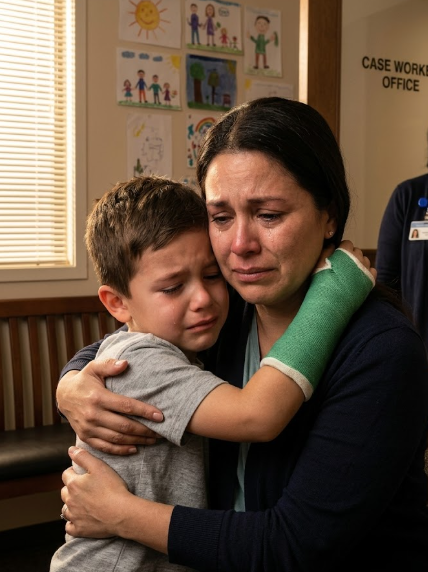
An hour later, I was sitting in the quiet, sunlit waiting room of the county child services building. The sterile walls were decorated with colorful drawings, but the atmosphere was still heavy with the sadness of the children who passed through it. My heart hammered against my ribs, not from panic this time, but from an anticipation so intense it made my breath short.
Then, a door at the end of the hallway opened.
A caseworker stepped out, and right beside her, holding her hand tightly, was Leo. He was wearing an oversized t-shirt I had bought for him, his left arm securely immobilized by his bright green cast. He looked small, tired, and deeply weary for a seven-year-old child.
But then he looked up and saw me.
His pale blue eyes lit up with a spark that I hadn’t seen in years—the bright, untamed joy of a little boy who finally knew he was safe. He broke away from the caseworker and ran toward me as fast as his small legs could carry him.
I dropped to my knees, opening my arms wide, and caught him against my chest. I held him tightly, mindful of his broken arm, burying my face in his soft hair. He buried his face into my shoulder, his small hand gripping the fabric of my shirt exactly the way he used to grip his old stuffed animals.
“I knew you’d come for me, Auntie Sarah,” he whispered, his voice muffled against my neck.
“Always, Leo,” I choked out, squeezing him just a little bit tighter. “I will always come for you. You’re safe now. Nobody is ever going to hurt you again.”
As we walked out of the building together, leaving the shadow of the courthouse and the memory of Jessica’s betrayal behind us, the oppressive July sun didn’t feel quite as merciless anymore. The air was still warm, but a gentle breeze rustled through the oak trees, drowning out the frantic scream of the cicadas.
We had survived the nightmare. We had faced the predator in her own home, dismantled her lies in the halls of justice, and broken the cycle of cruelty that had threatened to consume a beautiful, innocent life.
It would take time for Leo’s bones to heal, and even longer for the hidden scars on his heart to fade. But as I buckled him into the front seat of my car, watching him look out the window with a quiet, peaceful smile, I knew we had all the time in the world. He wasn’t a prop for an audience anymore; he was just a little boy, loved fiercely and unconditionally, starting the first day of his real life.
