
PART 2 – A Struggling Mother Accepted a Billionaire’s Marriage Offer – 12!001
PART 2
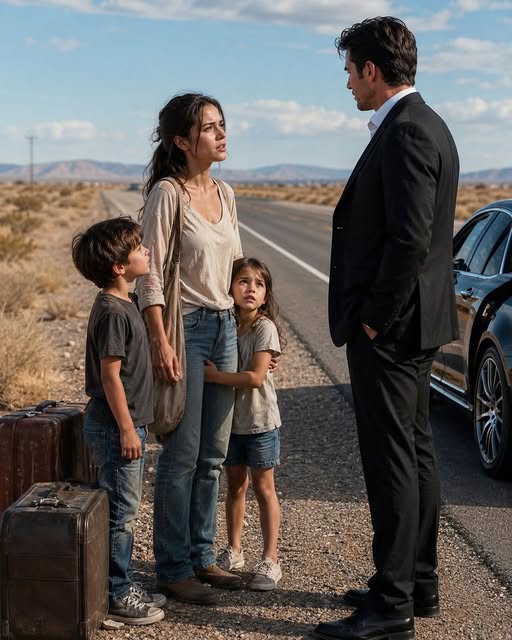
For one long second, I stood between the dead highway and Nathan Brooks’s open car door, feeling as if the world had narrowed to a single impossible choice.
Behind me, the desert stretched endlessly beneath a fading orange sky. Ahead of me waited a black leather seat, cool air drifting out from the sedan, and a man whose name sounded like it belonged on buildings, contracts, and newspaper headlines.
“Mommy?” Lily whispered.
Her little hand slipped into mine.
That was all it took.
I could survive pride. I could survive fear. I could survive humiliation.
But I could not watch my children go hungry another night.
I turned to Nathan. “If we get in that car,” I said carefully, “you don’t touch my children’s lives without my permission. No decisions about them. No promises you can take back. No pretending they’re props in whatever battle you’re fighting.”
Nathan’s eyes did not move from mine.
“Agreed.”
“And if I say no later?”
“Then you say no.”
“You’ll take us somewhere safe?”
“Yes.”
I searched his face for deception. I had learned, over the years, that dangerous men did not always look cruel. Sometimes they looked tired. Sometimes they spoke gently. Sometimes they offered help when you were too desperate to question the cost.
But there was something in Nathan’s expression that stopped me from stepping away.
Not kindness, exactly.
Restraint.
As though he was holding back more pain than power.
I nodded once.
“Noah,” I said softly. “Take Lily’s lunchbox.”
My son looked from me to Nathan, then back again.
“We’re going with him?”
“For now.”
Noah did not argue, but his small jaw tightened. He picked up the empty lunchbox with one hand and one suitcase with the other, even though it dragged against the ground.
Nathan noticed.
Without a word, he took both broken suitcases himself and placed them in the trunk.
Noah watched him with open suspicion.
“You don’t have to act nice,” my son said.
Nathan paused, then looked down at him. “I know.”
That answer seemed to confuse Noah more than any lie would have.
Inside the car, the air conditioning wrapped around us like a miracle. Lily sighed and leaned into my side, her eyes closing almost immediately. Noah sat stiffly on the other side of her, one arm around the torn cloth bag as if guarding our entire life.
Nathan sat in front beside the driver, a quiet man with gray hair and steady hands.
“Home, Mr. Brooks?” the driver asked.
Nathan hesitated.
Then he turned slightly, his gaze finding mine in the rearview mirror.
“First, somewhere to eat.”
I looked away quickly because my eyes had filled with tears.
The restaurant was not really a restaurant. It was a small, clean roadside diner with yellow light in the windows and red vinyl booths. Nathan led us inside as if he belonged everywhere and nowhere at once.
May you like




The waitress took one look at the children and softened.
“Booth by the window?”
“Yes, please,” I said before Nathan could answer.
I needed one small thing to still be my decision.
Lily woke fully when pancakes arrived. Noah tried to eat slowly, but hunger won. He swallowed eggs, toast, and orange juice with quiet determination. I ordered coffee and soup, but Nathan added sandwiches and fruit without making a show of it.
He did not ask why we had been stranded.
He did not ask where their father was.
He did not ask why my suitcase handle was tied together with shoelaces.
That silence felt like a mercy.
Halfway through the meal, Lily looked at Nathan with syrup on her chin and asked, “Are you really going to marry my mommy?”
I choked on my coffee.
Noah groaned. “Lily.”
Nathan folded his hands on the table. “That depends on your mother.”
“She doesn’t have a dress,” Lily said seriously.
A faint smile touched his mouth. “That can be arranged.”
“She also doesn’t like peas.”
“Useful information.”
“And she cries when she thinks we’re sleeping.”
The table went still.
My face burned.
“Lily,” I whispered.
But Nathan did not smile this time. His expression shifted, something quiet and heavy passing behind his eyes.
“I see,” he said gently.
Noah put down his fork. “Why do you need a wife?”
Nathan looked at him as if he had been expecting the question.
“Because my mother built part of my company with me. Years ago, she placed a condition in our family trust. If I remained unmarried when she became unable to make decisions, certain voting rights would pass temporarily to my uncle and cousin.”
“That sounds dumb,” Noah said.
“It was meant to protect me when I was young,” Nathan replied. “Now it may cost me everything.”
“Why don’t you marry someone you know?”
The question landed harder than it should have.
Nathan reached for his water, then set it down without drinking.
“Because everyone I know wants something from me.”
I almost said, And I don’t?
But I stopped myself.
Of course I wanted something from him. Food. Shelter. Safety. A chance to breathe.
The difference was that I had no graceful way to hide it.
After dinner, Nathan stepped outside to make a phone call. Through the window, I watched him stand beneath a flickering sign, one hand in his pocket, his shoulders rigid. He looked less like a billionaire then and more like a man trapped inside a life he had paid dearly to build.
Noah slid closer to me.
“Mom, this is weird.”
“I know.”
“We don’t know him.”
“I know that too.”
“Then why are we going?”
I touched Lily’s hair. She was humming softly to herself, arranging pieces of fruit by color.
“Because tonight, he can give you a bed,” I said. “Tomorrow, I’ll figure out the rest.”
Noah stared at the tabletop.
“What if the rest is bad?”
I took his hand. “Then we leave.”
“With what money?”
That was the question I could not answer.
Nathan returned before I found words. He paid the bill quietly, thanked the waitress, and held the door for us as we stepped into the cooling desert night.
His house was not in Tucson. It was north of the city, beyond a private gate and a long road lined with pale stone walls and dark cypress trees. By the time the sedan curved up the final drive, both children had fallen asleep against me.
The mansion rose from the desert like something from another world.
Not flashy. Not golden or absurd. It was wide, low, and elegant, built of warm stone and glass, with lights glowing in every window. Beyond it, the mountains were shadows against the night sky.
I stared at it and felt suddenly ashamed of my dusty clothes.
Nathan opened my door before the driver could.
“You don’t have to decide anything tonight,” he said quietly.
“Then why bring us here?”
“Because you needed somewhere safe to sleep.”
I wanted to believe him.
A woman waited inside the grand entryway. She was in her sixties, with silver hair pulled back in a neat bun and a face that had clearly mastered the art of not reacting.
“Mrs. Alvarez,” Nathan said, “this is Emily Parker. Her children, Noah and Lily.”
Mrs. Alvarez looked at us for exactly one heartbeat too long.
Then her face softened.
“Welcome,” she said. “You must be exhausted.”
I swallowed. “We don’t want to be trouble.”
“Children are not trouble,” she replied. “Hungry adults pretending not to be hungry sometimes are.”
Nathan glanced at me, and I looked away.
Within twenty minutes, Lily was in a bathtub full of bubbles, laughing for the first time that day. Noah stood in the doorway of a guest room, staring at the bed as if it might disappear if he blinked.
“This whole room is for us?” he asked.
“For tonight,” I said.
Mrs. Alvarez had brought clean pajamas, toothbrushes, and a tray with warm milk and sandwiches. I wanted to ask where they had come from so quickly, but rich people seemed to live in a world where needs were answered before they became requests.
When the children finally slept, I stood between their beds and watched their faces in the lamplight.
Noah had one hand tucked under his cheek, still frowning a little even in sleep. Lily clutched a stuffed rabbit Mrs. Alvarez had found somewhere, her lashes resting against her cheeks.
They looked safe.
That was the most dangerous thing about it.
I stepped into the hallway and found Nathan waiting near the staircase, jacket removed, sleeves rolled to his forearms. Without the suit coat, he seemed less untouchable.
“May we talk?” he asked.
I followed him to a small sitting room lined with books. The furniture was expensive but worn in the way real furniture becomes when people actually use it. A chessboard sat near the window. A framed photograph rested on the mantel: Nathan, much younger, standing beside a woman with dark hair and bright eyes.
His mother, I guessed.
“She’s beautiful,” I said.
“Yes.”
“Is she here?”
His face changed.
“She’s in the east wing. She has a private nurse. Some days she knows me. Some days she thinks I’m twenty-three and late for dinner.”
“I’m sorry.”
He nodded, but the words seemed to pass around him rather than into him.
He took a folder from the desk and placed it on the coffee table between us.
“I asked my attorney to draft an agreement months ago,” he said. “I never used it.”
“Months ago?”
“I knew my family would move eventually.”
I sat slowly. “So I’m not the first woman you thought of asking.”
“No.”
The honesty stung even though it should have reassured me.
He noticed.
“I don’t mean that the way it sounds.”
“How does it sound?”
“Cold.”
“It is cold.”
“Yes,” he admitted. “It is.”
The room was quiet except for the soft hum of air conditioning.
Nathan opened the folder.
“The agreement would give you a private account, monthly support, medical coverage for you and your children, education expenses, and ownership of a house in your name after one year, whether the marriage continues or not.”
I stared at him.
“That’s too much.”
“It is not enough for what I am asking.”
“And what are you asking, exactly?”
He met my eyes.
“Public appearances. A legal marriage. Discretion. You would live here with the children until the board matter is resolved. You would not be expected to share a bedroom with me.”
Heat rose in my face. “Good.”
A hint of amusement crossed his expression, but it vanished quickly.
“You would have your own suite. The children would have rooms near yours. Mrs. Alvarez would help with anything you need.”
“And after the board matter?”
“Six months, perhaps nine. We would quietly separate. You would be free.”
Free.
The word sounded strange.
I had been running for so long that freedom no longer meant open doors. It meant locked ones no one else had keys to.
“Why me?” I asked.
“I told you.”
“No. You told me why you need someone. Why me?”
Nathan closed the folder.
“Because when I stopped, you stepped in front of your children before you spoke to me. Because you asked for work, not charity. Because your son asked if I was a bad man and you did not hush him until you knew my answer.”
I looked down at my hands.
“And because,” he added, quieter, “desperation makes most people careless. You were afraid, but you were still thinking.”
I hated that he had seen so much.
“There are things you need to know about me,” I said.
“I assumed there would be.”
“My husband died two years ago.” My voice caught, but I forced it steady. “Car accident. After that, everything got smaller. Money. Friends. Options. I worked at a laundry. Then a motel. Then the motel closed. We stayed with my sister for a while, but her boyfriend didn’t want us there.”
Nathan’s expression hardened slightly, but he said nothing.
“I came to Arizona because someone promised me work at a care facility. When we arrived, the position was gone. I sold my wedding ring for bus tickets and food. Then the bus route…” I gave a bitter little laugh. “Well. You know the rest.”
He listened without pity, and that made it easier to continue.
“I don’t have family who can help. I don’t have savings. I don’t have a plan beyond keeping Noah and Lily safe.”
“That is a plan,” Nathan said.
It was such a simple sentence, but it reached something tired inside me.
I looked at the folder again.
“What happens if I say no tomorrow?”
“My driver will take you wherever you choose. I’ll give you enough money to get settled.”
“Why?”
“Because I found you on the side of a highway with two children,” he said. “And because I can.”
That should have been reassuring.
Instead, it terrified me.
People who could change your life with one decision could also change it back.
I stood. “I need to sleep.”
“Of course.”
At the doorway, I stopped.
“Mr. Brooks?”
“Nathan.”
“Nathan.” His name felt too intimate. “If I agree, my children come first. Always.”
“They should.”
“No matter what your family says.”
“My family has said worse things than your children could ever be.”
I did not know what to do with that answer.
So I left him standing in the lamplight, beside a folder that could either save us or swallow us whole.
The next morning, I woke to sunlight spilling across a room larger than any apartment I had ever lived in.
For a moment, I did not know where I was.
Then I heard Lily laughing.
I rushed into the next room and found her sitting on the floor with Mrs. Alvarez, brushing the fur of the stuffed rabbit as if grooming royalty. Noah stood near the window, looking out at the pool and gardens with a face too serious for a seven-year-old.
“Breakfast is ready,” Mrs. Alvarez said.
“I should help,” I replied automatically.
She looked at me over her glasses. “Today, you should eat.”
Downstairs, the dining table was set with fruit, eggs, toast, jam, and little silver dishes I did not know the purpose of. Lily climbed onto a chair and stared at everything in wonder.
Nathan entered a few minutes later, speaking on the phone.
“I don’t care what Conrad thinks,” he said, his voice low. “The meeting stays on Friday.”
He stopped when he saw us.
“I’ll call you back.”
Noah watched him closely. “Who’s Conrad?”
“My cousin.”
“Is he the bad guy?”
Nathan sat at the head of the table. “He would disagree with that description.”
“That means yes,” Noah muttered.
I gave him a look.
Nathan reached for the coffee. “It means he wants what I have.”
“What do you have?” Lily asked.
Nathan glanced around the room, then at my children.
“Too much, according to some people.”
After breakfast, a doctor came to examine the children. Then a woman arrived with clothes in simple colors and soft fabrics, all still tagged, but not flashy. Shoes. Socks. Hair clips for Lily. A small backpack for Noah.
I pulled Nathan aside in the hallway.
“This is too much.”
“You said they come first.”
“That doesn’t mean you can bury us under gifts.”
“They need clothes.”
“I know what they need.”
The words came out sharper than intended.
Nathan looked at me quietly.
After a moment, he said, “Then tell me how to do this without making you feel powerless.”
No one had ever asked me that before.
I folded my arms, more to hold myself together than to appear strong.
“Ask me first.”
He nodded. “All right.”
“And don’t make decisions in front of them before telling me.”
“Agreed.”
“And Noah doesn’t need to feel bought.”
Nathan looked toward the dining room, where Noah was inspecting the new shoes suspiciously.
“No,” he said. “He doesn’t.”
That afternoon, I met Nathan’s attorney.
Her name was Claire Whitmore, and she had sharp eyes, warm hands, and the kind of calm voice that made complicated things sound survivable. She explained the agreement without rushing. She encouraged me to get independent legal advice and even offered to arrange someone who did not work for Nathan.
That, more than anything, made me believe there might be a way to say yes without disappearing.
Still, when she left, I sat in the garden with the papers on my lap and felt sick.
Marriage.
I remembered my wedding to Daniel in the little church near my mother’s old house. He had cried when I walked down the aisle. I had teased him afterward for weeks, and he had never denied it.
Daniel had been ordinary in all the best ways.
He burned toast. He sang off-key in the shower. He used to lift Noah into the air and call him “captain.” When Lily was born, he had held her like a glass ornament and whispered, “She’s so small, Em. How do we keep her safe?”
We didn’t, I thought.
Not from everything.
Nathan found me there near sunset.
“I won’t pressure you,” he said.
“You don’t have to. My life is doing that for you.”
He accepted that without defense.
I looked at him. “Did you love someone once?”
The question seemed to catch him unprepared.
“Yes.”
“What happened?”
His gaze moved to the mountains.
“She left before the wedding.”
“I’m sorry.”
“Don’t be. She made the right choice.”
“Because of your family?”
“Because of me.”
For the first time, I saw something beneath his composure that looked like shame.
Before I could ask more, Mrs. Alvarez appeared at the garden door.
“Mr. Brooks,” she said. “Your uncle is here.”
Nathan’s expression closed like a locked gate.
A few minutes later, I met Victor Brooks.
He was in his late sixties, tall and silver-haired, with a charming smile that did not reach his eyes. Beside him stood a younger man in an expensive linen jacket, handsome in a polished, careless way.
Conrad.
Victor’s gaze moved over me with practiced politeness.
“Nathan,” he said. “You didn’t mention guests.”
“They are not guests.”
Conrad’s eyebrows rose.
I felt Nathan step closer, not touching me, but near enough that the room seemed to understand something before I did.
Victor smiled slowly.
“Ah.”
The silence became sharp.
“This is Emily Parker,” Nathan said. “My fiancée.”
My heart stopped.
I knew the arrangement. I knew the words were coming.
Still, hearing them out loud in that marble foyer made my knees weaken.
Conrad gave a soft laugh. “That was fast.”
Nathan’s voice did not change. “Life often is.”
Victor looked at my clothes, my hands, my bare ring finger.
“How lovely,” he said. “And the children?”
“My children,” I said before Nathan could answer.
Victor turned his smile on me. “Of course.”
Noah appeared at the top of the stairs, holding Lily’s hand.
Conrad looked up. “Well. A ready-made family.”
Nathan’s jaw tightened.
I stepped forward before he could speak.
“They can hear you.”
Conrad blinked, as if surprised I had a voice.
Then he smiled. “My apologies.”
But Noah had already heard enough. He pulled Lily back from the railing and disappeared down the hall.
Something hot and protective rose in my chest.
Victor watched the exchange with interest.
“Nathan, a word in private?”
“No.”
The older man’s smile thinned.
“This concerns the company.”
“Then say it here.”
Victor glanced at me. “Surely Miss Parker does not need to be burdened with business.”
“If she is to be my wife, she will hear what concerns me.”
My wife.
The words sounded different this time.
Not like an arrangement.
Like a shield.
Victor’s eyes cooled.
“Your mother’s condition is declining. The board requires stability. Sudden announcements do not create confidence.”
“Neither does circling my company like vultures.”
Conrad sighed. “Always dramatic.”
Nathan turned toward him. “You called three board members before noon.”
“I was concerned.”
“You were ambitious.”
A flicker of anger passed across Conrad’s face, then vanished beneath a smile.
Victor lifted a hand. “Enough. We’re family.”
“No,” Nathan said quietly. “We are relatives.”
The room went silent.
Victor looked at me once more, and this time his gaze was not polite. It was measuring.
“I hope you know what you’re entering, Miss Parker.”
I held his stare even though my stomach twisted.
“I’m learning quickly.”
After they left, Nathan stood in the foyer for a long moment, staring at the closed door.
“I’m sorry,” he said.
“They were exactly what I expected.”
“That doesn’t make it acceptable.”
“No,” I said. “It makes it familiar.”
He looked at me then, and I regretted the words. I had not meant to reveal so much.
From upstairs came a small sound.
Noah.
I found him in the children’s room, sitting on the edge of the bed with Lily beside him.
“He called us ready-made,” Noah said.
“I heard.”
“Like we came in a box.”
I sat beside him. “People say careless things when they think no one will stop them.”
“Mr. Brooks stopped him.”
“Yes.”
Noah picked at a loose thread on the blanket.
“Are you really going to marry him?”
“I haven’t decided.”
“But maybe.”
“Yes. Maybe.”
He looked up, and his eyes were too much like Daniel’s.
“Would Dad be mad?”
The question broke something open in me.
I pulled him close.
“No, baby,” I whispered. “Your dad loved us. He would want you safe.”
“Do you still love him?”
“Always.”
“Then how can you marry someone else?”
I closed my eyes.
“Sometimes grown-up choices aren’t about replacing love. Sometimes they’re about surviving long enough to protect the love that’s left.”
Noah leaned against me, stiff at first, then softening.
“I don’t want to like him,” he said.
“You don’t have to.”
“He got Lily a rabbit.”
“I know.”
“And he told the doctor I don’t like needles.”
“He did?”
Noah nodded reluctantly. “Mrs. Alvarez told him. He remembered.”
I kissed the top of his head.
“You can notice good things without trusting all of them yet.”
That night, I signed nothing.
The next morning, Nathan took me to visit his mother.
The east wing was quieter than the rest of the house. Sunlight filtered through sheer curtains, and the air smelled faintly of lavender and medicine. In a large bedroom overlooking the garden, Evelyn Brooks sat near the window in a pale blue robe, her silver-streaked hair braided over one shoulder.
She was thinner than in the photograph, but still beautiful.
Her eyes turned toward us as we entered.
For a moment, they were cloudy.
Then they fixed on Nathan.
“My boy,” she whispered.
Nathan crossed the room and knelt beside her chair.
“Hello, Mother.”
She touched his face with trembling fingers.
“You look tired.”
“I’m fine.”
“No, you’re not. You always say that when you’re falling apart.”
A faint smile broke through his solemn expression.
Evelyn’s gaze shifted to me.
“And who is this?”
Nathan stood. “This is Emily.”
I stepped forward. “It’s nice to meet you, Mrs. Brooks.”
Evelyn studied me for a long moment.
Then she said, “You have kind eyes and frightened shoulders.”
I did not know how to respond.
Nathan looked pained. “Mother.”
“What? It’s true.” She leaned closer to me. “Are you marrying him?”
My face warmed.
“I’m considering it.”
“Good. He needs someone who argues with him.”
Despite everything, I laughed.
Nathan sighed softly.
Evelyn smiled, pleased with herself. Then her expression changed, growing serious.
“Do you love him?”
The room went still.
I could have lied.
Instead, I said, “No. I barely know him.”
Evelyn nodded slowly. “Honest. That’s better than sweet.”
Nathan looked out the window.
Evelyn reached for my hand. Her fingers were cool and delicate.
“Then know this,” she said. “My son is not easy. He hides tenderness under duty until both become hard to recognize. But he is not cruel.”
I glanced at Nathan.
He looked almost young in that moment.
Before I could answer, Evelyn’s eyes drifted away from me. Confusion softened her face.
“Where is Rose?” she asked.
Nathan froze.
The nurse, standing near the door, moved forward gently. “Mrs. Brooks, Rose isn’t here today.”
Evelyn’s fingers tightened around mine.
“She promised she would come back before the baby.”
My breath caught.
The baby?
Nathan’s face had gone pale.
“Mother,” he said quietly, “you should rest.”
But Evelyn looked at me with sudden urgency.
“Don’t let them take the child,” she whispered.
The nurse stepped in quickly. “She gets confused when she’s tired.”
Nathan helped settle his mother back against the pillows, but his hands were not steady.
As we left the room, I waited until we reached the hallway.
“Who is Rose?”
“No one you need to worry about.”
“That sounds like someone I definitely need to worry about.”
He stopped walking.
For a moment, I thought he would shut me out completely.
Then he said, “Rose was my fiancée.”
“The one who left?”
“Yes.”
“And the baby?”
His expression tightened.
“There was no baby.”
“Your mother seemed to think there was.”
“My mother’s memories are tangled.”
I wanted to believe that.
But the way he would not look at me made it difficult.
The wedding happened two days later in a private judge’s office.
There were no flowers except a small bouquet Lily insisted I carry because “brides need something pretty.” Mrs. Alvarez found me a simple cream dress that fit as if it had been made for someone else’s better life. Noah wore a button-down shirt and stood beside me with solemn eyes.
Nathan wore a dark suit.
He looked calm.
I knew enough by then to understand that calm, for him, was armor.
The judge read the words. Legal words. Binding words. Words that had once meant forever to me and now meant safety, strategy, and a future purchased with trust I did not yet have.
When it was time, Nathan turned to me.
His hand was warm around mine.
“I, Nathan James Brooks, take you, Emily Parker…”
His voice did not tremble.
Mine nearly did.
When the judge said, “You may kiss the bride,” I stiffened.
Nathan only lifted my hand and pressed his lips lightly to my knuckles.
A polite kiss.
A careful kiss.
A grateful kiss, maybe.
Lily clapped anyway.
Noah did not.
By evening, the world knew.
Nathan Brooks, founder and CEO of Brooks Meridian, had married Emily Parker in a private ceremony.
The announcement was tasteful. No dramatic photographs. No staged romance. Just one image of us standing beside each other in the judge’s garden, my bouquet in hand, Nathan’s palm resting lightly at my back.
I barely recognized myself.
The next few days passed in a blur of adjustment.
My children began tutoring while Nathan’s staff arranged school enrollment. Lily fell in love with the kitchen garden and followed Mrs. Alvarez everywhere, asking if carrots grew faster when you sang to them. Noah discovered the library and pretended he was only interested because there were “old maps and probably secret codes.”
Nathan worked constantly.
Meetings. Calls. Documents. Quiet arguments behind closed doors.
But every evening, no matter how late, he asked me about the children.
Not in a performative way.
In detail.
Did Lily’s cough improve? Did Noah eat lunch? Did the tutor push too hard? Did they need anything?
One night, I found him in the kitchen at nearly midnight, attempting to make tea.
“You own half the desert and can’t find a mug?” I asked.
He looked at the open cabinet. “I know where they used to be.”
I reached past him and took one down.
“Mrs. Alvarez moved them?”
“Apparently.”
“She runs this house.”
“She allows me to live here.”
I smiled before I could stop myself.
He noticed, but did not comment.
We sat at the kitchen island, two strangers married by necessity, drinking tea under soft yellow lights.
“Did you eat dinner?” I asked.
“Yes.”
I raised an eyebrow.
He paused. “Coffee.”
“That is not dinner.”
“It was warm.”
“Nathan.”
He looked down at his cup, and something like amusement touched his mouth.
“You sound like my mother.”
“Then your mother was right.”
“She often was.”
Silence settled between us, but it was not uncomfortable.
After a while, he said, “The board meeting is tomorrow.”
“Are you worried?”
“Yes.”
The admission surprised me.
“What happens if they side with your uncle?”
“I lose executive control. Conrad likely becomes interim CEO. Projects I built to protect smaller suppliers, employee ownership plans, charitable contracts—many of them would be sold or dissolved.”
“That sounds personal.”
“It is.”
“Why?”
Nathan turned the mug slowly between his hands.
“My father built wealth by squeezing everyone beneath him. My mother hated it. Brooks Meridian was supposed to be different.”
“Is it?”
“I’ve tried to make it different.”
I studied him.
For the first time, I understood that this was not simply a rich man protecting rich things. Whatever Nathan had built mattered to him. Not because it made him powerful, but because it proved he had not become his father.
The next morning, I dressed carefully.
A navy dress. Low heels. Hair pinned back. Nothing too glamorous, nothing too meek.
When I came downstairs, Nathan was waiting in the foyer.
For half a second, his expression changed.
“You look…” He stopped.
“Presentable?”
“No.” His voice softened. “Steady.”
That meant more than beautiful would have.
The boardroom was on the top floor of a glass tower in downtown Tucson. The city spread below us, sunlit and distant. Men and women in expensive suits sat around a long table, watching me with curiosity they tried to hide.
Victor sat near the end. Conrad beside him.
Nathan introduced me simply.
“My wife, Emily Brooks.”
The name struck me like a bell.
Emily Brooks.
Not Parker.
Not Daniel’s wife.
Not the woman on the roadside.
Someone new, at least on paper.
The meeting began with polite language and quiet hostility. Financial reports. Voting rights. Legal interpretations. Health updates on Evelyn Brooks.
Then Victor leaned back and folded his hands.
“We all respect Nathan’s recent personal decision,” he said. “But the timing raises obvious concerns.”
Conrad nodded gravely. “A marriage entered days before a major governance decision is unusual.”
Every eye shifted toward me.
My mouth went dry.
Nathan’s hand rested on the table, still and controlled.
Before he could answer, I spoke.
“It is unusual.”
Nathan turned slightly.
I kept my voice even.
“So was being stranded on a highway with my children. So was learning the bus I waited for no longer existed. So was being offered food, shelter, and dignity by someone who could have driven past us.”
Victor’s eyes narrowed almost imperceptibly.
“I don’t understand corporate law,” I continued. “I won’t pretend I do. But I understand character. My husband did not hide what he needed from me. He gave me documents. He gave me legal counsel. He gave me time to say no. That may not make our marriage traditional, but it does make it honest.”
The room had gone very quiet.
Conrad smiled thinly. “A moving speech.”
I looked at him. “It wasn’t a speech.”
Nathan’s attorney, Claire, slid a document forward.
“The marriage is valid. The trust terms are clear. Mrs. Brooks’s standing is legally recognized.”
Victor’s expression remained pleasant, but his fingers tightened.
The vote took less than fifteen minutes.
Nathan kept control.
Not by a landslide.
By one vote.
As people stood and gathered their papers, Nathan remained seated for a moment, staring at the table.
Then he looked at me.
“Thank you,” he said quietly.
“For what?”
“For choosing not to be invisible.”
I did not know why that made my throat ache.
That night, Mrs. Alvarez made an actual dinner, and Lily declared it a “winning party.” Noah asked Nathan three questions about the company, two about the security cameras, and one about whether billionaires had to do homework when they were kids.
Nathan answered every one.
Later, after the children had gone to bed, I found an envelope slipped beneath my bedroom door.
Inside was a copy of the agreement, fully executed.
And a handwritten note.
You are not trapped here. The account is active. The house transfer is already in progress. Whatever happens next, you and the children will have a place that belongs only to you.
— N.
I sat on the edge of the bed, holding the note until the words blurred.
For so long, every kind act had come with a hook hidden inside it. A favor that became a debt. A roof that became a reminder. A meal that became leverage.
This felt different.
Or I wanted it to.
That was the frightening part.
The next week was almost peaceful.
Almost.
Noah began to relax in small ways. He stopped carrying the cloth bag everywhere. He let Nathan show him how to play chess. He still called him “Mr. Brooks,” but the sharpness faded from his voice.
Lily began calling him “Mr. Nathan,” then accidentally “Nathan,” then once, at breakfast, “almost-dad,” which made Noah drop his spoon and me nearly spill my coffee.
Nathan only said, “Almost is a very complicated title,” and passed her the jam.
But beneath the warmth, questions remained.
Rose.
The baby.
Evelyn’s warning.
Don’t let them take the child.
I told myself Nathan had explained it. Illness tangled memories. Grief invented ghosts. Families like his probably had closets full of old scandals that meant nothing now.
Then I found the photograph.
It happened on a rainy afternoon, rare and silver, washing the desert dust from every window. Lily was napping, Noah was with his tutor, and Nathan had gone to Phoenix for meetings.
Mrs. Alvarez asked me to choose linens from a storage room near the east wing.
“The blue cupboard,” she said. “Second shelf.”
I found the cupboard easily. But as I pulled down a folded blanket, a small wooden box slid forward and fell at my feet.
The lid popped open.
Photographs spilled across the floor.
I knelt quickly, intending only to put them back.
Then I saw Nathan.
Younger. Smiling. Truly smiling.
Beside him stood a woman with dark red hair and laughing eyes.
Rose, I knew instantly.
In the first photograph, she was holding Nathan’s hand near a lake. In another, she stood beside Evelyn in the garden, both women smiling at something outside the frame.
Then I found the last photograph.
Rose stood on the front steps of the mansion, one hand resting over the curve of her stomach.
Pregnant.
Very pregnant.
On the back, in faded blue ink, someone had written:
Rose, seven months. Nathan still doesn’t know what to do with his hands.
I stopped breathing.
There had been a baby.
The hallway behind me creaked.
I turned.
Mrs. Alvarez stood in the doorway, her face pale.
“You weren’t meant to find those.”
I rose slowly, the photograph trembling in my hand.
“Nathan told me there was no baby.”
Mrs. Alvarez closed her eyes.
When she opened them, they were filled with something that looked like sorrow.
“He believes that.”
A chill moved through me.
“What does that mean?”
Before she could answer, a soft voice came from behind her.
“She means they lied to him.”
Evelyn Brooks stood in the hallway in her robe, one hand braced against the wall, her nurse nowhere in sight.
Her eyes were clearer than I had ever seen them.
She looked at the photograph in my hand.
Then at me.
“The child lived,” she whispered. “And Emily… I think someone has brought that child back.”
END OF PART 2 – LIKE, SHARE AND COMMENT “THE ENTIRE STORY” IF YOU WANT TO READ THE FULL STORY
PART 3 – END – A Struggling Mother Accepted a Billionaire’s Marriage Offer – 12!001
PART 3 — FINAL PART
The photograph shook in my hand.
For a moment, the hallway seemed to tilt around me—the polished floor, the pale walls, the rain tapping softly against the high windows. Evelyn Brooks stood in her robe, thinner than the shadows around her, but her eyes were clear.
Clear and terrified.
“The child lived,” she whispered again.
Mrs. Alvarez reached for her. “Mrs. Brooks, you shouldn’t be out of bed.”
Evelyn did not look away from me. “They told him Rose left. They told him she betrayed him. They told him there was no baby.” Her mouth trembled. “But I held that child, Emily. I held her.”
Her.
The word entered the room like a candle in the dark.
“A girl?” I asked softly.
Evelyn nodded.
My fingers tightened around the photograph. Nathan, younger and smiling. Rose with one hand over her stomach. A future hidden inside her dress.
“Where is she now?” I asked.
Evelyn’s eyes filled.
“I don’t know.”
Mrs. Alvarez looked toward the stairwell, as if afraid the house itself might be listening.
“We need to get Mrs. Brooks back to her room,” she said quietly. “And we need to call Mr. Nathan.”
“No,” Evelyn said sharply.
The strength in her voice startled us both.
“No,” she repeated, softer now. “Not over the phone. Not when Victor may still have ears everywhere.”
A chill slipped down my spine.
Victor.
Of course.
The man who smiled like a gentleman and measured children like furniture.
I looked at Mrs. Alvarez. “What happened?”
She pressed her lips together. For the first time since I had met her, the unshakable housekeeper looked afraid.
“Rose disappeared eight years ago,” she said. “One month before the wedding. Nathan was in London finalizing a merger. Rose was supposed to stay here with Mrs. Brooks.” Her voice lowered. “Then one night, she was gone.”
“Gone where?”
Mrs. Alvarez shook her head. “That was the question no one was allowed to ask.”
Evelyn gripped the edge of the cupboard. “Victor said she left a letter.”
“To Nathan?”
“Yes.” Her face twisted. “It said she didn’t love him. That the baby wasn’t his. That she wanted money and freedom.”
I stared at the photograph again.
The woman in it looked young and bright and loved. Not like someone running from a life she had chosen.
“And Nathan believed it?” I asked.
Mrs. Alvarez answered before Evelyn could.
“He was heartbroken. Then Victor showed him documents. Medical records. Bank withdrawals. A statement from someone claiming Rose had boarded a private flight.”
May you like
“Claiming?”
Mrs. Alvarez’s eyes met mine. “I never believed it.”
Rain moved in silver lines down the window.
I thought of Nathan’s face when his mother had mentioned the baby. The way he had said, There was no baby.
Not coldly.
Not carelessly.
Like a man repeating a sentence he had needed to survive.
Evelyn reached for me with a trembling hand. “Victor wanted control even then. If Nathan married Rose, he would have become stronger in the trust. If he had a child…” Her voice broke. “A child would have changed everything.”
“Why now?” I whispered. “Why would someone bring the child back now?”
At that, Mrs. Alvarez slowly turned toward the east stairwell.
“There was a call this morning,” she said. “A woman asked for Mrs. Brooks. The nurse said she sounded young.”
Evelyn’s eyes shone.
“She said her name was Grace.”
The name hung between us.
Grace.
I felt suddenly aware of Lily sleeping somewhere downstairs, Noah bent over his schoolwork, Nathan driving back from Phoenix with no idea that the past he had buried was waiting inside his own house.
“What did she want?” I asked.
Mrs. Alvarez looked at Evelyn.
Evelyn swallowed. “She said she had something that belonged to Nathan Brooks. And she asked whether the blue garden still had white roses.”
Mrs. Alvarez’s hand flew to her mouth.
“What does that mean?” I asked.
Evelyn’s voice came out barely audible.
“Rose planted white roses in the east garden. She said if she ever had a daughter, she would bring her there first.”
The photograph slipped lower in my hand.
“Where is Grace now?”
“She said she would come tonight,” Mrs. Alvarez whispered. “After dark.”
I looked down the long hallway toward the front of the mansion.
Every light suddenly felt too bright. Every closed door felt like it might open.
Nathan had offered me a home, security, and a name.
But this house had secrets buried beneath every polished stone.
And one of them was walking back toward him.
When Nathan returned just after sunset, he found me standing in the foyer with the photograph in my hand.
He stopped halfway through removing his coat.
His eyes dropped to the image.
All the color left his face.
“Where did you find that?”
“In the east wing.”
His gaze lifted to mine. “You went through my mother’s things?”
“No. A box fell.”
His expression hardened, but beneath it was pain so raw I nearly looked away.
“You should not have seen that.”
“I think you should have.”
“Nathan—”
“There was no baby.”
His voice cracked on the last word.
Not loudly. Not dramatically.
Just enough to reveal the wound beneath it.
I stepped closer. “Who told you that?”
He looked at me as if the question itself hurt.
“Rose did.”
“In the letter?”
His eyes sharpened.
“What do you know about the letter?”
“Only that Victor showed it to you.”
For a moment, he said nothing.
Then he looked toward the staircase.
“My mother told you.”
“She remembered.”
A faint, bitter laugh left him. “My mother remembers fragments of a life that no longer exists.”
“She remembered Grace.”
The name struck him like a physical blow.
His hand tightened around the back of a chair.
“What did you say?”
“A young woman called today. She asked about the blue garden and white roses. She said she had something that belonged to you.”
Nathan stared at me.
Outside, thunder rolled far over the desert.
“That’s impossible,” he said.
The doorbell rang.
Neither of us moved.
Then Mrs. Alvarez appeared at the top of the stairs, one hand pressed to her heart.
Nathan turned slowly toward the door.
I had seen him in boardrooms, in family confrontations, in quiet grief. I had seen him composed, wounded, protective, distant.
But I had never seen him afraid.
The driver opened the front door.
A young woman stood beneath the covered entry, rain shining in her dark red hair.
She could not have been more than eighteen.
She wore jeans, a gray sweater, and a canvas backpack over one shoulder. Her shoes were muddy, and her face was pale with exhaustion. But her chin was lifted in a way that made my breath catch.
Because I had seen that expression before.
Not on Rose.
On Nathan.
The girl looked past the driver into the foyer.
Her eyes found Nathan.
For one long second, neither of them spoke.
Then she reached into her backpack and pulled out a small wooden music box. The varnish was scratched, the brass hinge worn.
“My mother told me,” the girl said, her voice shaking despite her effort to steady it, “that if I ever needed the truth, I should bring this back to the house with the white roses.”
Nathan looked at the music box as if it were alive.
His voice was barely there.
“Rose had that.”
The girl nodded once.
“My name is Grace.”
Nathan did not move.
So I did.
I stepped forward, slowly, gently, as I would approach a frightened child or an injured bird.
“Grace,” I said. “I’m Emily.”
Her eyes shifted to me. Cautious. Tired. Brave.
“Are you his wife?”
The question was simple.
The answer was not.
“Yes,” I said.
Something flickered across her face, but it vanished quickly.
“I’m sorry for coming here.” She tightened her grip on the music box. “I didn’t know where else to go.”
Nathan seemed to return to himself in pieces. He crossed the foyer, stopping several feet from her, as if afraid one wrong movement might make her disappear.
“Where is Rose?” he asked.
Grace looked down.
The whole house held its breath.
“She died three months ago.”
Nathan closed his eyes.
No sound came from him.
Yet I felt the loss move through the foyer like wind through broken glass.
Grace swallowed hard. “She was sick for a long time. She wouldn’t let me contact you. Not while she was alive. She said it was too dangerous. But before she died, she gave me the music box, some letters, and a name.” Her gaze flickered toward the shadows beyond the doorway. “Victor Brooks.”
Nathan opened his eyes.
They were changed.
Not with anger.
With recognition.
Mrs. Alvarez came down the stairs, tears on her face. “Come in, child. Please come in.”
Grace hesitated.
Then Lily appeared in the hallway behind us, rubbing her eyes and holding her stuffed rabbit by one ear.
“Mommy?”
Grace looked at Lily, and something in her guarded face softened.
Lily looked at Grace’s wet clothes.
“You need a towel,” she said seriously.
The smallest laugh escaped Grace. It broke almost immediately into a sob.
And just like that, the terrifying girl from the doorway became exactly what she was.
A child who had carried too much truth alone.
We brought her into the sitting room.
Mrs. Alvarez wrapped a blanket around her shoulders. I made tea because my hands needed something to do. Noah came downstairs, alert and suspicious, but when he saw Grace crying silently into her cup, his face changed.
He sat near Lily without speaking.
Nathan remained standing by the mantel, one hand resting near his mother’s photograph. He had not asked Grace for proof again. I think he was afraid of what proof might do to him.
Grace opened the music box.
A soft melody spilled into the room.
Evelyn, brought in by her nurse, began to cry before anyone spoke.
“That was Rose’s,” she whispered. “Her grandmother gave it to her.”
Grace knelt in front of Evelyn’s chair.
“My mother said you were kind to her.”
Evelyn reached for her face with trembling hands.
“Oh,” she breathed. “Oh, my darling.”
Grace did not resist when Evelyn touched her cheek. Her own tears fell then, quiet and unstoppable.
Nathan turned away.
I went to him.
He stared at the rain-dark window, jaw tight, shoulders rigid.
“I don’t know how to stand here,” he whispered.
It was such an honest confession that my heart ached.
“You don’t have to know yet.”
“She’s Rose’s daughter.”
I looked back at Grace.
The red hair. The proud chin. The careful way she held herself together.
Then she laughed softly at something Lily said, and her expression changed.
There it was.
Nathan’s smile.
Not a copy.
A spark passed from one life into another.
“She may be yours too,” I said.
Nathan pressed his fingers to his eyes.
“I believed them.”
“You were grieving.”
“I let her vanish.”
“You were lied to.”
He turned toward me then, and all his composure was gone.
“What if she needed me?”
I held his gaze.
“Then you start by being here now.”
Grace had brought more than the music box.
From her backpack she removed a bundle wrapped in oilcloth: letters, photographs, a hospital bracelet, a birth certificate, and a sealed envelope addressed in Rose’s handwriting.
Nathan sat before opening it.
His hands were steady this time, but only because he forced them to be.
The letter was dated four months earlier.
He read it silently at first.
Then, when Evelyn asked in a shaking voice, “What did she say?” he drew a breath and began again aloud.
Nathan,
If this letter has reached you, then I failed at the one thing I promised myself I would do: tell you the truth while I was still alive.
I loved you.
That is the first truth.
I loved you when I left, and I loved you every day after, even when loving you meant staying away.
Victor came to me while you were in London. He had documents, recordings, threats. He said if I married you, he would destroy you through the trust, the company, and the child. He told me your father had left debts hidden in legal structures I did not understand. He told me Evelyn’s care could be interrupted. He told me I would be painted as a fraud, that the baby would be dragged through courts before she learned to walk.
I was young. I was afraid. And I made the wrong choice for the right reason.
I ran.
But not with his money. Never that.
The letter you received was not mine.
Nathan stopped reading.
His face had gone white.
Grace looked down at her hands.
I reached for the letter gently. “May I?”
He nodded.
I continued where he had stopped.
I named our daughter Grace because I hoped one day she would receive more of it than I had given you.
She is yours, Nathan. She has your eyes when she is thinking too hard and your habit of hiding fear behind politeness. She asks questions no one wants to answer. She deserves the truth.
I have included what I kept. Copies, dates, names. I do not know whether they are enough to prove what Victor did, but they are enough to begin.
Please do not let bitterness be the inheritance she receives from us.
If Emily is the woman I think she may be, trust her. Yes, I know about her. I saw the announcement. I was angry first, then relieved. Not because you had replaced me. Because someone with tired eyes and a brave spine was standing beside you when I no longer could.
Tell Evelyn I remembered the white roses.
Tell Grace I was sorry every day.
And Nathan, if there is still any gentle part of you left, let it live.
Rose
When I finished, the room was silent except for the rain.
Nathan bowed his head.
Grace sat very still, as if she had heard the words before but needed to hear someone else believe them.
Then Noah, who had been silent the entire time, asked, “So Victor stole your family?”
No one corrected him.
Nathan looked up at Grace.
“I didn’t know,” he said.
Grace’s eyes filled again, but her voice stayed steady.
“I know.”
He swallowed. “I should have.”
“I wanted to hate you,” she whispered. “It would have been easier.”
Nathan flinched.
Grace looked at the music box. “But Mom never did. Not really.”
That undid him.
He covered his face with one hand.
And Grace, who had crossed miles of uncertainty to reach a stranger, rose from her chair and walked to him.
She stopped close, but not too close.
“I don’t know how to do this,” she said.
Nathan lowered his hand.
“Neither do I.”
For some reason, that was enough.
Grace stepped into his arms.
He held her as if she were both fragile and real, as if his whole life had narrowed to the miracle of not letting go.
Evelyn wept openly.
Mrs. Alvarez crossed herself.
Lily leaned against my side and whispered, “Is she ours now too?”
I looked at Nathan holding the daughter he had never known, and Grace holding the father she had been taught to fear and hope for at the same time.
“I think,” I whispered back, “she always was.”
The next days changed the house completely.
Not loudly.
Not all at once.
But in small shifts, like sunlight moving across a floor.
Grace slept in the room across from Noah and Lily because Lily insisted no one who arrived in the rain should be “too far away from snacks.” Noah pretended not to care, then left one of his old maps outside her door with a note that said, In case this house is confusing. It was, in his language, a welcome banner.
Nathan arranged for DNA testing, but not with cold urgency. He asked Grace first. He told her she did not have to prove herself to be treated with dignity in his home.
Grace agreed anyway.
“I want to know,” she said. “Even if I already do.”
While they waited for results, Claire began reviewing Rose’s documents.
The truth did not explode.
It unfolded.
A forged letter. A private account opened in Rose’s name without her knowledge. A flight record purchased but never used. Payments to a former family attorney. Emails preserved by Rose because she had never completely stopped hoping the truth would matter.
Victor had not kidnapped anyone. He had done something quieter and easier to hide.
He had surrounded a frightened young woman with legal threats, false evidence, and isolation until leaving felt like the only way to protect the people she loved.
It was not dramatic enough for movies.
It was far more believable.
And that made it hurt worse.
When Nathan confronted Victor, he did not do it in a shouting match in the marble foyer.
He did it in a conference room, with Claire beside him, two independent board members present, and a court reporter recording every word.
I was there too.
Not because I understood all the legal details.
Because Nathan asked.
Victor arrived smiling.
Conrad came with him, though his confidence faltered when he saw the documents spread across the table.
“Nathan,” Victor said warmly, “this feels unnecessary.”
Nathan did not rise.
“So did burying my daughter.”
Victor’s smile froze.
Conrad looked at him. “What?”
That was the first surprise.
Conrad did not know.
Not everything.
Not the heart of it.
Victor’s eyes flicked to me, then to Claire, then to the files.
“I don’t know what you think you have.”
“Enough,” Claire said calmly. “Enough to petition for your immediate removal from all trust-related authority. Enough for civil action. Possibly enough for criminal review, depending on what the district attorney decides.”
Victor’s face changed by degrees. Charm first. Then irritation. Then calculation.
“You think a dead woman’s scraps can undo decades of leadership?”
Nathan leaned forward.
“No. I think the truth can.”
For a moment, Victor looked almost sad.
Almost.
“I protected this family,” he said.
“No,” Nathan replied. “You protected your access to it.”
Conrad stood suddenly. His chair scraped back.
“You told me she left for money,” he said to Victor.
Victor’s mouth tightened. “Sit down.”
“You told me Nathan was unstable because she humiliated him. You told me the trust needed safeguards.”
“Conrad.”
But Conrad was staring at the documents now.
At Rose’s handwriting.
At the proof that ambition had been dressed up as family duty for years.
“I repeated that story,” he said quietly. “To board members. To investors.” He looked at Nathan, and for the first time since I had met him, he looked young. “I believed it.”
Nathan’s face remained guarded.
Conrad swallowed.
“I’m sorry.”
Victor gave a sharp laugh. “Pathetic. All of you. Do you think sentiment runs a company?”
“No,” Nathan said. “But neither does rot.”
In the end, justice did not arrive like thunder.
It arrived as signatures.
Victor resigned from the trust board pending investigation. His voting interests were frozen. Claire filed the documents. Conrad provided a statement and turned over records that helped unravel several questionable transfers.
It was not forgiveness.
Not yet.
Maybe not ever.
But it was accountability through the proper doors, with witnesses and paper trails and no one needing to become cruel in order to be strong.
Afterward, in the elevator, Nathan stood beside me in silence.
His reflection in the mirrored wall looked exhausted.
“You did it,” I said.
He shook his head. “Rose did. Grace did. My mother did. You did.”
“I mostly made tea.”
He turned to me, and there was warmth in his tired eyes.
“You stood in rooms where you owed no one anything and still chose courage.”
I looked down, suddenly overwhelmed.
He reached for my hand, then stopped, asking permission without words.
This time, I gave it.
His fingers closed around mine carefully.
The elevator descended in silence, but something between us rose.
The DNA results came on a Friday morning.
Grace was in the garden with Lily, trying to teach her how to braid stems of lavender without snapping them. Noah was pretending to read under a tree, though I saw him look toward the house every few seconds.
Nathan opened the envelope in the kitchen.
I stood beside him.
He read the page once.
Then again.
His hand lowered.
“Well?” I asked softly.
He looked through the window at Grace.
A smile appeared slowly, breaking through grief like dawn through cloud.
“She’s mine.”
I exhaled a breath I had not realized I was holding.
Outside, Grace looked up as if she felt the moment before anyone called her.
Nathan stepped out into the garden.
He walked toward her with the paper in his hand.
Grace rose.
Lily, sensing importance, froze mid-braid. Noah stood too, book forgotten in the grass.
Nathan stopped in front of Grace.
Neither of them spoke.
Then he handed her the page.
She read it.
Her mouth trembled.
“I knew,” she whispered.
“So did I,” Nathan said.
“But now you can’t politely doubt it.”
A laugh escaped him, broken and beautiful.
“No. Now I can’t.”
Grace folded the paper carefully and pressed it to her chest.
Then she looked at him with a bravery that reminded me of Rose’s letter.
“Can I ask you something?”
“Anything.”
“Did you love my mom?”
Nathan’s eyes softened.
“Yes.”
Grace nodded, absorbing that.
“Do you still?”
“Yes.”
Her gaze flickered toward me.
The question she did not ask was louder than the one she had.
Nathan understood.
“Love does not vanish because life changes,” he said. “It becomes part of what teaches us how to love the people still here.”
Grace looked at me then.
I did not know what expression she found on my face, but after a moment, she smiled a little.
“I think she would have liked you,” she said.
My throat tightened.
“I think I would have liked her too.”
Lily tugged on Grace’s sleeve.
“So are you my sister?”
Grace looked startled.
Noah sighed. “That is not how family trees work.”
Lily frowned at him. “It can if we draw it right.”
Grace laughed.
Nathan looked at me over their heads, and for the first time since I had entered his life, I saw something peaceful in him.
Not healed.
Healing.
There is a difference.
Weeks passed.
The house changed again.
Grace enrolled in school but chose to finish some classes online until she felt ready. She and Noah became unlikely allies, united by a shared suspicion of unnecessary small talk. Lily adored her with immediate, uncomplicated devotion.
Evelyn had good days and drifting days.
On the good days, she told Grace stories about Rose. How Rose sang badly but confidently. How she once planted an entire row of herbs upside down. How she made Nathan dance in the kitchen after midnight because she said serious men needed music most.
On the drifting days, Grace sat beside her anyway and played the music box.
Sometimes Evelyn called her Rose.
Grace would answer gently, “No, Grandma. It’s Grace.”
And Evelyn would smile.
“Of course it is.”
Grandma.
The first time Grace said it, Evelyn cried for ten minutes and then demanded cake.
Mrs. Alvarez made two.
As for Nathan and me, our marriage remained an arrangement on paper longer than it did in the quiet spaces between us.
He still slept in his suite.
I still slept in mine.
But we met in the kitchen more often.
Tea became dinner. Dinner became conversations. Conversations became laughter that surprised us both.
One night, I found him in the library staring at the chessboard.
“Noah beat you?” I asked.
“Badly.”
“He told me he was developing a strategy.”
“He developed betrayal.”
I laughed and sat across from him.
Nathan moved a pawn absently.
“I received confirmation today,” he said. “The house transfer is complete. It’s in your name.”
I stared at him.
The small house he had promised in the agreement. I had almost forgotten, not because it did not matter, but because survival no longer occupied every corner of my mind.
“You actually did it.”
“I said I would.”
“Yes, but people say things.”
“I know.”
I looked at the board, at the carved pieces waiting between us.
“So we have somewhere to go.”
“Yes.”
“And you’re reminding me.”
“Yes.”
“Why?”
His eyes met mine.
“Because I never want comfort to become a cage.”
The words settled over me softly.
For so long, I had thought safety meant depending on no one.
But maybe real safety was being able to stay without being trapped.
I touched the edge of the queen piece.
“What if I don’t want to go?”
Nathan became very still.
I forced myself to continue.
“What if the children don’t want to go? What if this impossible, ridiculous arrangement became something none of us planned?”
His voice was quiet.
“Emily.”
“I know we began as a contract.”
“Yes.”
“And I know you loved Rose.”
“I did.”
“I loved Daniel.”
“I know.”
I looked at him fully then.
“I still do.”
His face softened. “So do I.”
There was no jealousy in his voice. No demand. No need to erase the people who had come before.
That was when I realized what had been growing between us was not a replacement.
It was not a rescue.
It was a second room built carefully beside the first, with doors left open and windows full of light.
Nathan reached across the chessboard.
This time, he did not stop halfway.
His hand covered mine.
“I love you,” he said.
The words were simple. Almost too simple for everything they carried.
My eyes filled.
“I wasn’t ready for that.”
“I know.”
“I’m not sure I know how to be someone’s wife again.”
“Then don’t be what anyone expects. Be Emily. That has been more than enough.”
A tear slipped down my cheek.
I laughed softly through it.
“You make it sound easy.”
“No,” he said, brushing the tear away with his thumb. “I make it sound worth learning.”
I leaned across the chessboard and kissed him.
Not for the judge.
Not for the cameras.
Not for protection, strategy, or survival.
For us.
The final unexpected truth arrived from a place none of us had thought to look.
My old torn cloth bag.
It happened two months later, on a Saturday morning filled with pancakes, laundry, and Lily’s dramatic announcement that she intended to become “a carrot scientist.” We were sorting through the few belongings I had carried from the highway, deciding what to keep and what to finally let go.
At the bottom of the cloth bag, beneath Daniel’s old work shirt and a cracked picture frame, Noah found an envelope.
“Mom?” he said. “This has Dad’s handwriting.”
My heart stopped.
The envelope was yellowed at the edges, sealed but bent from travel.
On the front, Daniel had written:
For Emily, when the road gets too hard.
I sat down slowly.
I had never seen it.
Maybe he had tucked it into the bag before some trip. Maybe I had moved it from box to box without noticing, grief making me blind to anything that might hurt.
Nathan, standing nearby, quietly guided Lily and Grace toward the kitchen.
But Noah stayed.
“He was my dad too,” he whispered.
I nodded and opened the envelope.
Inside was a letter and a folded receipt from a mechanic’s shop in Tucson.
Emily,
You always tell me I worry too much, so here is proof.
If anything ever happens and you need help, there is a man in Arizona named Samuel Ortiz. He served with my brother before we lost him. He owns a repair shop outside Tucson. He once told me that if my family ever needed a place to land, I should send you to him.
I hope you never read this because you need it.
But if you do, listen to me: needing help does not mean you failed. It means the world is too heavy for one pair of hands.
Take the kids somewhere safe. Eat. Sleep. Let someone be kind to you.
And Em, when life asks you to keep living, don’t mistake that for leaving me behind.
I love you in every road you take.
Daniel
The room blurred.
Noah pressed against me, crying silently.
I held him and read the last line again.
I love you in every road you take.
The receipt beneath the letter showed an address.
Outside Tucson.
My breath caught.
The highway where Nathan found us had not been random.
We had been less than ten miles from the repair shop Daniel had named.
I showed Nathan the letter later.
He read it with quiet reverence.
Then he looked at the receipt.
“I know this shop,” he said.
“You do?”
He nodded slowly. “Samuel Ortiz repaired my mother’s car for years. He was the one who called my driver that day.”
I stared at him.
“What?”
Nathan’s expression shifted, as if another hidden piece had clicked into place.
“My driver received a call about a woman and two children stranded near the old route. Samuel saw you when he passed in a tow truck, but he had a vehicle hooked and couldn’t stop safely. He called the house because he knew our car was nearby.”
My hand flew to my mouth.
“So you didn’t just happen to stop?”
“I chose to stop,” Nathan said. “But Samuel sent me down that road.”
Daniel’s letter trembled in my hand.
A road that had felt abandoned had been lined with unseen mercy.
My husband, gone two years, had left a name.
That name had called Nathan.
Nathan had stopped.
And because he stopped, Grace had found her way home too.
When we visited Samuel Ortiz the next day, he remembered Daniel immediately.
“Good man,” he said, wiping his hands on a rag. “Talked about his wife like she hung the moon and organized the stars.”
I cried right there between two old pickup trucks.
Samuel hugged me like family.
Then he looked at Nathan and shook his hand.
“You did right by them.”
Nathan glanced at me.
“They did right by me.”
One year after the day on the highway, we gathered in the east garden beneath the white roses.
Not for a legal wedding.
That had already happened in a judge’s office with paperwork and fear.
This was something else.
A choosing.
Evelyn sat in the front row in a pale blue dress, Grace beside her. Mrs. Alvarez cried before anyone even spoke. Noah wore a suit and carried the rings with grave importance. Lily scattered rose petals in wild handfuls, mostly on her own shoes.
Grace read from Rose’s letter.
Noah read from Daniel’s.
And when Nathan and I stood facing each other beneath the warm desert sky, there were no secrets between us that mattered more than truth.
“I offered you a name,” Nathan said, his voice thick with emotion. “You gave me back my family.”
I shook my head, smiling through tears.
“You gave my children a door when every road had closed.”
Grace sniffed loudly. Lily handed her a petal in sympathy.
Nathan took my hands.
“I promise you freedom with my love. Not instead of it.”
I could barely speak.
“I promise to stay because I choose to. Not because I have nowhere else to go.”
His smile broke open, full and real.
The kind from the photograph.
The kind I had once wondered if I would ever see.
Later, as the sun sank behind the mountains, we ate cake in the garden while Lily explained carrot science to an extremely patient board member, Noah taught Grace chess openings, and Evelyn hummed along to the old music box.
Nathan found me near the white roses.
He slipped his hand into mine.
“Forty-seven cents,” I said softly.
He looked at me. “What?”
“That’s what I had in my pocket the day we met.”
His thumb brushed over my wedding ring.
“And now?”
I looked across the garden.
At Noah laughing.
At Lily dancing with Mrs. Alvarez.
At Grace leaning her head on Evelyn’s shoulder.
At the house that no longer felt like a bargain or a hiding place, but a home.
“Now,” I said, “I have more than I knew a life could hold.”
Nathan kissed my temple.
Above us, the desert evening opened wide and golden.
Once, I had stood on the side of a deserted highway waiting for a bus that would never come.
I thought that was the end of everything.
But sometimes the road that fails you is only making room for the car that stops, the truth that returns, the family that forms in ways no one could have planned.
And sometimes, when life asks you to step into a future you do not understand, it is not asking you to forget who you were.
It is asking you to discover how much love can still be waiting ahead.
THE END
