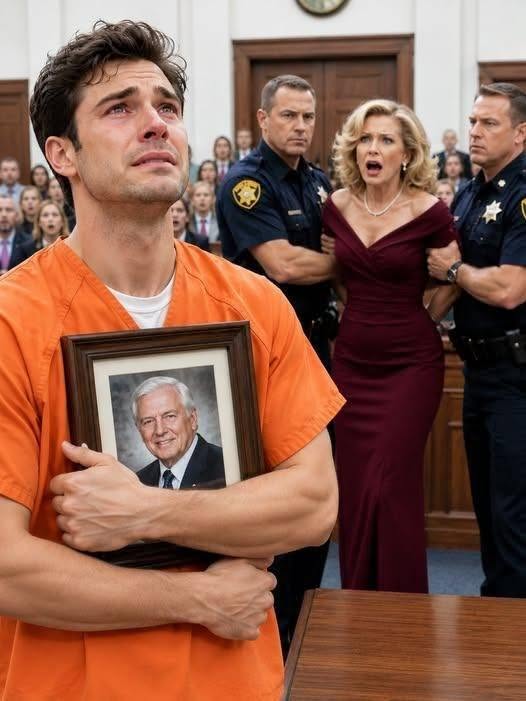
My Stepmother Said My Father Died While I Was in Prison and Stole His House, Then the Cemetery Groundskeeper Gave Me a Key He Left Behind
“Your father died a year ago, Finnley, and this house does not belong to you anymore. So do not make a scene. Just leave.”
Reagan said it without looking away.
After three years inside Oakwood Prison, I had imagined a hundred versions of the day I would finally come home.
None of them looked like this.
I stood on the front porch of the house where I had grown up with an old backpack hanging from one shoulder, forty three dollars in my pocket, borrowed clothes on my back, and hands that would not stop trembling.
For one thousand ninety five nights, I had imagined my father opening that door.
Sometimes, when the lights went out in my cell, I would close my eyes and picture Camden Dennis sitting in his worn brown leather chair beside the fireplace.
He would be holding a cup of coffee.
He would look older, of course.
Maybe thinner.
Maybe angrier.
But alive.
In those imaginary conversations, he always said the same thing.
“Hang in there, son. The truth always finds a way to come out.”
I had needed to believe that.
I had needed to believe he was waiting for me.
Instead, Reagan stood in the doorway wearing an emerald green dress, pearl earrings, and an expression that made me feel like a stranger asking for money.
Behind her, everything had changed.
The walls had been painted.
The photographs were gone.
My mother’s portrait, which had hung beside the staircase since I was six years old, had disappeared.
My father’s wooden coat rack was gone too.
Even the smell of the house was different.
When I was a kid, that hallway always smelled faintly of cedar, coffee, and whatever my father had cooked badly the night before.
Now it smelled like expensive candles and disinfectant.
I looked at Reagan.
“What do you mean he died?”
She sighed.
“Cancer.”
“When?”
“Last August.”
“And nobody told me?”
Her mouth tightened slightly.
“You were in prison.”
“I know where I was.”
My voice came out sharper than I intended.
“I asked why nobody told me.”
Reagan crossed her arms.
“Because Camden did not want you there.”
The words struck harder than I expected.
“That is a lie.”
“You can believe whatever makes you feel better.”
“My father visited me.”
“Until he stopped.”
I stared at her.
That was true.
For the first seventeen months of my sentence, my father had visited twice a month.
Rain, snow, holidays, it did not matter.
He came.
He sat across the scratched metal table in the prison visiting room and listened while I told him again and again that I had not stolen the money.
Nearly four hundred thousand dollars had vanished from Dennis Architectural Supply, the company he had built from a warehouse and two employees into a regional business.
The prosecutors said I transferred the money through a series of vendor accounts.
They had emails.
They had access records.
They had my electronic signature.
They even had surveillance footage showing someone using my office late at night.
My attorney told me to accept a plea.
I refused.
I went to trial.
I lost.
My father never said he believed the evidence.
He only said he believed me.
Then, nineteen months into my sentence, the visits stopped.
I wrote him.
No answer.
I called.
The number had been disconnected.
I assumed Reagan was interfering.
I never imagined he was dying.
“Where is he buried?” I asked.
Reagan hesitated for a fraction of a second.
“Pinecrest.”
“Beside Mom?”
“Yes.”
Something about the way she answered made me uneasy.
“Let me inside.”
“No.”
“I want to see his room.”
“There is nothing to see.”
“Reagan.”
“This is my home now.”
“It was my father’s home.”
“And your father left it to me.”
A voice came from inside.
“Mom, are you going to close that door?”
Then Carter appeared at the top of the staircase.
My stepbrother.
Thirty four years old.
Designer shirt.
Gold watch.
The same lazy smile he had worn when we were teenagers and he got caught stealing forty dollars from my father’s wallet.
“Well,” he said as he walked down the stairs. “Look who survived.”
I stared at him.
Carter had always been charming when he wanted something.
He had also spent most of his adult life losing money.
Sports betting.
Poker rooms.
Online gambling.
Business ideas that vanished as quickly as they appeared.
My father had paid off his debts twice after marrying Reagan.
The third time, he refused.
Carter had hated him ever since.
“The ex convict has come home for his inheritance,” Carter said.
“I came home to see my father.”
“Little late for that.”
I stepped toward the doorway.
Reagan moved in front of me.
“If you set foot inside, I will call the police.”
“This was my home.”
“Not anymore.”
She lifted her phone.
“With your record, Finnley, I would think very carefully about how your first day of freedom looks.”
Carter smiled behind her.
I wanted to hit him.
I wanted to push past both of them and search every room.
Three years of rage climbed into my throat.
Then I heard my father’s voice in my memory.
Never make an important decision while someone else is deciding how angry you should be.
He used to say that whenever I fought with kids at school.
So I stepped backward.
Reagan seemed almost disappointed.
“Smart choice.”
The door closed.
Softly.
That sound stayed with me.
Not a slam.
Not an argument.
Just a quiet click.
As if thirty years of my life could be locked away that easily.
I stood on the sidewalk for several minutes before I started walking.
Pinecrest Cemetery was almost four miles away.
I could have taken a bus, but I needed the distance.
Silver Lake had changed while I was gone.
The old bakery had become a coffee shop.
The hardware store had disappeared.
People walked past me without knowing where I had spent the last three years.
That was one strange thing about prison.
Inside, your conviction becomes your entire identity.
Outside, strangers see only a man carrying a backpack.
By the time I reached Pinecrest, the afternoon sun was dropping behind a line of cypress trees.
My mother had been buried there for twenty two years.
I knew exactly where her grave was.
Section C.
Row twelve.
Near the little stone fountain.
I walked there expecting to see a second headstone beside hers.
There was nothing.
Only grass.
I checked the row.
Then the next one.
Maybe Reagan had misunderstood my question.
Maybe my father had been buried in another section.
I found a groundskeeper pushing a wheelbarrow along the path.
He was older, perhaps seventy, wearing a faded blue shirt and a wide straw hat.
“Excuse me,” I said.
He stopped.
“Can I help you?”
“I am looking for Camden Dennis.”
The man went still.
“Camden?”
“Yes. He died last year.”
The old man looked at me more carefully.
“What is your name?”
“Finnley Dennis.”
His face changed.
Not shock.
Recognition.
“You are Finnley.”
I felt a cold sensation move across my back.
“How do you know me?”
He glanced toward the cemetery gates.
Then toward a small maintenance building.
“Come with me.”
“Why?”
“Because I promised your father something.”
I followed him.
His name was Silas Monroe.
Inside the maintenance shed, he locked the door and opened a dented metal cabinet.
From behind several gardening manuals, he removed a yellow envelope.
My name was written across it.
Finnley.
I recognized the handwriting instantly.
My knees nearly gave out.
“My father wrote this?”
Silas nodded.
“A little over a year ago.”
“You saw him?”
“Many times.”
“But Reagan told me he died.”
Silas looked at me with an expression I could not understand.
“I think you should read the letter before I tell you anything else.”
My hands shook as I opened it.
Inside was a brass key attached to a small metal tag.
STORAGE UNIT 108.
There was also a folded letter.
I opened it.
Son,
If you are reading this, Reagan has already started lying to you.
Do not confront her.
Do not confront Carter.
Do not go to the police until you have opened Unit 108.
Trust Silas.
Trust Evelyn Shaw.
Trust no document Reagan gives you without verification.
Most importantly, I need you to know something I should have said during every prison visit.
I believe you.
I always believed you.
What happened to you was not an accident.
I am sorry it took me so long to prove it.
Dad.
For several seconds I could not breathe.
I read it again.
Then again.
“What does this mean?”
Silas sat on an overturned bucket.
“It means your father spent his final months trying to prove who framed you.”
“Final months?”
Silas looked down.
“Camden is dead, Finnley.”
The hope I had not realized I was holding disappeared.
“Then where is he buried?”
“He is not buried here.”
“Why?”
“Because Reagan had him cremated.”
I stared at him.
“My father hated the idea of cremation.”
“I know.”
“He bought the plot beside my mother.”
“I know.”
“He told me he wanted to be buried there.”
“I know.”
My hands curled into fists.
Silas leaned closer.
“That is why your father made me promise that if anything happened and Reagan prevented his burial here, I would tell you.”
“Tell me what?”
“That he expected her to.”
The storage facility was on the edge of the industrial district.
By the time I arrived, darkness had settled over the city.
Unit 108 was inside an older concrete building behind two security gates.
The key worked.
When I raised the metal door, I expected boxes.
Furniture.
Maybe company records.
Instead, there was a desk, a folding chair, three filing cabinets, a locked metal case, and a small battery powered lamp.
My father had built a secret office.
On the desk sat another envelope.
FINNLEY, START HERE.
I opened it.
Inside was a flash drive and a handwritten page.
Reagan monitors the house.
Do not take these materials there.
If I am gone, contact Evelyn Shaw before anyone else.
Her number was written underneath.
I borrowed the storage facility manager’s phone.
Evelyn answered on the fourth ring.
“Hello?”
“My name is Finnley Dennis.”
Silence.
Then a breath.
“My God.”
“You knew my father?”
“I was his attorney for twenty seven years.”
“I need your help.”
“Where are you?”
“Unit 108.”
Another silence.
Then she said, “Stay there.”
She arrived forty minutes later.
Evelyn Shaw was sixty two, silver haired, sharp eyed, and dressed in a navy suit despite the late hour.
The moment she saw me, she hugged me.
I did not know what to do.
Nobody had hugged me since before prison.
“You look like Camden,” she whispered.
I stepped back.
“What happened to him?”
“We should sit down.”
“No. Tell me.”
Evelyn looked around the unit.
“Your father became suspicious about the theft after your conviction.”
“Why after?”
“Because something never made sense to him. The prosecution claimed you created false vendors and transferred money into accounts you controlled. But Camden discovered one of those vendor accounts had existed before you received access to the company finance system.”
My heart began pounding.
“That was in the trial records?”
“No.”
“Why not?”
“Because it had been removed from the company server.”
“By whom?”
“That is what Camden started investigating.”
Evelyn opened one of the filing cabinets.
Inside were folders organized by date.
“He hired a forensic accountant named Miles Corbin.”
She handed me a report.
I scanned the first pages.
Transactions.
Server logs.
Bank records.
Then a name appeared.
Carter Vale.
My stepbrother.
I looked at Evelyn.
“Carter?”
“He had access to the company through Reagan. Camden had allowed Reagan to handle payroll while he recovered from surgery four years ago. She created an administrative account. That account was later used to generate duplicate credentials under your name.”
My mouth went dry.
“They framed me.”
“That is what Camden believed.”
I kept turning pages.
There were bank transfers connected to a shell corporation called North Peak Consulting.
North Peak had paid another company.
That company had transferred money to gambling platforms.
Accounts registered to Carter.
“Why did nobody find this?”
“Because they were careful. And because the prosecution had evidence pointing directly at you.”
“Fake evidence.”
“Yes.”
I stared at the papers.
Three years.
Three years of steel doors.
Strip searches.
Concrete walls.
My father dying while I sat in a cell.
All because Carter wanted money.
But Evelyn was not finished.
“There is something worse.”
She connected my father’s flash drive to an old laptop from the cabinet.
A video appeared.
My father sat at the desk inside Unit 108.
He looked thin.
Painfully thin.
But alive.
“Finnley,” he began.
My throat closed.
“If you are seeing this, I probably did not get the chance to tell you everything myself.”
He coughed.
“I failed you.”
I shook my head without realizing it.
“No, Dad.”
Evelyn looked away.
My father continued.
“After you were convicted, I spent months believing the police must have found something I could not understand. But I never believed you were a thief. Eventually, I started checking the company records myself.”
He explained the duplicate accounts.
The hidden transfers.
Carter’s debts.
Then he said something that made me freeze.
“Carter could not have done it alone.”
The video changed.
A photograph appeared on screen.
Reagan entering a bank.
Then another.
Reagan meeting a man outside an office building.
My father’s voice continued.
“I discovered Reagan had taken out loans using company assets without my knowledge. When Carter’s gambling debts became dangerous, she needed money quickly. Framing you solved two problems. It gave them access to the money, and it removed the person most likely to inherit control of Dennis Architectural Supply.”
I whispered, “No.”
The next image was a copy of a legal document.
A will.
My father continued.
“Reagan believes she convinced me to sign a new will leaving her the house and controlling interest in the company. She is wrong.”
Evelyn paused the video.
I looked at her.
“What does that mean?”
“It means Camden knew she was manipulating him.”
“Then why did he sign?”
“He wanted her to believe she had won.”
Evelyn opened the metal case.
Inside was a notarized trust.
“The house was transferred into a family trust before his marriage to Reagan.”
I stared at her.
“Who owns it?”
“You are the beneficiary.”
I almost laughed.
Not because it was funny.
Because after three years of having every choice taken from me, the idea that Reagan had threatened to call the police on me from a house that legally belonged to a trust established for me felt unreal.
“What about the company?”
“More complicated.”
“How complicated?”
“Camden placed his shares into the same trust six months before he died.”
“So Carter and Reagan own nothing?”
“They own whatever property was genuinely theirs.”
A strange silence filled the storage unit.
Then I remembered something.
“You said my father died of cancer.”
Evelyn nodded.
“That part is true.”
“Did Reagan take care of him?”
Evelyn’s expression hardened.
“For a while.”
“What does that mean?”
“When Camden began questioning the finances, their marriage deteriorated. He moved into a private care residence during the final months of his life.”
“Reagan said he died at home.”
“He did not.”
“Did she visit?”
“Rarely.”
“And Carter?”
“Never.”
I looked back at the frozen image of my father.
“Did he ask for me?”
Evelyn’s eyes softened.
“Every week.”
I looked down.
My father had died wanting to see me.
That thought hurt more than prison ever had.
“Why did nobody contact me?”
“We tried.”
“What?”
“Camden submitted multiple requests for a compassionate visit.”
“I never heard about them.”
“They were denied at first because of his medical status and because your facility classified the case as a financial crime involving a family business. Later, when his condition became terminal, we submitted another request.”
“What happened?”
Evelyn hesitated.
“The prison received a letter saying Camden no longer wanted contact with you.”
I stared at her.
“He never wrote that.”
“No.”
“Who did?”
“We believe Reagan did.”
The room seemed to shrink.
There were crimes you could explain with greed.
Money.
Property.
Inheritance.
But taking away a dying father’s last chance to see his son required something colder.
I turned back to the video.
My father continued speaking.
“Son, I know you are angry. You have every right to be. But do not destroy your future trying to punish the people who stole your past.”
I closed my eyes.
That sounded exactly like him.
“I need you to do this correctly. Evidence first. Anger later.”
The video ended with him smiling.
A weak smile.
But my father’s smile.
“I love you, Finnley. I never stopped being proud of you.”
I cried.
Not loudly.
Three years in prison had trained me not to make noise when I was hurting.
I sat on the concrete floor of Unit 108 and covered my face.
Evelyn said nothing.
She simply waited.
The next morning, we went to the district attorney’s office.
Not the prosecutor who had handled my case.
The head of the conviction review unit.
Evelyn had already arranged the meeting.
We brought copies of the forensic report, server logs, banking records, and my father’s recorded statement.
The review attorney, Marcus Bell, spent nearly two hours examining everything.
When he finally looked up, he said, “If these records authenticate, your conviction may be unsafe.”
“Unsafe?”
He corrected himself.
“Wrong.”
That word mattered.
Wrong.
For three years, every official document had called me convicted.
Inmate.
Offender.
Felon.
Wrong was the first word that made me feel human again.
The investigation moved faster than I expected.
Apparently my father had already given part of the evidence to Evelyn before his death, but he had insisted on withholding certain documents until I was released because he feared Reagan would destroy them if she learned how much he knew.
Two weeks later, investigators executed warrants on Carter’s financial accounts.
The numbers told the story.
Gambling debts totaling nearly six hundred thousand dollars.
Transfers from North Peak Consulting.
Payments tied to the same shell vendors used to frame me.
Then came the email archives.
Carter had deleted them.
He had not realized the company’s old backup server had preserved copies.
One message from Reagan read:
Finnley has access. Use his account. If this goes wrong, everyone already knows Camden favors him.
Another from Carter:
Once he is gone, Dad will stop questioning everything.
Reagan replied:
Leave Camden to me.
When Marcus showed me that message, I read it three times.
“Leave Camden to me.”
Those four words haunted me.
I asked the question everyone else seemed afraid to ask.
“Did she kill my father?”
The room went silent.
Marcus answered carefully.
“We have no evidence of that.”
“Then why are you investigating his medical records?”
Evelyn looked surprised.
Marcus leaned back.
“Because Camden changed care facilities shortly before his death, and there are discrepancies in who had authority over certain medical decisions.”
“What discrepancies?”
“Finnley.”
“Tell me.”
Marcus folded his hands.
“Your father’s cancer was terminal. There is currently no evidence that anyone caused his illness or directly caused his death. We are reviewing whether documents relating to his care and estate were falsified.”
It was not the answer I wanted.
But it was the answer supported by evidence.
My father had died of cancer.
Reagan had not murdered him.
What she had done was different.
While he was sick, she had tried to control what he signed.
She had intercepted mail.
She had forged correspondence.
She had kept me away.
And after his death, she had taken his ashes.
That discovery came three weeks later.
Evelyn called me to her office.
“We found them.”
I stood immediately.
“My father?”
She nodded.
Reagan had placed Camden’s ashes in a storage closet at the house.
Not on a mantel.
Not beside photographs.
In a cardboard box behind Christmas decorations.
The investigators found the urn during a search related to financial records.
For the first time since leaving prison, I wanted revenge badly enough to frighten myself.
I imagined walking into the house.
I imagined telling Reagan exactly what I thought of her.
Instead, I drove to Pinecrest.
Silas was trimming shrubs near my mother’s grave.
“They found him,” I said.
He understood immediately.
A week later, my father was buried beside my mother.
There were only twelve people at the funeral.
Silas.
Evelyn.
Several former employees.
Two neighbors.
A retired teacher who had known my father since childhood.
And me.
Reagan did not attend.
Neither did Carter.
Both were under investigation.
I stood beside the grave holding the same old brass key that had led me to Unit 108.
“I am sorry I was not there,” I whispered.
The wind moved through the trees.
For years, I had imagined telling my father I was innocent.
Now I finally understood something.
He had never needed convincing.
He knew.
The court formally vacated my conviction seventy nine days after my release.
I sat in the same courthouse where I had once heard a judge sentence me to prison.
This time, Marcus Bell stood before the court and said the evidence used against me had been manipulated and that newly recovered records identified other individuals as responsible for the theft.
The judge looked at me.
“Mr. Dennis, this court cannot return the years you lost.”
“No,” I said.
It could not.
My conviction was dismissed.
Outside the courthouse, reporters waited.
I walked past most of them.
Then one shouted, “Finnley, what do you want to happen to the people who framed you?”
I stopped.
For a second, I thought about Carter smiling at me from the staircase.
I thought about Reagan closing the door.
I thought about my father dying while letters written in his name told the prison he no longer wanted to see me.
“I want the truth documented,” I said. “What happens after that is for the law to decide.”
Months earlier, I would not have believed I could say that.
But my father had been right.
Evidence first.
Anger later.
Carter was arrested first.
Financial fraud.
Identity theft.
Evidence tampering.
Conspiracy.
His attorney initially claimed Reagan had controlled everything.
Then Reagan’s attorney claimed Carter had acted alone.
Their loyalty to each other lasted approximately forty eight hours after criminal charges became real.
Each began producing evidence against the other.
Carter turned over text messages.
Reagan provided account records.
Both apparently believed betrayal would save them.
Instead, it completed the case.
The most painful evidence had nothing to do with money.
Investigators recovered letters my father had written to me.
Twenty six of them.
Reagan had never mailed them.
Evelyn gave me the box.
I read one each night.
In the first, my father apologized for not finding the truth sooner.
In another, he described sitting outside the prison parking lot after a visit, crying because he could not bring me home.
In one written shortly after his diagnosis, he said:
I am not afraid of dying, Finnley. I am afraid of dying before you know that I never abandoned you.
I stopped reading for several minutes after that.
Then I continued.
The final letter was dated nine days before his death.
Son,
My strength is going quickly.
I still hope they will approve the visit.
If they do not, remember that a locked door does not decide whether someone loves you.
Reagan may control the house right now.
She may control the phone.
She may even control who gets into this room.
But she cannot control what I know.
You are innocent.
I know it.
Soon everyone else will know it too.
Do not let what happened turn you into someone who lives only to punish people.
Build something.
That will hurt them more than hatred ever could.
Dad.
I kept that letter.
Not in a bank vault.
Not in Unit 108.
In my wallet.
Six months after my conviction was dismissed, the trust litigation ended.
Reagan tried to challenge it.
She claimed my father lacked capacity when he moved the property and shares.
Medical records showed the opposite.
The family trust had been established years before his illness.
The house legally belonged to the trust for my benefit.
Evelyn called me after the court issued its ruling.
“It is yours.”
I drove to Silver Lake that afternoon.
For the second time since prison, I stood on the sidewalk looking at my childhood home.
This time, Reagan was packing.
A moving company had filled the driveway with boxes.
The white SUV was gone.
Apparently she had sold it to pay legal fees.
Carter was awaiting trial and had moved into a detention facility several weeks earlier after violating bail conditions.
Reagan came out carrying a box.
When she saw me, she stopped.
Neither of us spoke for several seconds.
Then she laughed bitterly.
“I suppose you are enjoying this.”
“No.”
“Do not pretend.”
“I am not pretending.”
“You took everything.”
I looked at her.
That sentence almost made me angry.
Almost.
“I took everything?”
Her expression shifted.
“You know what I mean.”
“I lost three years.”
She looked away.
“My father died while I was locked up for something Carter did.”
“You cannot blame all of that on me.”
“You forged letters in my father’s name.”
Her face hardened.
“Your father was sick.”
“He was not incapable.”
“He was obsessed with clearing you.”
“He should have been.”
“He was destroying our marriage over you.”
There it was.
Not remorse.
Jealousy.
I finally understood that Reagan had not merely wanted money.
She had resented my father’s refusal to stop being my father.
“You could have walked away,” I said.
“And lost everything?”
The words escaped before she could stop them.
We both heard what she had admitted.
I nodded slowly.
“That was always the problem, Reagan.”
She tightened her grip on the box.
“You think Camden was some saint?”
“No.”
“He made mistakes.”
“I know.”
“He chose you over everyone.”
“He believed his son was innocent.”
“He would have ruined himself trying to prove it.”
“Then I am grateful he tried.”
Her eyes filled with tears.
For one moment I wondered if they were real.
Maybe they were.
People can do terrible things and still feel pain.
One does not erase the other.
“You will be alone in that house,” she said.
I looked past her toward the door.
“No.”
She frowned.
“My parents will be there.”
She followed my eyes and understood.
My mother’s portrait had been recovered from a storage room in the basement.
My father’s ashes now rested where he had always wanted.
Beside her.
The house would not feel empty.
Reagan walked past me.
I never saw her again outside a courtroom.
I did not keep the house exactly as it had been.
My father’s letter said to build something.
So I did.
I sold Dennis Architectural Supply a year later.
Not because I hated the company.
Because I did not want the rest of my life to be defined by the place where the crime happened.
With part of the proceeds, I created the Camden Dennis Foundation.
We funded legal assistance for people with credible wrongful conviction claims.
We also helped recently released prisoners find housing and employment.
The first office was small.
Three rooms above a pharmacy.
Silas came to the opening ceremony.
Evelyn joined the board.
Marcus Bell sent flowers.
On the wall behind my desk, I framed a copy of the first letter from Storage Unit 108.
Not the whole thing.
Only one line.
I believe you.
Three words.
People underestimate how powerful three words can be when the world has decided you are lying.
Two years after I walked out of Oakwood Prison, I returned there voluntarily.
The foundation had created a reentry program.
I sat in a classroom with twenty men who were approaching their release dates.
Some were guilty.
Some claimed they were not.
All of them were scared.
One man asked me what freedom felt like.
I thought about it.
“It feels confusing at first.”
Several men laughed.
I continued.
“You imagine the gate opening is the ending. It is not. It is the beginning. The hardest part is figuring out who you are when nobody is telling you who you are anymore.”
Afterward, I stood outside the prison.
Same walls.
Same towers.
Same fences.
But I was on the other side.
I reached into my pocket.
The old brass key was still there.
I carried it sometimes.
Storage Unit 108 no longer existed.
I had emptied it years earlier.
The evidence had gone to attorneys.
The desk had gone to the foundation.
The filing cabinets were destroyed after the cases ended.
But I kept the key.
Not because it opened anything.
Because it reminded me that on the worst day of my life after prison, when I believed I had come home too late, my father had left one door for me.
Carter eventually accepted a plea agreement and received a lengthy prison sentence for financial crimes and conspiracy.
Reagan was convicted on several charges involving fraud, forged documents, and obstruction.
Their cases did not give me back my father.
Nothing could.
But the public record finally said what I had been saying from the beginning.
I had not stolen the money.
Years later, I visited Pinecrest on the anniversary of my father’s death.
Silas had retired by then.
The cemetery was quiet.
I sat between my parents’ graves while late afternoon sunlight filtered through the cypress trees.
My mother’s stone was older and weathered.
My father’s was newer.
CAMDEN ELIAS DENNIS
BELOVED HUSBAND
DEVOTED FATHER
A MAN WHO KEPT LOOKING FOR THE TRUTH
That final line had been my choice.
I placed fresh flowers beside both graves.
“You were right,” I told my father.
The truth had found a way out.
But it had not happened magically.
Truth had needed someone to hide documents.
Someone to ask questions.
Someone to refuse an easy lie.
Someone to preserve a server.
Someone to keep an envelope in a cemetery shed for more than a year.
The truth had needed Silas.
Evelyn.
Miles Corbin.
My father.
And finally, it had needed me to open a door instead of breaking one down.
I sat there until the shadows grew long.
Before leaving, I took the old key from my pocket and placed it against my father’s headstone.
For a moment, I considered leaving it there.
Then I changed my mind.
I put it back in my pocket.
Some things are not meant to be buried.
Some things are meant to be carried.
As I reached the cemetery gate, I heard someone behind me.
“Mr. Dennis?”
I turned.
A young man stood near the path holding an envelope.
He looked nervous.
“Yes?”
“My mother said I might find you here.”
“Who is your mother?”
“Dana Corbin.”
I recognized the last name.
“Miles Corbin?”
“He was my father.”
The forensic accountant.
The man Camden had hired to uncover the financial trail.
I stepped closer.
“I heard your father moved away.”
The young man looked down.
“He did. He died six months ago.”
“I am sorry.”
“He left something for you.”
He held out the envelope.
My stomach tightened.
For a strange second, I was back in that cemetery years earlier, staring at Silas Monroe as he handed me my father’s letter.
I accepted it.
“What is this?”
“My dad said if anything ever happened to him, you should have it.”
“Why?”
“He said there was one part of your case he never understood.”
The cemetery suddenly felt very quiet.
“What part?”
The young man hesitated.
“The first transfer.”
I stared at him.
“What about it?”
“My dad said Carter and Reagan stole the money and framed you. He was certain of that.”
“Then what did he not understand?”
“He said the first transfer happened before Carter had access to your credentials.”
I felt the old cold sensation return.
“That does not make sense.”
“I know.”
“Who made it?”
“He never found out.”
I looked down at the envelope.
There was handwriting on the front.
Not my father’s.
Miles Corbin’s.
FINNLEY DENNIS
ONE QUESTION REMAINS.
I slowly opened it.
Inside was a single bank record.
The first fraudulent transfer from Dennis Architectural Supply.
Date.
Time.
Authorization code.
And one employee identification number.
I recognized it.
Not mine.
Not Reagan’s.
Not Carter’s.
My father’s.
Camden Dennis.
For several seconds, the world seemed to stop.
“That is impossible,” I whispered.
The young man shook his head.
“My dad thought so too.”
I turned the page over.
There was a handwritten note.
Camden told me he did not authorize this transaction.
If he was telling the truth, someone had access to his credentials before Reagan and Carter began their scheme.
Whoever started this may have given them the idea.
I looked back toward my father’s grave.
For years, I had believed the story was finished.
Reagan and Carter had framed me.
My father uncovered it.
The truth cleared my name.
That was supposed to be the ending.
But staring at the first transfer, I realized something terrifying.
Reagan and Carter had not created the original doorway into the company’s accounts.
Someone else had.
Someone who had never been charged.
Someone who had watched me go to prison.
Someone who had watched Reagan and Carter take the blame.
Someone who might still believe the secret was buried.
I folded the document and placed it inside my jacket.
Then I looked at the young man.
“Did your father leave anything else?”
He nodded.
“A name.”
My pulse quickened.
“Whose?”
He looked past me toward Camden’s grave before answering.
“Someone your father trusted more than anyone.”
I felt the brass key in my pocket.
For the first time in years, it seemed heavy again.
And that was when I understood.
Storage Unit 108 had not contained the end of my father’s investigation.
It had contained only the part he had lived long enough to finish.
The final secret was still waiting.
And this time, the person behind it already knew I was free.
