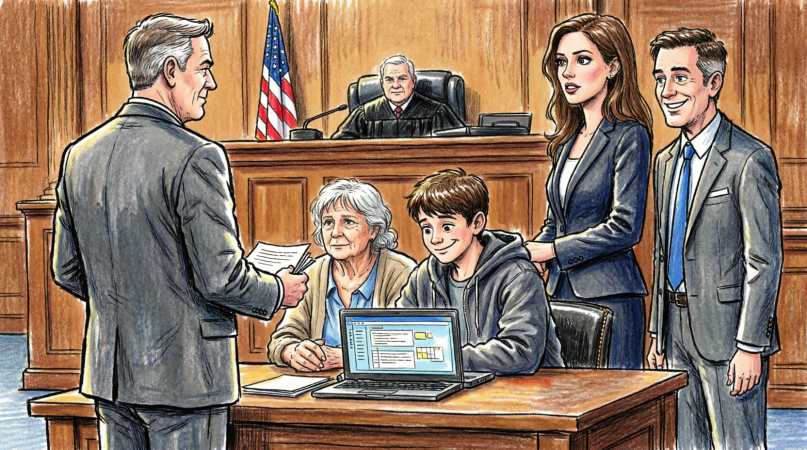
Aarav did not say anything more. He returned to his chair, placed his hands flat on the table, and looked at Priya with that quiet stillness people always mistook for weakness.
Priya adjusted her bangles. “See?” she said to her lawyer. “He doesn’t even understand what is happening. That is why I must step in.”
There it was.
Aarav’s fingers tapped once against the wood.
Mr. Menon looked at him, confused.
Priya continued, encouraged by the silence. “Amma has done what she could, but she is old. Poor. Emotional. This boy needs proper management now. He needs someone practical.”
“Someone practical,” I repeated.
She did not hear the warning in my voice.
Her husband finally spoke. “We’re not here to fight. We’re here to protect the asset.”
The asset.Aarav lifted his head.
“What asset?” he asked softly.
Priya smiled, the way adults smile when they think a child has asked a foolish question. “Your company, beta. Your future.”
“My future,” Aarav said.
“Yes. And because you are still under eighteen, I can legally help you. You may be brilliant with computers, but life is different. Money is different. Businessmen will cheat you. Your grandmother cannot understand these things.”
I wanted to slap the pity from her face.
But Aarav had told me to let her speak.
So I did.
Priya leaned forward. “We can make this easy. You come live with me. We will get you a proper room, proper doctors, proper clothes. I will handle meetings. I will sign papers. I will make decisions.”
“Will Nani come?” Aarav asked.
Priya’s smile tightened. “That may not be best.”
My breath stopped.
Aarav nodded slowly, as if confirming an answer on a test.
“Why?” he asked.
Priya sighed. “Because she has filled your head. She has made you dependent. She is attached to the money now.”
My knees weakened. Eleven years of hunger, fever, sleepless nights, school rejections, therapy bills, and scraped coins from steel boxes—and she called it attachment to money.
Mr. Menon stepped forward. “Ms. Priya, I advise you to choose your words carefully.”
Her lawyer placed a hand on the folder. “My client is speaking as a concerned mother.”
Aarav turned toward him. “Concerned mothers leave?”
The room froze.
Priya’s face flushed. “You don’t understand what happened.”
“I understand dates,” Aarav said. “You left on June 14th. 8:37 p.m. Monsoon rain. Blue suitcase. Auto-rickshaw number MH12 Q 7441. Nani paid the driver because you said you had no change.”
The color drained from Priya’s cheeks.
Aarav continued, his voice flat but clear. “You said, ‘I cannot live my whole life for this.’ Then you did not call for eleven years, three months, and nine days.”
Her lawyer shifted.
Priya recovered quickly. “Children remember things wrongly. He was five.”
“I remember patterns,” Aarav said. “And I remember pain.”
For the first time, my daughter looked afraid of him.
Then Aarav opened his laptop.
The screen glowed against his face. He typed a password. Once. Twice. A folder appeared. He clicked it.
“Mr. Menon,” he said, “please play the file named ‘Mother_Return_01.’”
Priya stood. “What is this?”
Mr. Menon stared at the screen. “Aarav?”
“The door camera,” Aarav said. “I installed it after the investor meetings. Audio too. Legal for home security. Nani knows.”
I had forgotten about the tiny black camera above the calendar of Lord Ganesha.
Aarav clicked play.
Priya’s voice filled the room.
“I came for my son.”
Then the lawyer’s voice.
“Manage his estate, business interests, and financial decisions.”
Then Priya again.
“I am only doing what is best for my son.”
Aarav paused it.
“That is not enough,” he said. “Keep speaking.”
Priya’s lawyer snapped, “Stop this recording immediately.”
Aarav looked at him. “No.”
One small word. But it carried eleven years of silence behind it.
Priya pointed at me. “You taught him this.”
“No,” Aarav said. “You did.”
Her face twisted. “Enough. You are a child. You are autistic. You don’t know how ugly the world is.”
“I know,” Aarav said. “You were my first proof.”
No one moved.
Then Priya made her mistake.
She threw the mask away.
“You think you can insult me?” she shouted. “I gave birth to you. Without me, you are nothing. That old woman kept you alive, fine. But I am your mother. The law will see that. You don’t even know how to speak to investors without shaking. You can’t attend one loud meeting without headphones. You think you can run a company? You need me. And whether you like it or not, I will control every rupee until you are old enough—and after that, we will see.”
Aarav’s eyes did not blink.
“Thank you,” he said.
Priya looked confused.
Aarav turned the laptop toward Mr. Menon. “Second folder.”
Mr. Menon opened it. His eyes widened.
“What is this?” I whispered.
Aarav touched my hand. “The reason I smiled.”
On the screen were scanned papers. Not one or two. Many.
Company incorporation documents.
Intellectual property assignment.
Board resolutions.
Trust deed.
Letters from investors.
Medical capacity evaluation.
A notarized statement.
Mr. Menon read faster and faster, and with every page his face changed from fear to disbelief to something like joy.
“Aarav,” he whispered, “when did you do all this?”
“Three months ago,” Aarav said. “Investor uncle said sudden money brings sudden relatives. I researched. Then I asked him to help me contact proper lawyers. Not to replace you, Menon uncle. For company law.”
Mr. Menon laughed once, breathless. “Replace me? Beta, today I am happy to be replaced.”
Priya’s lawyer snatched one paper, read it, and went still.
“What is it?” Priya demanded.
Aarav answered for him.
“The app is not mine alone. The code belongs to a private company. I own shares, but voting control is held by a protective trust until I turn twenty-one. Nani is trustee. Two independent trustees must approve major decisions. No single guardian can transfer ownership.”
Priya stared at him.
“The money from the investment,” he continued, “is not in my personal account. It is company capital. Founder salary is limited. Education fund is protected. Nani’s medical fund is protected. No parent can touch it.”
Her husband stepped forward. “That cannot be legal.”
The lawyer said nothing.
That silence was answer enough.
Aarav opened one more file.
“This is my statement,” he said. “Recorded before a child welfare counselor. It says I do not want to live with Priya Rao. It says I consider Shanta Rao my primary caregiver. It includes school records, hospital records, therapy bills, neighbor statements, and proof of abandonment.”
Priya’s lips parted. “You planned this?”
Aarav looked at her.
“No. I protected us.”
Us.
Not me.
Us.
I had spent eleven years protecting him from the world. Quietly, secretly, patiently, he had grown strong enough to protect me back.
The next week, we went to court.
I had never been inside a courtroom before. The benches were hard. The fans turned lazily overhead. Priya came in a pale blue saree this time, softer, simpler, as if cotton could make her innocent.
When the judge asked her why she had returned after eleven years, she cried.
Real tears, perhaps.
Or practiced ones.
She said she had been young. Depressed. Afraid. She said poverty had broken her. She said she had thought of Aarav every day.
I looked at my grandson.
He sat beside me with headphones around his neck, not over his ears. His hands were clasped tightly, but he did not hide.
Then Mr. Menon played the recording.
Priya’s own voice filled the courtroom.
“Protect the asset.”
“Control every rupee.”
“You are autistic.”
“You need me.”
No one interrupted.
Even the ceiling fan seemed to slow.
After that, Mr. Menon submitted the documents. The court-appointed counselor submitted her report. Aarav answered the judge’s questions himself.
The judge asked, “Do you understand who Priya Rao is?”
Aarav said, “Yes. Biological mother.”
“Do you wish to live with her?”
“No.”
“Why?”
He took three breaths.
Then he said, “Because she came back for money before she came back for me.”
Priya began sobbing.
Aarav did not look at her.
The judge dismissed her emergency petition. She refused financial guardianship. She ordered that my caregiving role be formally recognized and that any future contact would require Aarav’s consent and counseling approval.
When the gavel fell, I did not understand all the legal words.
I only understood that my grandson was not being taken from me.
Outside the courtroom, Priya waited near the steps.
For the first time, she had no lawyer speaking for her.
“Amma,” she said.
I stopped, though every bone in my body wanted to keep walking.
She looked older in the sunlight. Smaller.
“I made mistakes,” she whispered.
“Yes,” I said.
“I was alone too.”
“So was he.”
Her eyes filled again. “Can I at least talk to him?”
I turned to Aarav.
For many years, I had answered for him because the world would not wait for his words. But that day, I waited.
Aarav looked at Priya.
“No,” he said.
Priya flinched as if slapped.
He added, “Not today. Maybe not ever. That is my decision.”
Then he took my hand and walked down the steps.
That night, Pune smelled of rain and frying onions. Our flat was the same small flat. The wall still had a damp patch near the window. The dining table still had one shaky leg. The blue toy train still sat on the shelf above Aarav’s books.
I made dal.
Aarav chopped coriander too finely, the way he always did.
For a long time, we ate without speaking.
Then he said, “Nani.”
“Haan, beta?”
“Are you sad?”
I placed my spoon down.
I could have lied. Grandmothers are famous for lying with love. We say we are not tired when our knees burn. We say we have eaten when the rice is not enough. We say we are fine when our hearts are breaking quietly.
But Aarav had always deserved the truth.
“Yes,” I said. “A little.”
His shoulders tightened.
“Because of me?”
I reached across the table and touched his wrist, lightly, the way he liked.
“Never because of you. I am sad because my daughter forgot how to be a mother. But I am not sorry. Not for one day with you.”
He stared at the dal.
“I was afraid,” he said.
“In court?”
“No. When she left. I thought maybe I was the problem.”
My throat closed.
I stood, walked around the table, and knelt beside him though my knees protested. I took the blue train from the shelf and placed it in his hands.
“You were five,” I said. “You were a child holding a toy. Adults failed you. That does not make you a problem.”
His fingers wrapped around the train.
“The world is loud,” he whispered.
“Yes,” I said. “But you are not broken.”
His face changed then. Not a smile exactly. Something deeper. Something healing in a place I had not known was still bleeding.
Months passed.
The app grew. Aarav hired people who spoke gently, who sent agendas before meetings, who understood that brilliance did not always arrive wearing a suit and making eye contact. He added a feature for delivery workers who could not read English well. He lowered subscription fees for tiny shops. He made sure the first kirana owner who trusted him never paid a rupee again.
Reporters came. They wanted photographs of the “teen genius.” Aarav hated that phrase.
He told one journalist, “My Nani is the founder of me.”
They printed it as the headline.
I cut it out and hid it inside my prayer book.
On Aarav’s eighteenth birthday, investors sent flowers, shopkeepers sent sweets, and the dabbawalas from Mumbai sent a steel tiffin with his name engraved on it.
Priya sent a message.
Happy birthday, son. I hope one day you understand me.
Aarav read it once.
Then he blocked the number.
Not angrily.
Not dramatically.
Simply.
Like closing a door that had already been empty for years.
That evening, he brought me to the balcony. Down below, scooters honked, children shouted, pressure cookers whistled from neighboring kitchens, and the city roared in all its ordinary cruelty.
Aarav wore his headphones.
I wore my old cotton saree.
He handed me an envelope.
Inside was a deed.
My name.
A small house on the edge of the city, with a garden, wide windows, and a room designed with soft lights and soundproof walls.
“For us,” he said.
I cried then. Loudly. Shamelessly.
He stood beside me, patient as always, holding my elbow so I would not fall.
Eleven years earlier, my daughter had left a child at my door and called him “this.”
Now the world called him founder, genius, millionaire.
But to me, he was still the boy with the blue train, the boy who lined up screws, the boy who heard too much and felt too deeply, the boy who taught me that love does not always speak loudly.
Sometimes love sits beside you at a cracked laptop.
Sometimes love remembers the date you were abandoned and builds a future no one can steal.
Sometimes love whispers, “Let her speak,” because truth does not need shouting.
It only needs time.
And my Aarav, the child they pitied, had turned time itself into justice.
💔 Before You Continue…
Some wounds do not end when the courtroom empties.
Some families do not break in a single day.
And sometimes… the people who disappear from our lives return years later carrying new secrets, new regrets, and new storms behind their eyes.
After thousands of readers asked what happened next to Emiliano, Teresa, and Karla…
Here is the continuation no one expected.
👉 Part 2: Ten Years Later… The Woman Outside Teresa’s Hospital Room
Ten years passed quietly.
Not peacefully.
Just quietly.
Teresa’s hair turned almost completely silver. Her knees worsened during winter. The tiny apartment in Pune was long gone now, replaced by the soft-lit home Emiliano had built for them on the edge of Pennsylvania, where the mornings smelled of rain and pine trees instead of exhaust and fried onions.
The world knew Emiliano Rao as many things now.
Founder.
Visionary.
Tech millionaire.
“The autistic genius who changed accessibility software forever.”
But inside the house, he was still the same boy who hated loud blenders, still separated his rice from his beans, still wore the same gray headphones whenever the world became too sharp around the edges.
And every morning before leaving for work, he still asked Teresa the same question.
“Did you take your medicine, Nani?”
Always Nani.
Never Grandma.
Never Teresa.
Nani.
Like the frightened little boy inside him had never fully disappeared.
Teresa lived for those small moments.
The fame surrounding Emiliano never impressed her much. She did not care about magazine covers or investor dinners or the articles calling him “the future of neurodivergent innovation.”
She only cared that he was eating properly.
Sleeping enough.
Remembering to rest.
Loving gently.
Because underneath the success, Teresa still saw the scars nobody else noticed.
She saw how Emiliano checked every lock in the house three times before bed.
How unexpected visitors made his shoulders stiffen.
How he still froze whenever someone suddenly raised their voice.
Money had changed their lives.
But it had not erased the abandoned child inside him.
One rainy November morning, Teresa collapsed while watering the garden.
Emiliano found her unconscious beside the roses.
For the first time in years, he panicked so badly he could not speak.
At the hospital, nurses rushed around them while fluorescent lights buzzed overhead. Emiliano sat frozen beside Teresa’s bed, fingers pressed hard against his headphones while machines beeped around him like alarms inside his skull.
The doctor finally approached.
“She had a mild stroke,” he said carefully. “She’s stable. But stress and age are catching up.”
Stress.
Emiliano hated that word.
People always used soft words for heavy things.
That night, he refused to leave her room.
He sat in silence beside Teresa while rain tapped softly against the hospital window.
Then around midnight…
Someone knocked gently on the door.
Emiliano looked up.
A woman stood outside holding white flowers.
Older now.
Thinner.
Her expensive beauty faded into something more fragile.
But he recognized her instantly.
Karla.
Teresa’s eyes widened weakly from the bed.
For a moment, nobody moved.
Then Karla stepped inside slowly, almost nervously.
“I heard about the hospital,” she whispered.
Emiliano stared at her without expression.
Ten years.
Ten entire years since the courtroom.
Ten years since she had chosen money over motherhood.
And now here she was again.
Teresa’s voice trembled.
“How did you find us?”
Karla looked down.
“You’re not hard to find anymore.”
That was true.
Emiliano’s company had become global. Interviews. Conferences. Articles. Awards.
The abandoned autistic boy nobody wanted had become famous enough that strangers recognized him in airports.
But Emiliano never answered reporters when they asked about family.
Never.
Karla stepped closer to the bed.
“I just wanted to see you,” she told Teresa quietly.
Teresa said nothing.
The silence hurt more than shouting.
Karla looked toward Emiliano next.
He had not spoken a single word since she entered.
His face remained unreadable.
Cold.
Controlled.
Older.
But his eyes…
Those were still the eyes of the five-year-old boy she left behind.
“I know you hate me,” Karla whispered.
Emiliano finally spoke.
“I don’t hate you.”
For one brief second, hope appeared across her face.
Then he finished quietly:
“I stopped needing you.”
The hope died instantly.
Teresa closed her eyes.
Even after everything, hearing those words still broke something inside her.
Because no matter what Karla had done…
she was still her daughter.
Karla sat slowly in the chair near the window.
“You think I came for money again,” she said softly.
Emiliano did not answer.
Because yes.
That was exactly what he thought.
Karla noticed the silence and gave a weak laugh.
“I deserve that.”
Rain continued falling outside.
Then she said the sentence that changed the entire room.
“I’m dying.”
Teresa’s eyes opened immediately.
Emiliano’s fingers stopped moving.
Karla swallowed hard before continuing.
“Stage four ovarian cancer.”
The room became very still.
No dramatic music.
No screaming.
Just machines beeping softly while rain touched the glass.
Teresa stared at her daughter as if seeing her for the first time in years.
“How long?” she whispered.
“Eight months since diagnosis.”
“Why didn’t you tell us?”
Karla looked at Emiliano.
“Because he deserved peace before guilt.”
Emiliano’s jaw tightened slightly.
Karla continued staring at the floor.
“I tried to contact you many times,” she admitted quietly. “I wrote emails. I deleted them. I drove near the house once and stayed parked outside for an hour.”
Teresa looked confused.
“Why?”
Karla’s voice cracked.
“Because I was ashamed.”
Silence again.
Heavy silence.
The kind families carry for years.
Then Karla reached slowly into her bag and pulled out a small worn envelope.
“I didn’t come for money this time,” she whispered. “I came because there’s something Emiliano deserves to know before I die.”
Emiliano’s eyes narrowed slightly.
Karla placed the envelope carefully on the hospital table.
His name was written across the front in shaky handwriting.
Not Emiliano Rao.
Not Mr. Rao.
Just:
My Son.
And for the first time in over ten years…
Emiliano looked afraid.
👉 Part 3: The Letter Karla Never Meant Him to Read
The envelope sat untouched beside Teresa’s hospital bed for almost twenty minutes.
Nobody moved toward it.
Nobody even breathed loudly.
Rain slid slowly down the hospital windows while machines hummed softly around them, filling the silence none of them knew how to cross.
Emiliano stared at the envelope as though it were dangerous.
Maybe it was.
Some truths destroy people more quietly than lies.
Karla kept her eyes lowered.
“I wrote it three years ago,” she whispered. “I never planned to give it to you.”
Teresa looked between them carefully.
“Then why now?”
Karla smiled weakly.
“Because dying changes what you’re afraid of.”
Emiliano’s fingers tapped once against his knee.
An old habit.
Teresa recognized it immediately.
He was overwhelmed.
Too many emotions at once.
Too much noise inside his mind.
Finally, he spoke.
“What’s inside?”
Karla swallowed.
“The truth.”
Emiliano almost laughed at that.
Not because it was funny.
Because people who say “the truth” are usually the ones who buried it first.
Slowly, carefully, he reached for the envelope.
His hands did not shake outwardly.
But Teresa noticed the tiny stiffness in his fingers.
The same stiffness he had as a child before panic attacks.
He opened the letter.
Inside were several folded pages.
And one photograph.
The second Emiliano saw the photo, his expression changed.
Teresa leaned forward weakly from the hospital bed.
It was a picture of Karla holding him as a baby.
She looked impossibly young.
Tired.
But smiling.
Actually smiling.
Emiliano stared at the image for a long time.
As if his brain could not connect this woman…
with the one who abandoned him.
Karla spoke softly.
“That was before everything got bad.”
Emiliano unfolded the letter.
The room remained silent except for the sound of paper opening.
Then he began to read.
My Son,
If you are reading this, then I was too much of a coward to say these words out loud.
You probably believe I left because you were autistic.
That is partly true.
But not in the way you think.
When you were born, I loved you so much it terrified me.
You were different even as a baby. Sensitive to sounds. Sensitive to touch. You cried for hours if lights were too bright. Doctors told me you were “difficult.” Your father called you “wrong.”
Yes.
Father.
The man you were told died before you were born.
That was the first lie.
Emiliano stopped reading.
Teresa looked up sharply.
“Karla…”
But Karla was already crying quietly.
Emiliano continued reading.
Your father’s name is Daniel Mercer.
He was not poor.
He was not weak.
He came from money and reputation, and when doctors began suggesting developmental evaluations, he became angry.
He said he would not raise a “defective child.”
At first he blamed me.
Then he blamed you.
The shouting became worse after you turned three.
You covered your ears whenever he entered the room.
You hid under tables.
Once, when you spilled juice because your hands were shaking, he grabbed your arm so hard you bruised.
That night I realized something terrible:
I was afraid of him.
But I was even more afraid that one day… you would become afraid of me too.
Teresa covered her mouth.
Emiliano kept reading silently now.
His eyes moved faster across the pages.
The room felt colder with every second.
The night I left you with Nani, I had already packed my bags twice before and failed to go.
I know what I did was unforgivable.
But Daniel had hired lawyers.
He wanted you institutionalized.
He said children like you ruined families.
He promised if I disappeared quietly, he would stop fighting for custody.
I believed him.
I thought leaving you with Nani would save you from him.
But then shame consumed me.
Every year that passed made returning harder.
Every birthday became proof that I had failed you.
And when your app became successful, Daniel returned.
That was why I came back with lawyers.
Not because I wanted money.
Because he wanted access to you.
And I was terrified he would find a way.
Emiliano stopped breathing for a second.
Teresa stared at Karla in horror.
“You never told me this.”
Karla shook violently.
“Because you would’ve made me go to police. And I was scared.”
“Scared?” Teresa whispered angrily. “Your son thought you abandoned him because he was broken!”
Karla burst into tears.
“I KNOW!”
A nurse glanced through the hallway window at the noise before continuing past.
Inside the room, eleven years of buried pain cracked open all at once.
Emiliano looked back down at the letter.
I know I don’t deserve forgiveness.
Maybe I deserve your hatred.
But there is one more thing you must know.
Your father is dying too.
And now that your company is worth billions…
he wants to meet you.
Not as a son.
As leverage.
Please be careful.
There are things powerful men protect with money.
And there are things they destroy to keep buried.
I failed you once already.
I could not die before warning you.
I am sorry.
For all of it.
— Mom
Mom.
Not Karla.
Not Mother.
Mom.
Emiliano lowered the pages slowly.
No one spoke.
Teresa’s entire body felt numb.
For years, she had hated her daughter for selfishness.
But now…
she saw fear too.
Cowardice.
Weakness.
Failure.
But fear.
Karla wiped her face shakily.
“He found me again after your company exploded online,” she whispered. “At first he wanted information. Then meetings. Then control.”
Emiliano’s voice was dangerously calm.
“And you believed coming back with lawyers was the best solution?”
Karla looked ashamed.
“I thought if I gained legal access first, I could protect you before he moved.”
“You should’ve told the truth.”
“I know.”
“You should’ve protected me eleven years ago.”
Karla broke completely then.
“I KNOW!”
Her sob echoed through the hospital room so painfully that even Teresa flinched.
But Emiliano did not.
He just sat there quietly, holding the letter in both hands.
Like a child holding evidence from another lifetime.
Then finally…
he asked the question neither woman expected.
“What does he want from me now?”
Karla looked terrified.
Not guilty.
Terrified.
And that scared Teresa more than anything.
Karla whispered:
“Your father’s company is collapsing.”
She looked directly at Emiliano.
“And he believes your technology can save it.”
👉 Part 4: The Father Who Wanted a Genius, But Never Wanted a Son
The hospital room fell silent again.
Only the rain remained.
Soft against the windows.
Steady.
Merciless.
Emiliano stared at Karla as though trying to solve an equation that refused to make sense.
For eleven years, he believed one thing:
She left because I was too difficult to love.
Now the story had changed.
Not completely.
She still left.
She still failed him.
But suddenly there was another shadow standing behind her mistakes.
A man neither Teresa nor Emiliano had ever truly known.
Daniel Mercer.
His father.
The name itself sounded expensive.
Cold.
Sharp around the edges.
Teresa’s voice trembled with anger.
“So all these years… he knew where Emiliano was?”
Karla nodded slowly.
“I hid as much as I could. But after the app exploded online, there was no hiding anymore.”
“Why didn’t he come earlier?”
Karla laughed bitterly through tears.
“Because before the money, he called Emiliano an embarrassment.”
Those words hung in the room like poison.
Emiliano looked down at the letter again.
Embarrassment.
Broken.
Defective.
Words followed him his whole life.
Schoolchildren used them.
Teachers whispered them.
Neighbors repeated them.
But hearing they came from his own father…
felt different.
Not louder.
Just deeper.
Teresa reached for his wrist carefully.
He allowed it.
A small thing.
But important.
Because when overwhelmed, Emiliano hated unexpected touch.
Karla noticed too.
Even now, Teresa still knew him better.
That realization visibly hurt her.
“I shouldn’t have hidden the truth,” Karla whispered. “But Daniel scares people. He always has.”
Teresa’s eyes hardened.
“He doesn’t scare me.”
Karla looked up sadly.
“That’s because you never needed his approval.”
The room went quiet again.
Then—
A vibration.
Emiliano’s phone.
He glanced at the screen.
Unknown Number.
He ignored it.
A second later, another message arrived.
Then another.
Then another.
His jaw tightened slightly.
Teresa noticed immediately.
“Beta?”
Slowly, Emiliano turned the screen toward them.
A single text message filled the display:
We should finally meet, son.
Below it:
I think we can help each other.
And then:
You got your intelligence from me.
Karla went pale.
“No…”
Another message appeared.
Your mother was always emotional. But you and I are alike.
Then another:
I’m downstairs.
Teresa’s blood turned cold.
“What?”
Karla stood so fast the chair nearly fell backward.
“He followed me.”
Before anyone could react, the hospital room door opened.
And for the first time in his life…
Emiliano saw his father.
Daniel Mercer looked nothing like the monster from childhood memories.
That almost made him worse.
He looked polished.
Controlled.
Silver-haired.
Expensive watch.
Perfect posture.
The kind of man people trusted instantly in business meetings.
The kind of man who ruined lives politely.
He entered calmly as if he belonged there.
His eyes moved first to Karla.
Disappointment.
Then Teresa.
Dismissal.
And finally…
Emiliano.
Something changed in his expression then.
Not love.
Not regret.
Recognition.
Like an investor discovering hidden gold.
“There he is,” Daniel said softly.
Teresa immediately stood.
“You need to leave.”
But Daniel ignored her completely.
His eyes never left Emiliano.
For several long seconds, father and son simply stared at each other.
The resemblance was undeniable now.
Same focused eyes.
Same controlled stillness.
Same habit of studying a room before speaking.
Karla noticed it too and looked suddenly sick.
Daniel smiled slightly.
“You look exactly how I imagined.”
Emiliano answered quietly:
“No you didn’t.”
The smile weakened.
Daniel stepped closer.
“I know you have reasons to hate me.”
“I don’t hate you either.”
Daniel seemed relieved.
Then Emiliano added:
“I don’t know you enough for that.”
Teresa almost gasped.
Karla closed her eyes.
Even Daniel himself looked caught off guard.
Not because the words were cruel.
Because they were true.
The man recovered quickly.
“I deserve that,” he admitted smoothly. “But perhaps we should speak privately.”
“No,” Teresa snapped immediately.
Daniel finally looked at her directly.
“You must be Teresa.”
“Nani,” Emiliano corrected instantly.
Daniel’s eyes flicked back toward him.
Interesting.
That look bothered Teresa deeply.
It was the same look businessmen gave rare objects.
Daniel folded his hands calmly.
“I came because there are things your mother clearly explained poorly.”
Karla’s face twisted.
“You don’t get to do this.”
Daniel ignored her too.
“I know what people told you about me,” he continued. “But successful men are often misunderstood.”
Emiliano finally spoke again.
“You called me defective.”
Daniel paused only briefly.
“You were struggling.”
“You wanted me institutionalized.”
“You needed specialized care.”
“You hit me.”
Silence.
Real silence.
The kind even manipulative people cannot immediately control.
Daniel’s expression tightened slightly for the first time.
“You remember more than I expected.”
“I remember everything.”
That answer landed harder than shouting ever could.
Daniel slowly changed tactics.
Teresa could literally SEE it happen.
His voice softened.
“You built something remarkable, Emiliano. I’m proud of you.”
Proud.
Such a small word.
Yet Teresa saw Emiliano physically stiffen hearing it.
Because children abandoned by parents remain hungry for approval far longer than they admit.
Even intelligent children.
Even grown men.
Daniel noticed the reaction too.
And smiled faintly.
Predator.
Teresa saw it instantly.
“So,” Daniel continued gently, “perhaps we can move beyond old emotions and discuss the future.”
“There is no future with you,” Karla whispered.
Daniel finally turned toward her fully.
Coldness replaced charm immediately.
“You failed at managing him. I won’t.”
Managing him.
Not loving him.
Managing him.
Emiliano noticed too.
His fingers began tapping against his leg again.
Fast now.
Too fast.
Teresa recognized the signs immediately.
Sensory overload.
Emotional overload.
Dangerous overload.
The fluorescent lights.
Hospital sounds.
The tension.
Too much at once.
Then Daniel made the worst mistake possible.
He stepped forward suddenly and placed a hand on Emiliano’s shoulder.
Everything happened instantly.
Emiliano jerked violently away like he’d been burned.
The chair crashed backward.
Machines beeped loudly.
His headphones hit the floor.
Daniel froze.
Teresa moved immediately.
“Nobody TOUCHES him without warning!”
Nurses rushed toward the doorway as Emiliano stumbled backward breathing unevenly, both hands over his ears now.
The hospital sounds had become unbearable.
The lights.
The shouting.
The beeping.
Too much.
Way too much.
Daniel looked stunned.
Not guilty.
Stunned.
As if he genuinely could not understand why his own son reacted that way.
And in that moment…
Teresa realized something horrifying.
Daniel Mercer never truly saw Emiliano as human.
Not when he was a child.
Not now.
Only as:
a problem
a diagnosis
a business asset
a brilliant machine
Never a son.
Emiliano crouched beside the wall, shaking slightly while trying to regulate his breathing.
Teresa knelt beside him instantly.
Soft voice.
Gentle.
Predictable.
Safe.
“Nani’s here,” she whispered. “Slow breaths, beta. Slow breaths.”
Meanwhile Daniel stood motionless near the hospital bed.
Watching.
Studying.
Calculating.
And then he quietly said something that made Karla’s face drain completely white.
“You never told him about the trust.”
👉 Part 5: The Trust Fund No One Was Supposed to Find
The room went completely still.
Even Emiliano stopped breathing for a second.
Teresa looked up slowly from beside him.
“The what?”
Karla’s face had turned ghost-white.
“Daniel—don’t.”
But Daniel was already watching Emiliano carefully again.
Always watching him.
Like every emotion was data.
Every reaction a calculation.
“The trust,” Daniel repeated calmly. “The one created before he was born.”
Teresa rose slowly to her feet.
“What are you talking about?”
Karla stepped forward desperately.
“It doesn’t matter anymore.”
“It matters to him,” Daniel replied coldly.
Emiliano was still crouched near the wall, one hand pressed hard against his headphones now while trying to steady himself. But despite the overload flooding his senses…
he was listening to every word.
Always listening.
Daniel adjusted his cufflinks before continuing.
“My father was worth nearly four hundred million dollars when he died.”
Teresa blinked.
Four hundred million.
The number sounded unreal inside a hospital room that smelled like disinfectant and rain.
Daniel continued.
“The Mercer family created a private inheritance structure decades ago. Old money. Old rules.”
Karla whispered angrily:
“Stop.”
But Daniel ignored her again.
“There was one condition attached to my branch of the inheritance.”
His eyes settled directly onto Emiliano.
“A legitimate male heir.”
The room felt colder.
Teresa suddenly understood why Karla looked terrified.
Not money.
Power.
Generational power.
Daniel spoke almost casually now.
“When doctors began discussing developmental concerns, family advisors became nervous.”
“Developmental concerns,” Emiliano repeated quietly.
Daniel nodded once.
“The Mercer board feared instability.”
“You mean autism.”
Daniel did not answer immediately.
That silence answered enough.
Karla suddenly exploded.
“They called him defective!”
The word shattered across the room like broken glass.
A nurse glanced nervously through the door again.
Daniel’s expression hardened.
“They were protecting the company.”
“He was THREE YEARS OLD!”
“They believed long-term leadership capacity mattered.”
Karla laughed bitterly through tears.
“You let billionaires evaluate your son like livestock.”
Daniel’s voice became dangerously cold.
“You knew the consequences.”
“And you chose money over him!”
“No,” Daniel snapped for the first time. “I chose survival.”
Silence again.
Heavy.
Ugly.
Emiliano slowly stood now, though his breathing still looked uneven.
Teresa reached toward him instinctively, but he gave the smallest shake of his head.
Not yet.
He needed space.
Needed control.
Daniel noticed everything carefully.
Always calculating.
“The trust was frozen after your diagnosis,” Daniel explained to Emiliano. “My father considered redirecting control to my cousins instead.”
“And that mattered more than your son?”
Daniel’s jaw tightened slightly.
“You don’t understand how families like ours work.”
“No,” Emiliano said quietly. “You don’t understand how families work.”
That line hit harder than shouting.
Even Teresa felt it.
For the first time since entering the room, Daniel looked slightly off balance.
Just slightly.
But enough.
Karla wiped tears from her face angrily.
“He wanted me to place you in a residential institution.”
Teresa froze.
“What?”
Daniel exhaled sharply.
“It was a medical recommendation at the time.”
“No,” Karla spat. “It was a reputation recommendation.”
Emiliano stood perfectly still now.
Too still.
Teresa recognized that stillness.
Dangerous stillness.
The kind he had before emotional collapse.
Or emotional shutdown.
Daniel continued speaking anyway.
“If you had entered specialized care, the board would have released the trust.”
“So I was worth more hidden away,” Emiliano said softly.
“No,” Daniel corrected immediately. “Protected.”
“From what?”
Daniel hesitated.
And that hesitation told everyone the truth.
Not protected from the world.
Protected from embarrassment.
Protected from scandal.
Protected from shareholders.
Emiliano looked down briefly.
Then he asked:
“How much?”
Karla whispered:
“Emiliano…”
But he repeated calmly:
“How much money?”
Daniel answered directly.
“With current growth and investments… approximately two hundred and thirty million dollars.”
Even Teresa nearly lost balance hearing the number.
Two hundred and thirty million.
And suddenly everything made horrible sense.
The lawyers.
The manipulation.
The pressure.
The fear.
Not because Emiliano became valuable later.
Because powerful people believed he had value before he could even speak.
Just not as a child.
As an heir.
As leverage.
As ownership.
Emiliano stood silent for several long seconds.
Rain continued outside.
Machines beeped softly.
And Teresa watched her grandson process the realization that before he was ever loved…
he had already been financially evaluated.
Finally, Emiliano looked at Daniel again.
“One question.”
Daniel straightened slightly.
“When I was little…”
Emiliano’s voice remained calm.
“…if I had not been autistic…”
For the first time, real emotion flickered across Daniel’s face.
Tiny.
But visible.
And somehow that made Teresa hate him even more.
Because it meant he HAD understood.
At least a little.
Emiliano finished the question quietly:
“Would you have stayed?”
The room held its breath.
Karla looked away immediately.
Because she already knew the answer.
Daniel opened his mouth once.
Closed it.
Then finally said:
“Yes.”
That single word destroyed something invisible inside the room.
Not loudly.
Not dramatically.
Quietly.
Like paper tearing.
Teresa physically felt Emiliano go still beside her.
Not angry.
Not crying.
Worse.
Accepting.
As if the final missing piece of his childhood had finally clicked into place.
Daniel stepped forward carefully.
“You need to understand something, son—”
“Don’t call me that.”
Daniel stopped.
Emiliano’s eyes finally lifted fully toward him again.
Cold now.
Not emotional.
Clear.
“You loved the version of me that never existed.”
Daniel’s face tightened.
“You’re emotional right now.”
“No,” Emiliano replied softly.
“For the first time in my life…”
He looked directly into his father’s eyes.
“…I think I finally understand you perfectly.”
And for the very first time since entering the hospital…
Daniel Mercer looked afraid………………
The Secret Emiliano Found Inside the Mercer Files
Daniel Mercer had spent his entire life controlling rooms.
Boardrooms.
Courtrooms.
Private clubs filled with rich men pretending morality could be purchased alongside whiskey and silence.
But standing inside that hospital room…
for the first time in years…
he was losing control.
Teresa saw it clearly.
The tiny tension in his jaw.
|The stiffness in his posture.
The careful businessman mask beginning to crack.
Because Emiliano was not reacting the way Daniel expected.
No screaming.
No tears.
No emotional explosion.
Just stillness.
Quiet, terrifying stillness.
The same stillness Emiliano had before solving impossible problems.
Daniel attempted one final calm smile.
“You’re overwhelmed right now.”
“No,” Emiliano said softly.
“I’m organizing.”
That answer unsettled everyone.
Especially Karla.
Because she knew that tone.
When Emiliano spoke like that, it meant his mind was already ten steps ahead of everyone else in the room.
Daniel stepped closer carefully.
“You’re seeing this emotionally instead of strategically.”
Teresa nearly laughed in disbelief.
Strategically?
This man spoke about childhood trauma like corporate restructuring.
But Emiliano only tilted his head slightly.
“Strategically?”
Daniel nodded quickly, sensing opportunity.
“Yes. Whatever happened in the past, we can still build something useful now.”
Useful.
Again.
Not family.
Not healing.
Useful.
“You built extraordinary technology,” Daniel continued smoothly. “And Mercer Biotech desperately needs innovation leadership after recent losses.”
Karla looked sick hearing it.
“He’s doing it again…”
Daniel ignored her completely.
“There are major investors involved, Emiliano. Global expansion opportunities. Medical integration. Government partnerships. Together we could build something historic.”
Emiliano stared at him silently.
Then asked:
“What exactly does your company do?”
Daniel relaxed slightly.
Finally.
Business territory.
Safe territory.
“We specialize in neurological and behavioral technologies.”
Teresa suddenly disliked the sound of that immediately.
Daniel continued confidently.
“Predictive behavioral systems. Cognitive analysis. Neural adaptation software.”
Emiliano’s expression did not change.
But Teresa noticed something else.
His fingers stopped tapping.
Completely.
That was never random.
It meant intense focus.
Dangerous focus.
Daniel continued speaking proudly now.
“We’re currently developing advanced AI systems for early behavioral detection in children.”
Karla whispered:
“Oh God…”
Daniel frowned slightly at her reaction.
But Emiliano noticed instantly.
“Detection of what?”
Daniel answered carefully.
“Developmental irregularities.”
The room went silent.
And suddenly…
everything connected.
The trust.
The shame.
The obsession with autism.
The fear.
The control.
Emiliano’s voice became very quiet.
“You built a company around identifying children like me.”
Daniel immediately adjusted his tone.
“That’s an unfair simplification.”
“No,” Emiliano said calmly.
It’s precise.”
Daniel sighed.
|“The world runs on data, Emiliano. Early diagnosis changes lives.”
“But your family wanted me hidden.”
Daniel hesitated again.
Too long.
And that hesitation was enough.
Karla covered her face weakly.
“You promised me they stopped the program…”
Daniel’s eyes snapped toward her instantly.
“Not here.”
Teresa’s stomach dropped.
Program?
What program?
Emiliano noticed too.
“What program?”
Nobody answered.
That was mistake number one.
Because silence was gasoline to Emiliano’s mind.
He stepped toward the hospital bedside table slowly and picked up his laptop.
Daniel’s expression changed immediately.
“What are you doing?”
Emiliano ignored him.
Laptop open.
Hands steady now.
Focused.
Cold.
The entire room seemed to disappear around him.
Karla whispered desperately:
“Emiliano… maybe not now.”
Too late.
His fingers moved rapidly across the keyboard.
Daniel took one step forward.
“Stop.”
Emiliano finally looked up.
And Teresa felt chills immediately.
Because his face no longer looked hurt.
It looked analytical.
Like a man dissecting something dead.
“You said your company handles behavioral predictive systems.”
Daniel stayed silent.
“You also said investors feared autism could affect leadership stability.”
Still silence.
“And your company currently develops child behavioral identification technology.”
Daniel’s jaw tightened.
“Those are separate matters.”
“No,” Emiliano replied softly.
“They’re probably the same project.”
Karla burst into tears.
Daniel snapped:
“Enough.”
But Emiliano was already gone mentally.
Deep inside the pattern.
Connecting pieces.
Finding structure.
Finding truth.
Then—
His screen froze briefly.
A loading window appeared.
And suddenly Emiliano stopped moving entirely.
Teresa’s heart dropped.
“What is it?”
Emiliano stared at the screen without blinking.
Then quietly asked:
“Why does Mercer Biotech still have my childhood medical files?”
Nobody answered.
Teresa turned toward Daniel in horror.
“What?”
Daniel’s calm mask finally cracked.
Only slightly.
But enough.
Emiliano rotated the laptop slowly toward them.
On screen was a secured corporate database.
MERCER NEURODEVELOPMENT INITIATIVE
Below it:
SUBJECT FILES
And underneath…
one file highlighted in blue.
SUBJECT E-17
STATUS: HIGH FUNCTIONAL ADAPTIVE CASE
Teresa felt physically sick.
Karla whispered:
“No…”
Daniel stepped forward immediately.
“You accessed private company systems illegally.”
But Emiliano’s voice cut through the room quietly:
“You kept records on me.”
“No.”
“You categorized me as a subject.”
“It was research.”
“You monitored me after abandonment.”
Daniel’s silence confirmed everything.
Teresa looked like she might faint.
“What kind of people ARE you?”
Daniel finally lost patience completely.
“You have absolutely no understanding of how the real world functions!”
His voice echoed sharply across the hospital room.
Machines beeped louder.
Nurses turned again.
But Emiliano never flinched this time.
Not once.
Because suddenly…
the fear was changing into something else.
Understanding.
Cold understanding.
He opened the file slowly.
Page after page appeared.
Behavioral observations.
Sensory evaluations.
Cognitive predictions.
Risk assessments.
Projected executive adaptability.
Even comments from board members.
One line froze everyone in the room:
“Subject demonstrates exceptional pattern recognition despite neurodevelopmental instability. Potential strategic value remains unusually high.”
Strategic value.
Not child.
Not boy.
Not son.
Value.
Teresa began crying silently.
Karla looked completely destroyed now.
But Emiliano…
Emiliano just kept reading.
Then finally he reached the last page.
And everything changed.
Because at the bottom of the file was a signature.
Not Daniel’s.
Someone else.
A name Emiliano recognized instantly.
One of the biggest investors in his own company.
The same man who helped him build his app years ago.
The same man he trusted like family.
Emiliano stared at the signature for several long seconds.
Then whispered:
“…No.”
👉 Part 7: The Man Emiliano Trusted Most
The hospital room disappeared around him.
Not physically.
But mentally.
The voices.
The machines.
The rain.
All of it faded behind one single name glowing at the bottom of the screen.
Elias Vaughn.
Emiliano’s chest tightened instantly.
No.
Impossible.
Elias was the first investor who believed in him.
The man who told reporters:
“Emiliano isn’t disabled. He’s operating on a different frequency than the rest of us.”
The man who sat through meetings in silence whenever Emiliano became overstimulated.
The man who redesigned conference rooms with softer lights because “genius shouldn’t require suffering.”
The man Emiliano trusted.
And now his signature sat beneath childhood files labeling him:
SUBJECT E-17.
Teresa saw the color drain from Emiliano’s face immediately.
“Beta?”
He didn’t answer.
Didn’t blink.
Didn’t move.
Daniel noticed too.
And for the first time since entering the room…
Daniel looked uncomfortable.
Not manipulative.
Not arrogant.
Uncomfortable.
Karla stepped toward the laptop slowly.
Then covered her mouth in horror.
“Oh my God…”
Emiliano’s voice came out barely above a whisper.
“How long?”
Nobody answered.
He looked directly at Daniel now.
“How long did Elias Vaughn know about me?”
Daniel exhaled slowly.
“Longer than you think.”
The words landed like a knife.
Teresa’s knees weakened.
No.
Not Elias too.
For years, Emiliano had defended that man to everyone.
Even when reporters accused investors of exploiting autistic founders for “inspirational branding.”
Emiliano always said:
“Elias treats me like a person.”
Now even that memory felt contaminated.
Daniel folded his arms carefully.
“You’re misunderstanding the relationship.”
“No,” Emiliano whispered.
“I think I’m finally understanding all of them.”
Karla shook violently.
“Elias promised the research division was dead…”
Daniel’s expression hardened.
“The original program ended.”
“Then why are the files still active?”
No answer.
Again.
Always silence when truth became dangerous.
Emiliano scrolled further through the database.
Internal communications appeared.
Board discussions.
Psychological projections.
Investment risk analyses.
Then one email stopped him cold.
FROM: Elias Vaughn
TO: Mercer Executive Board
“The child’s adaptive intelligence is extraordinary. If properly guided, Subject E-17 may eventually surpass original behavioral projections.”
Subject E-17.
Not Emiliano.
Not child.
Subject.
Teresa physically grabbed the edge of the hospital bed to steady herself.
“This man ate dinner in our house…”
Karla whispered:
“They were studying him.”
Daniel immediately corrected:
“Observing. Not studying.”
Emiliano finally looked up sharply.
“What’s the difference?”
Daniel opened his mouth—
—but Emiliano interrupted for the first time in his life.
“You tracked my sensory behavior.”
Click.
“You monitored developmental milestones.”
Click.
“You predicted cognitive outcomes.”
Click.
“You estimated my future market value.”
Each sentence landed harder.
Colder.
Sharper.
“And then one of your investors conveniently appeared in my life when I became useful.”
Silence.
That silence was confession.
Teresa suddenly remembered something.
Years ago.
After Emiliano’s app first went viral.
Elias Vaughn had appeared unusually fast.
Too fast.
Offering mentorship.
Protection.
Connections.
Resources.
At the time, it felt like kindness.
Now…
it felt orchestrated.
“Oh God…” Teresa whispered.
Emiliano’s hands finally started shaking.
Not from overload.
From betrayal.
Far worse.
Because sensory pain fades.
But betrayal rewrites memory itself.
Every safe moment suddenly becomes suspicious.
Every act of kindness becomes evidence.
Karla reached toward him carefully.
“Emiliano…”
He stepped back immediately.
Not from fear.
From thinking.
Fast thinking.
Dangerous thinking.
His breathing became shallow.
Teresa recognized the signs instantly.
His brain was moving too fast now.
Connecting years of data.
Patterns.
Coincidences.
People.
Then suddenly—
Emiliano froze.
Completely.
His eyes locked onto another file buried deeper inside the database.
A scheduled meeting document.
Dated eleven years ago.
Three days before Karla abandoned him.
ATTENDEES:
Daniel Mercer
Elias Vaughn
Mercer Board Representatives
SUBJECT:
“Long-Term Risk Management Strategy for E-17”
Teresa felt sick.
Karla whispered:
“No… no no no…”
Emiliano opened the attached transcript.
And quietly began reading aloud.
“Public exposure risk remains manageable if maternal separation proceeds naturally.”
Teresa’s blood turned cold.
Emiliano continued reading.
“Emotional instability in the mother may accelerate voluntary withdrawal.”
Karla collapsed into the chair behind her.
“No…”
Daniel stepped forward immediately.
“That document doesn’t mean what you think.”
But Emiliano kept reading.
“Board consensus suggests grandmother placement offers lowest legal visibility and minimal reputational damage.”
The room exploded.
“You MONSTER!” Teresa screamed.
Even nurses rushed toward the doorway now.
Karla burst into uncontrollable sobbing.
“You told me leaving was MY choice!”
Daniel’s composure finally shattered.
“It WAS!”
But nobody believed him anymore.
Because the document remained glowing on screen like poison.
Long-term risk management.
Minimal reputational damage.
Grandmother placement.
Like Emiliano wasn’t a child.
Just a corporate problem needing relocation.
Emiliano looked physically ill now.
Not emotional.
Destroyed.
Because suddenly…
his entire childhood looked engineered.
The abandonment.
The investor.
The timing.
The silence.
The “help.”
All connected.
Daniel moved toward him desperately now.
“You need to calm down and think rationally.”
That sentence almost made Teresa laugh from horror.
Rationally?
This man helped reduce a child’s life into strategy documents.
But Emiliano only stared at him with hollow eyes.
Then quietly asked:
“Did anyone ever actually love me…”
His voice cracked for the first time.
“…without wanting something from me?”
Silence.
Heavy silence.
And that silence broke Teresa’s heart more than anything else.
Because no child—
not even a grown man—
should ever have to ask that question.
Teresa moved toward him immediately.
But before she could speak—
another voice came from the hospital doorway.
Calm.
Familiar.
Devastating.
“I did.”
Everyone turned instantly.
And standing there…
still wearing his rain-soaked coat…
was Elias Vaughn himself.
👉 Part 8: Elias Vaughn’s Truth
For a moment, nobody moved.
Rainwater dripped slowly from Elias Vaughn’s coat onto the hospital floor.
The hallway lights behind him flickered softly, casting shadows across his face.
And Emiliano…
looked at him like a stranger.
Not mentor.
Not investor.
Not family.
Stranger.
Elias noticed immediately.
That hurt him more than anything else in the room.
Slowly, carefully, he stepped inside.
“You shouldn’t have come,” Daniel said coldly.
Elias ignored him completely.
His eyes remained fixed on Emiliano.
“I was trying to reach you.”
Emiliano’s voice sounded empty now.
“You monitored me before we met.”
Not accusation.
Not anger.
Just exhaustion.
Elias closed his eyes briefly.
“Yes.”
Teresa felt sick hearing the confirmation aloud.
Karla began crying harder.
But Elias continued anyway.
“Not the way you think.”
Daniel laughed sharply.
“Oh, don’t start pretending morality now.”
Elias finally looked at him.
And the hatred between the two men instantly became obvious.
Not business rivalry.
Personal hatred.
Old hatred.
The kind built over years.
Elias stepped further into the room.
“You want the truth?” he asked quietly.
Then he looked directly at Emiliano.
“Your father’s family built a private behavioral research initiative twenty years ago.”
Teresa whispered:
“Research on children…”
Elias nodded once.
“At first it was marketed as early developmental intervention. Wealthy families paid enormous money for predictive cognitive analysis.”
Daniel snapped immediately:
“It saved lives.”
“No,” Elias fired back. “It classified lives.”
Silence.
Heavy silence.
Elias turned back toward Emiliano.
“The Mercer board became obsessed with identifying children who could become exceptional.”
“Exceptional,” Emiliano repeated quietly.
“Pattern recognition. Mathematical projection. adaptive cognition. Emotional compartmentalization. Neurodivergent children often scored unusually high in predictive modeling.”
Teresa could barely breathe.
They weren’t studying disabilities.
They were studying potential.
Like investors gambling on human minds.
Elias continued:
“When your evaluations came back, the board panicked.”
“Because I was autistic.”
“Yes.”
Daniel interrupted immediately:
“Because unpredictability creates liability.”
Elias looked disgusted.
“You hear that?” he said to Emiliano softly. “Even now he speaks about people like spreadsheets.”
Daniel’s jaw tightened.
“Don’t act innocent. You took their money too.”
“Yes,” Elias admitted immediately.
That honesty stunned everyone.
Even Daniel paused.
Elias removed his glasses slowly.
“For years, I told myself I was helping reform the system from inside.”
Karla laughed bitterly through tears.
“That’s what all rich men say before ruining people.”
Elias accepted the insult without defense.
“Maybe.”
Then he looked directly at Emiliano again.
“But the first time I saw your file… everything changed.”
Emiliano’s expression remained unreadable.
Elias continued carefully.
“Most children in the program were reduced to numbers. Predictions. Percentages.”
He swallowed hard.
“But your file was different.”
Teresa’s heart pounded.
Different how?
Elias answered quietly:
“You were five years old… and despite severe sensory distress, emotional abandonment indicators, and social isolation…”
His voice weakened slightly.
“…your psychological profile still showed unusually high empathy.”
The room fell silent.
Even Daniel looked away slightly.
Elias continued.
“The board saw strategic value.”
His eyes locked onto Emiliano.
“I saw a child trying to survive.”
For several seconds, nobody spoke.
Then Emiliano quietly asked:
“So you followed me?”
“Yes.”
“You tracked me?”
“Yes.”
“You invested in me because of those files?”
Elias hesitated.
That hesitation hurt more than lies.
Finally—
“Yes.”
Teresa closed her eyes painfully.
There it was.
Even this relationship began with observation.
With strategy.
With data.
Emiliano looked completely hollow now.
Elias stepped forward carefully.
“But that’s not why I stayed.”
Daniel scoffed immediately.
“Oh please.”
Elias ignored him.
“You know what I remember most from the first day we met?”
Emiliano stayed silent.
“You refused to pitch your app until the receptionist with anxiety was allowed to leave the crowded room first.”
The memory hit instantly.
Teresa remembered that day too.
The investors had been impatient.
Annoyed.
But Emiliano noticed the receptionist shaking near the wall and quietly refused to continue until she felt safe.
Elias smiled sadly.
“You were sixteen years old… and still more human than every executive in that building.”
Something flickered across Emiliano’s face then.
Pain.
Confusion.
Grief.
Because the worst betrayals are never simple.
Simple villains are easy to hate.
But kindness mixed with manipulation?
That destroys certainty itself.
Daniel folded his arms coldly.
“You’re romanticizing exploitation.”
“No,” Elias said sharply. “I’m admitting guilt.”
That shut the room silent.
Elias looked back toward Emiliano.
“I should have told you the truth years ago.”
“Yes,” Emiliano whispered.
“I was afraid.”
“Of what?”
Elias answered honestly.
“That you would look at me exactly the way you’re looking at me now.”
The room hurt with silence.
Then Emiliano quietly asked the question haunting him since Elias entered:
“When you looked at me…”
His voice cracked slightly again.
“…did you see a person first?”
Elias answered instantly.
“Yes.”
No hesitation.
No calculation.
Just yes.
But Emiliano’s eyes filled anyway.
Because damaged children do not know how to trust “yes” anymore.
Daniel suddenly checked his phone.
And for the first time that night…
his face changed completely.
Real fear.
Not anger.
Fear.
Elias noticed immediately.
“What happened?”
Daniel looked up slowly.
Then toward Emiliano.
“There’s been a breach.”
Elias frowned.
“What kind of breach?”
Daniel’s voice lowered.
“The Mercer files leaked.”
Everyone froze.
Teresa’s heart stopped.
Leaked?
Daniel continued:
“The database is spreading online right now.”
Karla whispered:
“Oh my God…”
Then Daniel looked directly at Emiliano.
And said the one sentence nobody expected:
“Someone inside your company released them.”
👉 Part 9: The Enemy Inside Emiliano’s Company
The hospital room erupted into confusion.
“What do you mean leaked?” Teresa asked immediately.
Daniel was already typing furiously into his phone now, his calm businessman mask finally cracking completely.
“Internal archives are appearing on multiple encrypted forums,” he said sharply. “Board documents. Subject files. Investor communications.”
Karla looked horrified.
“That could destroy hundreds of families…”
“No,” Elias corrected coldly.
“It could expose them.”
Daniel ignored him.
“This isn’t activism. It’s corporate sabotage.”
But Emiliano wasn’t listening anymore.
Because only one sentence mattered.
Someone inside your company released them.
His company.
Not Mercer Biotech.
His.
A strange feeling spread through his chest then.
Not panic.
Not fear.
Pattern recognition.
Fast.
Cold.
Precise.
Because suddenly…
certain things from the past few months no longer looked random.
Late-night security warnings.
Unusual access requests.
Board members acting nervous.
One employee resigning without explanation.
Elias noticed the shift in Emiliano’s face immediately.
“You’re thinking of someone.”
Emiliano stayed silent for several seconds.
Then quietly asked:
“When did the leak begin?”
Daniel checked his screen again.
“Approximately forty-three minutes ago.”
Forty-three minutes.
Emiliano’s eyes narrowed slightly.
That was almost exactly when Daniel entered the hospital room.
Too perfect.
Too synchronized.
Not coincidence.
Teresa recognized that look instantly.
The look he got before solving things nobody else understood.
The world always mistook his silence for emptiness.
But silence was where Emiliano became dangerous.
“Beta?” Teresa whispered carefully.
He finally looked up.
“Someone knew he would come tonight.”
Daniel frowned.
“What?”
“The leak timing.”
Elias understood instantly.
“You think this was coordinated.”
“Yes.”
Karla shook her head weakly.
“No… no, nobody knew I came here.”
Emiliano looked toward her calmly.
“You told someone.”
She froze.
Daniel immediately stepped forward.
“Who?”
“I don’t know!” Karla cried. “I only told—”
She stopped.
Too late.
Elias’ expression darkened immediately.
“You told who?”
Karla looked terrified now.
“I… I called Maya.”
Daniel cursed under his breath instantly.
Elias whispered:
“Oh no…”
Teresa looked between them helplessly.
“Who is Maya?”
Nobody answered immediately.
That silence again.
Always silence before disaster.
Finally Elias spoke carefully.
“Maya Chen is one of Emiliano’s senior operations directors.”
Emiliano went completely still.
Maya.
No.
Not Maya.
She had worked beside him for four years.
Quiet.
Brilliant.
Patient.
One of the only executives who understood his communication style without forcing him to “act normal.”
She organized meeting notes into structured visual layouts because she knew verbal chaos overwhelmed him.
She defended neurodivergent hiring policies publicly.
She once sat beside him during a sensory shutdown at a conference for nearly two hours without speaking a single unnecessary word.
No.
Impossible.
Karla looked like she wanted to disappear.
“She contacted me months ago,” she whispered.
Daniel turned sharply.
“What?”
“She said she wanted to help protect Emiliano from Mercer.”
Elias looked furious now.
“You spoke to one of HIS executives behind his back?”
“I was scared!”
Emiliano finally spoke.
“What exactly did she ask you for?”
Karla’s face crumpled.
“Documents.”
The room went dead silent.
Daniel whispered:
“You idiot…”
“She said Mercer Biotech was dangerous!”
“It IS dangerous!” Elias snapped back.
“But leaking confidential archives could destroy everything!”
Teresa looked toward Emiliano.
He still hadn’t reacted emotionally.
That scared her more.
Because when pain became too large…
Emiliano’s mind often shifted into pure logic instead.
Cold survival mode.
“What documents?” he asked quietly.
Karla wiped tears from her face.
“Emails. Old custody records. Medical reports. Anything connected to Daniel.”
Daniel’s face had become thunderously dark now.
“She used you.”
Karla shook violently.
“I thought she was helping!”
Elias suddenly looked toward Emiliano carefully.
“Did Maya have backend security clearance?”
“Yes.”
“How much?”
“Too much.”
That answer frightened Elias instantly.
Because Emiliano trusted very few people deeply.
And when he trusted someone…
he often gave them enormous responsibility.
Teresa suddenly remembered something.
Three months ago, Emiliano had defended Maya during a board conflict.
Someone accused her of overstepping authority.
Emiliano personally protected her position.
Now his face looked haunted by that memory too.
Daniel checked his phone again.
Then muttered:
“It’s worse than I thought.”
Elias stepped closer.
“How bad?”
Daniel slowly turned the screen around.
News headlines were already exploding online.
SECRET FILES REVEAL ELITE CHILD BEHAVIOR MONITORING PROGRAM
AUTISTIC CHILDREN LABELED “HIGH VALUE SUBJECTS”
MERCER BIOTECH ACCUSED OF DECADES OF ETHICAL ABUSE
Teresa covered her mouth.
This wasn’t private anymore.
The entire world was about to see it.
And then Emiliano noticed something else on the screen.
A single article quote highlighted in red.
SOURCE INSIDE EMILIANO RAO’S COMPANY CLAIMS:
“THE FOUNDER DESERVES TO KNOW THE TRUTH.”
The founder deserves to know the truth.
Not revenge.
Not profit.
Truth.
Emiliano whispered:
“…Maya.”
Elias looked deeply unsettled now.
“You think she did this for you?”
“I think she believed she was saving me.”
Daniel laughed bitterly.
“Congratulations. Your company hired another unstable idealist.”
That sentence changed the entire room instantly.
Because this time…
Emiliano reacted.
Not loudly.
Not violently.
But his eyes lifted slowly toward his father with a coldness Teresa had never seen before.
And when he spoke…
even Daniel Mercer finally looked nervous.
“You still think empathy is weakness.”
👉 Part 10: The Night Emiliano Finally Became Dangerous
The room went silent again.
But this silence felt different.
Sharper.
Heavier.
Because for the first time that night…
Emiliano no longer looked hurt.
He looked awake.
Daniel noticed it too.
And suddenly the powerful businessman standing near the hospital window seemed less confident than before.
Emiliano stepped slowly toward him.
No shaking now.
No sensory panic.
No uncertainty.
Just terrifying clarity.
“You spent my entire childhood believing emotions make people weak,” Emiliano said quietly.
Daniel folded his arms carefully.
“In business, emotional decisions destroy companies.”
“And yet your company is collapsing tonight because nobody inside it trusted you.”
That landed hard.
Elias almost smiled despite the tension.
Daniel’s jaw tightened.
“You think this leak is justice? You have no idea what chaos is coming.”
“No,” Emiliano replied softly.
“You’re afraid I finally do.”
Teresa watched him carefully.
Something had changed.
For years, Emiliano survived by adapting quietly to powerful people.
Teachers.
Doctors.
Executives.
Investors.
People who underestimated silence.
But tonight…
for the first time…
he was no longer adapting.
He was seeing the entire structure clearly.
And once Emiliano understood a system—
he became dangerous to it.
Daniel looked toward Elias sharply.
“You need to contain this immediately.”
Elias laughed once.
Actually laughed.
After hours of tension, that sound felt almost unreal.
“Contain it?” Elias repeated. “Daniel, the internet already copied everything ten thousand times over.”
Daniel’s face darkened further.
“You don’t understand the investors involved.”
“No,” Elias said coldly. “YOU never understood what happens when frightened intelligent people stop staying quiet.”
Emiliano suddenly looked up from his laptop.
“Maya didn’t leak this alone.”
Everyone turned toward him.
“How do you know?” Teresa asked.
He rotated the screen slowly toward them.
Security logs.
Access chains.
Encrypted transfers.
Timestamp maps.
Hundreds of lines of data moving across the screen faster than Teresa could understand.
But Emiliano understood perfectly.
“She had help from someone inside Mercer.”
Daniel immediately denied it.
“Impossible.”
“No,” Emiliano corrected calmly. “Necessary.”
He zoomed into one transfer path.
“Mercer servers use segmented archival encryption. Maya never could’ve bypassed that alone.”
Elias stepped closer.
“So somebody opened the door for her.”
“Yes.”
Daniel suddenly looked uneasy again.
Real uneasy.
Emiliano noticed immediately.
“Who are you thinking about?”
Daniel stayed silent.
Too long.
Then Elias’ expression shifted suddenly.
“…Richard.”
Daniel snapped toward him instantly.
“No.”
But Elias already knew.
“Richard Hale still oversees legacy behavioral archives, doesn’t he?”
Teresa frowned.
“Who’s Richard?”
Nobody answered immediately.
Which meant:
dangerous.
Finally Daniel spoke tightly.
“My father’s former advisor.”
Elias looked disgusted.
“The architect.”
Architect?
Teresa’s stomach turned.
Emiliano’s fingers moved rapidly across the keyboard again.
Searches.
Cross-references.
Archived signatures.
Then—
A photo appeared on screen.
An older man.
Thin smile.
Sharp eyes.
Corporate posture.
RICHARD HALE
Former Executive Ethics Director – Mercer Foundation
Ethics.
The word almost felt insulting now.
Emiliano opened another file.
And Teresa saw his face change instantly.
“What?” she whispered.
He didn’t answer immediately.
Then quietly said:
“He attended my eighth birthday.”
Everyone froze.
Teresa blinked.
“What?”
Emiliano enlarged the image.
There it was.
A photograph from years ago.
Tiny apartment.
Plastic decorations.
Cheap cake.
Young Emiliano sitting beside Teresa.
And near the back of the room—
Richard Hale.
Watching.
Not celebrating.
Watching.
Teresa physically recoiled.
“No…”
Karla began shaking again.
“I never invited him…”
Daniel looked genuinely disturbed for the first time.
“That shouldn’t exist.”
But Emiliano already kept digging.
More files appeared.
Photos.
Reports.
Observations.
Even after abandonment…
they had continued monitoring him.
Not every day.
Not constantly.
But enough.
Always enough.
School competitions.
Public interviews.
Scholarship records.
Psychological projections.
Like scientists tracking an experiment from afar.
Teresa suddenly felt violated in ways she couldn’t explain.
Her grandson’s entire childhood…
watched by strangers.
Then Emiliano opened the final archived memo.
And this time…
even he stopped breathing.
TOPIC:
“Projected Long-Term Commercial Potential of Subject E-17”
Below it:
“If adaptive development stabilizes, Subject E-17 may eventually become more valuable outside institutional control than within it.”
Teresa felt physically ill.
Valuable.
Again that word.
Always value.
Never humanity.
Karla whispered:
“They planned his entire life…”
“No,” Emiliano said quietly.
Everyone looked toward him.
He stared at the screen for several long seconds before continuing:
“They planned to profit from whichever version of my life survived.”
Silence.
Even Daniel had no defense left now.
Because it was true.
If Emiliano failed?
Institutionalize him.
If he succeeded?
Monetize him.
Either way—
someone powerful benefited.
Then suddenly—
Emiliano’s phone rang.
Unknown number.
Everyone froze.
Daniel immediately said:
“Don’t answer.”
But Emiliano already knew something.
Pattern.
Timing.
Fear.
He answered calmly.
“Hello?”
Static.
Then an older male voice.
Smooth.
Controlled.
Terrifyingly calm.
“Good evening, Emiliano.”
Every adult in the room visibly reacted.
Even Daniel went pale.
Emiliano’s eyes narrowed slightly.
“…Richard Hale.”
Soft laughter on the other end.
“Very intelligent. Your father always underestimated you.”
Daniel whispered:
“Put it on speaker.”
Emiliano did.
Richard’s voice filled the hospital room.
“I imagine emotions are high tonight.”
Elias stepped forward immediately.
“You sick bastard.”
Richard ignored him.
Instead, he spoke directly to Emiliano.
“You deserve answers.”
Emiliano’s face remained unreadable.
“And you deserve prison.”
A brief amused silence.
Then Richard replied:
“Perhaps. But before morality starts feeling exciting, you should ask yourself one important question…”
The room held its breath.
Richard’s voice softened dangerously.
“If your entire life was monitored so carefully… why do you think they allowed your company to become successful in the first place?”…