PART 2
For one breathless moment, nobody moved.
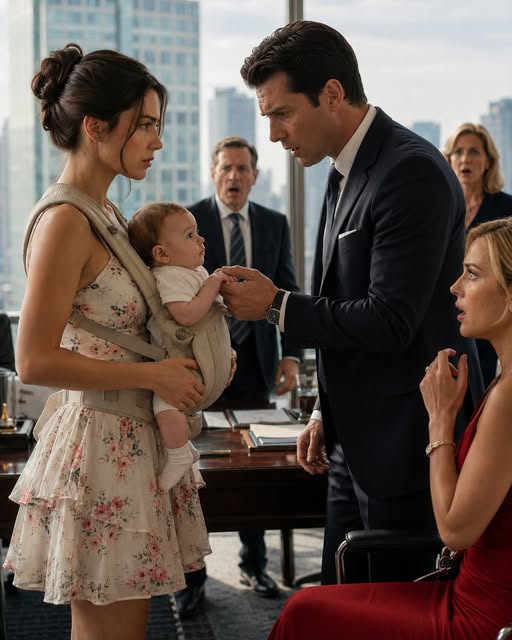
The city stretched behind Adrian Hartwell’s office windows in polished towers and distant silver light, but all I could see was his face. I had seen that face on magazine covers, charity banners, and across dinner tables where silence had sat between us like a third person. I had watched it turn cold during arguments and unreadable during negotiations.
But I had never seen it afraid.
His attorney, Mr. Lowell, recovered first. He cleared his throat and rose halfway from his chair.
“Mrs. Hartwell, this is a private legal meeting.”
I looked at him, then at the thick folder on the table with my married name printed neatly across the label.
“I know exactly what this is.”
Rose shifted against my chest. Her tiny mouth parted, and she made the softest sound, barely more than a sigh. Adrian’s eyes dropped to her again, and something in him seemed to fracture quietly.
“How old?” he asked.
His voice was low, almost unfamiliar.
I placed one protective hand over Rose’s back. “Four months.”
The words settled over the room like dust after a collapse.
Four months.
Long enough for sleepless nights, hospital bracelets, first smiles, and frightened mornings when I had wondered how I would pay for formula after choosing between rent and medicine. Long enough for me to stop expecting his call. Long enough for my heartbreak to harden into something steadier.
Adrian stood slowly.
Around the conference table, executives looked anywhere but at us. Some pretended to study papers. Others stared at their screens, though nothing had changed there. Everyone understood they were witnessing something money could not soften.
His gaze returned to me.
“Clara,” he said. “Why didn’t you tell me?”
I laughed once, quietly, because the question was so small compared to the answer.
“I tried.”
His brow tightened.
“You blocked my number,” I said. “Your assistant returned my letters unopened. Your attorney told me all communication should go through the firm. When I came here six months ago, security escorted me out of the lobby.”
A muscle moved in his jaw. “I never ordered that.”
“No,” I said. “You simply built a life where nobody had to ask you before making people disappear.”
That landed.
I saw it in the way his shoulders drew back, not with anger, but with the reflex of a man struck by truth in front of witnesses.
Mr. Lowell stepped forward again. “Mrs. Hartwell, perhaps we should schedule a separate discussion.”
“No,” Adrian said.
The attorney stopped.
Adrian did not look away from me. “Everyone leave.”
No one hesitated.
Chairs scraped softly. Papers were gathered. Tablets snapped shut. The executives filed out with careful, embarrassed expressions. Mr. Lowell lingered, clearly torn between professional duty and self-preservation.
“Adrian,” he began.
“I said leave.”
This time, even he obeyed.
The double doors closed behind them.
For the first time in nearly a year, I was alone with my husband.
Except we were not alone.
Rose blinked sleepily, studying the stranger before her with solemn blue-gray eyes. They were Adrian’s eyes. I had known that from the moment the nurse placed her in my arms. I had spent four months loving and fearing that resemblance.
Adrian took one step closer, then stopped as if the space between us had become sacred.
“What’s her name?” he asked.
“Rose.”
His expression changed again. Not dramatically. Adrian was not a dramatic man. He carried emotion the way others carried secrets, buried deep beneath polished control. But I saw it—the small softening around his mouth, the stunned ache behind his eyes.
“Rose,” he repeated.
“She has my mother’s name.”
He nodded, absorbing that too. My mother had adored him once. She had believed he was lonely rather than distant, wounded rather than proud. On our wedding day, she had squeezed my hands and whispered that love sometimes needed patience.
She had died before learning patience could become a cage.
Adrian’s voice was rough when he spoke again. “Is she mine?”
The question should have offended me.
Instead, it exhausted me.
I reached into my coat pocket and removed the envelope I had carried for weeks. Inside were copies of hospital records, a birth certificate, and a DNA test I had paid for with money I did not have, because I knew powerful people liked proof more than tears.
I placed it on the table.
“Yes.”
He stared at the envelope but did not touch it.
“I didn’t know,” he said.
“I know.”
That seemed to hurt him more than if I had accused him.
I moved to the chair opposite his, careful not to wake Rose. My legs felt suddenly unsteady. Determination had carried me through the lobby, the elevator, the hallway, and the doors. Now that the room was quiet, my body remembered it was tired.
Adrian noticed.
“Sit,” he said, then caught himself. “Please.”
“I am sitting.”
He looked away, ashamed of the old habit in his voice. He had always given instructions when he did not know how to ask.
For several seconds, the only sound was Rose’s breathing.
Then he said, “You were pregnant when you left.”
“No,” I replied. “I was pregnant when you told me our marriage had become inconvenient.”
His face tightened.
“That is not what I said.”
“It was what you meant.”
He walked to the windows, then back again, restless in a room designed to obey him. “I said we needed space.”
“You moved me out of the apartment within forty-eight hours.”
“I arranged a townhouse.”
“You arranged a temporary place under your company’s name with staff who reported when I came and went.”
He closed his eyes briefly.
I had not come to punish him. I reminded myself of that. I had come because the divorce papers arrived with a settlement that treated our marriage like an employment contract and our daughter like an impossibility. I had come because Rose deserved to exist in the truth.
Still, truth had weight.
Adrian opened the envelope at last.
He read in silence.
I watched his hands. They were steady until he reached the birth certificate. Then one thumb paused over the line where his name should have been.
Father: Unknown.
He swallowed.
“Why didn’t you put me down?”
“Because you were not there.”
His eyes lifted.
It was not cruel. It was simply the fact that had shaped every day since Rose was born.
His voice lowered. “I was in Singapore.”
“You were in Singapore for three weeks. She was born after eighteen hours of labor during a rainstorm in Queens. My neighbor drove me to the hospital because the ambulance would have taken too long.”
Adrian sat down as if his knees had given way.
I had imagined telling him that sentence many times. In some versions, I shouted. In others, I cried. In reality, I spoke quietly, because the hardest things often came out that way.
“Clara,” he said, “I would have come.”
“I needed to believe that once.”
“You should have told me.”
“I did.”
He rubbed both hands over his face, and for a fleeting second he looked less like a billionaire and more like a man who had lost the map to his own life.
“Who kept the letters from me?” he asked.
I shook my head. “That is not why I came.”
“It matters.”
“It matters later.”
“No,” he said, looking at the empty conference table, the papers, the evidence of a divorce prepared without me in mind. “It matters now.”
Rose stirred again and began to fuss.
The sound transformed him.
Adrian looked up sharply, startled by the tiny complaint. I unfastened the carrier and lifted her carefully into my arms, rocking her against my shoulder. She opened her mouth, made a wounded little cry, then settled when I whispered her name.
Adrian watched as if seeing a language he had never learned.
“May I…” He stopped. Tried again. “May I see her?”
I hesitated.
His expression did not harden. He did not demand. That mattered, though not enough to erase everything.
I shifted Rose gently so he could see her face.
He leaned closer, keeping a respectful distance. Rose stared at him with calm curiosity, one tiny hand opening and closing in the air.
“She looks like you,” he said.
“She looks like both of us.”
The words surprised me.
Maybe they surprised him too.
He smiled then—not the public smile from newspaper photographs, but a smaller, uncertain thing. Rose answered by grabbing at the edge of my coat.
Something painful moved through his eyes.
“I missed everything,” he whispered.
“Yes.”
Her first cry. Her first bath. The first time she gripped my finger with shocking strength. The nights she would not sleep unless I walked the apartment from window to door and back again. The morning she smiled at the cracked ceiling fan as if it had told her a secret.
Adrian had missed all of it.
But Rose had not missed him.
That was the mercy and the heartbreak of babies. They arrived without grudges, trusting the world to become worthy of them.
A knock sounded at the door.
Adrian straightened, his old mask trying to return.
“What?”
The door opened slightly, and his assistant, Elise, appeared. Her composed face faltered when she saw the baby.
“I’m sorry, Mr. Hartwell. Your father is here. He says it’s urgent.”
Adrian’s expression darkened.
“Tell him I’m unavailable.”
“I did, sir. He said it concerns the settlement.”
The room changed.
I felt it before I understood it. Adrian became very still. Elise looked at me quickly, then away.
“What settlement?” I asked.
Adrian did not answer fast enough.
The double doors opened wider before Elise could stop him.
Richard Hartwell entered like a man accustomed to doors opening before his hand reached them. Adrian’s father was silver-haired, impeccably dressed, and cold in the way marble was cold. He had disliked me from the beginning, though never loudly. Loudness was for people without influence.
His eyes moved from me to Rose.
Not shock.
Recognition.
That was the first crack in the floor beneath me.
“Well,” Richard said calmly, “this complicates matters.”
Adrian stood. “Get out.”
Richard ignored him. “Clara. You should have called before bringing the child here.”
The child.
I rose slowly, holding Rose close.
“You knew.”
Adrian turned toward his father.
“What does she mean?”
Richard sighed, as if disappointed by our inability to remain civilized. “This is not the place.”
Adrian’s voice sharpened. “What did you know?”
For once, Richard looked at his son as if calculating whether the truth could still be managed.
Then he looked at me.
“You were young, overwhelmed, and emotional. I did what was necessary to protect the family.”
The family.
Not my child.
Not the marriage.
The family.
My grip tightened on Rose.
“You intercepted my letters,” I said.
Richard’s mouth formed a thin line. “I ensured Adrian was not distracted during a critical acquisition.”
Adrian stared at him. “You knew Clara was pregnant?”
“I suspected.”
“You suspected?”
Richard adjusted one cuff. “Later, I confirmed.”
The silence that followed felt bottomless.
Adrian took a step back from his father, and for the first time I saw something between them I had missed before. Not respect. Not loyalty. Training. Adrian had been shaped by this man the way iron was shaped by pressure and heat.
I wondered how much of my marriage had been crowded by Richard Hartwell before I ever noticed.
Adrian spoke carefully. “You knew I had a daughter.”
Richard did not deny it.
“Her existence created legal vulnerability,” he said. “Your divorce needed to be resolved cleanly.”
My breath caught.
Adrian’s face went pale again, but this time the emotion behind it was different. Not fear. Horror.
“You were going to let me sign those papers today,” he said.
“I was going to protect your company.”
“My daughter is not a liability.”
Richard’s eyes flashed. “Everything is a liability when billions of dollars, voting shares, and succession rights are involved.”
Rose began to fuss, perhaps sensing the tension in my body. I pressed my cheek to her soft hair and breathed slowly.
Adrian looked at me. “Clara, I didn’t know.”
This time, I believed him.
Belief did not bring relief. It brought a more complicated pain.
Because if Adrian had not known, then someone else had built the wall between us brick by brick. And I had lived on the other side of it alone, blaming only him.
Richard turned to me. “You will be compensated appropriately.”
I almost did not understand him.
Then I did.
He was trying to buy silence in the same tone another man might order lunch.
“No,” I said.
His eyebrows lifted.
“No?” he repeated, faintly amused.
“No.”
Adrian stepped between us. “Father, leave.”
Richard studied him. “You are emotional.”
“Yes,” Adrian said. “I am.”
That simple admission seemed to cost him more than any fortune.
Richard’s gaze hardened. “Then I will speak plainly. If you acknowledge this child without preparation, the board will react, the press will feast, and every interest attached to Hartwell Holdings will shift. You think fatherhood exists apart from power. It does not.”
Adrian’s voice was quiet. “Maybe that is the first honest thing you’ve ever taught me.”
For a moment, Richard looked almost wounded.
Then the moment passed.
He turned and left without another word.
The door closed softly behind him.
I sank back into the chair, shaking now despite my effort not to. Adrian noticed but did not move toward me. He was learning, perhaps too late, that care sometimes meant staying where you were.
“Elise,” he called.
His assistant appeared again, visibly uncomfortable.
“Cancel everything for the rest of the day,” he said. “No exceptions. Find out who handled all correspondence from Mrs. Hartwell in the past year. Quietly. I want names, dates, and copies.”
“Yes, sir.”
“And call Dr. Merrin.”
Elise nodded and closed the door.
“Who is Dr. Merrin?” I asked.
“A family attorney. Not the company’s. Mine.”
“I already have legal help.”
“Good,” he said. “Keep it.”
That answer disarmed me.
He sat across from me, leaving the table between us. “I won’t ask you to trust me.”
“Good.”
“I won’t ask you to come back.”
“Better.”
His mouth tightened slightly, but he nodded. “I will ask what Rose needs.”
I looked down at my daughter. She had fallen asleep again, one hand curled beneath her chin, innocent of wealth, divorce, and men who spoke of babies as legal complications.
“She needs stability,” I said. “Health insurance. A safe home. Time. A father, maybe, but only if he can become one without making her life into a headline.”
Adrian absorbed every word.
“And you?” he asked.
The question nearly broke me.
Nobody had asked me that in a very long time.
I looked toward the windows, where afternoon light had softened into gold against the glass. Below us, the city moved on, unaware that my private world had tilted.
“I need to stop being afraid every time the mail comes,” I said. “I need to stop choosing which bill can wait. I need to sleep without wondering whether pride is the only thing keeping me upright.”
His eyes closed.
“I’m sorry.”
I wanted to reject it. Apologies from powerful men often arrived polished and empty. But this one came quietly, without excuse.
So I let it remain in the room.
I did not forgive it.
I did not throw it away.
Adrian stood and walked to a cabinet near his desk. He removed a blanket still wrapped in tissue paper, cream-colored and soft. I recognized it with a jolt.
It was from Milan.
A baby blanket I had once admired in a shop window during our honeymoon, laughing at the absurd price. I had said no child needed anything so expensive. Adrian had bought it anyway, joking that maybe one day we would find out.
I thought he had forgotten.
He held it out, uncertain.
“I kept this,” he said.
I stared at the blanket.
A memory opened between us. Rain on stone streets. His hand warm around mine. A younger version of me believing love could grow simply because we wanted it to.
I took the blanket, because Rose was innocent of our history.
“Thank you,” I said.
His eyes flicked to mine.
It was a small thing.
It was not enough.
But sometimes not enough was still the first step away from nothing.
We spent the next hour discussing practical matters. Names of doctors. Copies of records. Temporary support arranged through attorneys, not whispered promises. A revised legal process. Boundaries. Visitation only after counsel agreed. No press. No sudden appearances at my apartment. No decisions made by Richard Hartwell.
Adrian wrote everything down himself.
That surprised me too.
The man who once delegated even birthday flowers now sat with his sleeves rolled up, writing Rose’s pediatrician’s name in careful letters.
At one point, he asked, “Does she have a favorite song?”
I looked at him.
He seemed embarrassed by the question but did not withdraw it.
“My mother used to sing ‘Moon River,’” I said. “Rose likes that.”
He wrote it down.
The ache in my chest became almost unbearable.
When I finally stood to leave, the office felt different from when I had entered. Not warmer. Not healed. But altered, as though every polished surface had been forced to reflect something real.
Adrian walked us to the elevator.
He kept his distance, hands at his sides, eyes on Rose.
At the doors, he said, “Clara.”
I turned.
“I know I have no right to ask for anything today.”
“You don’t.”
He nodded. “May I see her again through the proper channels?”
I looked at Rose, then at him.
The answer mattered.
Not because he was Adrian Hartwell. Not because he had money, influence, or a name that opened doors. It mattered because Rose would one day ask who her father was, and I wanted to answer truthfully without bitterness poisoning every word.
“Yes,” I said. “Through the proper channels.”
Relief crossed his face so quickly he could not hide it.
The elevator doors opened.
I stepped inside.
Just before they closed, Adrian said, “I will find out what my father did.”
The doors slid shut before I could answer.
On the ride down, Rose woke and blinked at me. I kissed her forehead, breathing in her sweet, milky scent.
“We did it,” I whispered.
But I did not yet know what we had done.
Outside, rain had begun to fall, fine and silvery against the pavement. I stood beneath the awning, adjusting Rose’s blanket before stepping toward the curb.
A black town car idled nearby.
The rear window lowered.
Richard Hartwell sat inside, dry and composed, his face half-shadowed.
“Clara,” he said, “a word.”
I almost kept walking.
Then he lifted a small envelope between two fingers.
“Your mother wanted you to have this.”
I froze.
My mother had been dead for two years.
Richard saw that he had my attention.
“She came to see me before she died,” he said. “She knew more about your marriage than you think.”
Rain tapped softly on the awning above us.
I looked at the envelope, then at the man who had hidden my daughter from her father.
“What are you talking about?”
Richard’s expression did not change.
But his next words made the world feel suddenly unsteady.
“She asked me to protect you from Adrian,” he said. “And she left proof of why.”
END OF PART 2 – LIKE, SHARE AND COMMENT “THE ENTIRE STORY” IF YOU WANT TO READ THE FULL STORY
