PART 3 — FINAL PART
The Sister My Mother Hid, and the Truth Lucas Couldn’t Bury
For several seconds, I did not move.
The photograph on my phone showed Lucas standing on a warmly lit porch I had never seen before, his smile soft and trustworthy, the exact smile he used with waiters, neighbors, bank managers, grieving daughters, pregnant mistresses, and apparently sisters who had been told I was dead.
In his hands was my mother’s cedar box.
The room around me seemed to hold its breath.
I looked toward the guest room upstairs, where the cedar box should have been sitting beside the bed. I had slept next to it. I had opened it. I had smelled lavender rising from the past.
Then I remembered.
I had left it there when I went to Miriam’s office.
Lucas still had a house key.
My hand tightened around the phone.
Clara’s message waited beneath the photograph.
Lucas Grant came to my house tonight. He said he was your attorney. He said my sister Anne had died six years ago.
My sister.
The word struck deeper than fear.
I called Clara before I could talk myself out of it.
She answered on the second ring, but neither of us spoke immediately. I could hear her breathing, quick and uneven. Somewhere in the background, wind chimes moved softly, delicate notes brushing against the silence.
“Clara?” I said.
A pause.
“Yes.”
Her voice was gentle. Careful. Younger than I expected and older than I was ready for.
“It’s Anne.”
Another pause, longer this time.
Then she whispered, “You’re alive.”
I closed my eyes.
“Yes.”
A small sound came through the phone. Not quite a sob. Not quite relief.
“He told me you died,” she said. “He said our mother had hidden things because she was ashamed, and that you passed away before she could tell me.”
“Our mother was not ashamed of you,” I said quickly.
The words came out with such force that Clara went silent.
I pressed my palm to the table, trying to steady myself.
“I don’t know everything yet,” I said. “But I found her journals. She wanted to tell me. She was trying to find you.”
Clara breathed in sharply.
“He brought the box,” she said. “He said it had belonged to Evelyn. He said it was all he had left from your estate, and he wanted me to sign papers so he could preserve the property for the family.”
“What papers?”
“I didn’t sign.” Her voice trembled, but there was steel under it. “Something was wrong. He knew too much and not enough. He called her Evelyn every time, never Mom. And when I asked what your laugh sounded like, he said he didn’t remember.”
May you like




A strange ache opened inside me.
“What did you do?”
“I told him I needed to think. Then I waited until he left and called Miriam Vale. Her name was in one of the old letters my adoptive father kept. Miriam told me not to answer the door again. Then Theo sent me your number.”
“Is Lucas still there?”
“No. He left ten minutes ago.”
“Do you have the cedar box?”
“Yes.”
My breath loosened.
“Keep it inside. Don’t let him near it again.”
“I won’t.”
We sat in silence, connected by a line neither of us had known existed that morning.
Then Clara said, “Anne?”
“Yes?”
“Did she love me?”
The question landed so softly that it hurt more than accusation would have.
I looked down at my mother’s journal, open beneath my hand. The page blurred as tears gathered.
“She wrote your name,” I said. “Again and again. She wrote that she had to find you before Lucas did. She kept your birth certificate. Your letters. Your photograph. Clara, she loved you enough to spend years hurting over the choice she made.”
On the other end, Clara began to cry.
Quietly.
Like someone who had been waiting all her life for permission.
I stayed on the phone with her until her breathing slowed. Then I called Daniel Cho.
He answered with the alertness of a man who had expected bad news.
“Anne?”
“Lucas broke into my house,” I said. “He took my mother’s cedar box and brought it to Clara Bennett in Palm Springs.”
Daniel was silent for one second.
Then his voice sharpened.
“Do not call Lucas. Do not go anywhere alone. I’m contacting Miriam and the bank’s fraud department. We also need to notify local police about the unauthorized entry and removal of property.”
“I want Clara protected.”
“She will be. Send me everything.”
After we hung up, I walked upstairs.
The guest room door was slightly open.
I knew before I entered.
The bedspread had been disturbed. The closet door stood ajar. The space where the cedar box had rested was empty except for a faint rectangle in the dust.
Lucas had come home while I sat in lawyers’ offices, while I began gathering proof, while I thought I was finally standing ahead of him.
But this time, something had changed.
He had the box.
I had the truth.
And now Clara had it too.
The next morning began before dawn.
Daniel arrived at my house with a colleague named Priya, a quiet woman with a tablet, calm eyes, and a way of photographing rooms that made every detail feel important. They documented the missing box, the lock, the upstairs hallway, even the faint scrape on the guest room window where Lucas had apparently forced it after realizing I had changed the alarm code.
“He didn’t want a record of using the front door,” Priya said.
Daniel looked at the window frame.
“That helps us.”
For once, the damage felt useful.
By nine, Miriam joined us on a video call. Clara appeared on the screen from her kitchen in Palm Springs, pale but composed, wearing a blue cardigan and holding a mug with both hands. Behind her, morning light fell across yellow curtains and a vase of sunflowers.
For a moment, I forgot the legal crisis.
I simply looked at my sister.
She had Mom’s eyes. Not just the color, but the way they held sadness without surrendering to it.
Miriam’s voice softened when she saw us both on the screen.
“Your mother would have wanted this conversation,” she said.
Clara swallowed.
“Then let’s have it.”
For the next hour, the story unfolded through documents.
The Palm Springs land had originally been purchased decades ago by three families, including my father’s and my mother’s. After a series of deaths, transfers, and quiet legal arrangements, my mother’s share had been divided in a way that none of us fully understood until Miriam traced it.
I owned forty percent.
Clara owned thirty percent.
Another thirty percent belonged to a charitable trust connected to an old music school in California.
Clara blinked.
“A music school?”
Miriam nodded. “Your adoptive mother served on its board.”
Clara pressed her fingers to her lips.
“My mother taught piano there.”
Something moved across Miriam’s face.
“I wondered whether you knew.”
Clara looked stunned.
“My adoptive parents always told me my birth mother wanted me to have music. I thought they meant… generally. Like a wish.”
Miriam opened another scanned document.
“It was more than a wish.”
On the screen appeared a letter from Evelyn Mercer to Clara’s adoptive parents, written in careful blue ink.
Please let music find her early. I cannot give her my name, but I can give her the only language that never abandoned me.
Clara covered her mouth. Her shoulders shook once.
I stared at the words.
My mother had played piano every Sunday morning when I was little. Nothing fancy. Old hymns, folk songs, half-remembered melodies. After Clara was born and gone, she must have sat at that piano with one daughter in the room and another in the world, sending notes into the distance because she had no other way.
Daniel cleared his throat gently.
“Lucas appears to have discovered the ownership structure while helping Evelyn with documents before her death. After that, he formed Desert Vista Holdings and began positioning himself to acquire the land. He needed Anne’s signature. He likely planned to pressure or deceive Clara into signing once he controlled Anne’s portion.”
“And Melanie?” I asked.
Daniel glanced at his notes. “Melanie’s accounts were used to route some preliminary development payments. Whether she understood the full purpose is still unclear, but based on what Theo provided, she is cooperating.”
Clara looked at me through the screen.
“He used all of us.”
Not with the same consequences. Not in the same ways.
But yes.
Lucas had studied our loneliness like a map.
Mine had been grief.
Melanie’s had been hope.
Clara’s had been the ache of unanswered origin.
And he had walked straight through all of them.
“What happens now?” Clara asked.
Miriam leaned forward.
“Now we stop the sale. We challenge every fraudulent document. We notify the charitable trust. And if both of you agree, we remove Desert Vista from any involvement before Lucas can do more harm.”
“How?” I asked.
“By doing something he never expected,” Miriam said.
Daniel almost smiled.
“We make the truth public to the right people before he can control it privately.”
Not a spectacle.
Not revenge.
A record.
By noon, formal notices had gone out. By two, the title company had frozen the closing. By four, the bank had locked the joint account against unilateral withdrawals. By five, Daniel confirmed that Lucas’s attorney had received notice of disputed signatures, suspected fraud, and preservation demands for all communications related to Desert Vista Holdings.
At six thirty, Lucas called.
I let Daniel answer on speaker.
“Anne?” Lucas said.
“No,” Daniel replied. “This is Daniel Cho, counsel for Anne Grant.”
The silence was immediate.
Then Lucas laughed once, lightly.
“I’m sorry, counsel for what exactly?”
“For financial, marital, and property matters currently under review.”
Another silence.
When Lucas spoke again, the warmth had drained.
“Put my wife on the phone.”
Daniel looked at me. I shook my head.
“All communication should go through counsel.”
Lucas exhaled.
“This is ridiculous. Anne is emotional. She’s grieving. She doesn’t understand what she’s doing.”
There it was again.
The old spell.
Only now it sounded small.
Daniel’s expression did not change.
“Mr. Grant, you are instructed not to contact Mrs. Grant directly. You are also instructed not to contact Clara Bennett.”
A pause.
“I don’t know anyone by that name.”
Clara, listening from Daniel’s second phone, closed her eyes.
Daniel said, “That response is noted.”
Lucas hung up.
No goodbye.
No hearts.
No brave girl.
The mask had finally met a locked door.
That night, I slept in my own bedroom for the first time since the airport. Not because I felt safe exactly, but because I refused to let Lucas’s choices exile me from my own life.
Before bed, Clara texted me a photograph.
The cedar box sat on her kitchen table. Its lid was open. Inside were Mom’s journals, letters, and a small velvet pouch I had not noticed before.
Beneath the photo, Clara wrote:
There’s a key in here.
I sat upright.
What kind of key?
Small. Brass. No label. Also a note tucked into the lining. It has your name and mine.
A minute later, the image arrived.
The note was written in Mom’s handwriting.
For Anne and Clara, if I fail to be brave in time. Box 19. First Federal Bank of Boulder. Ask Miriam.
My heart began to pound.
I forwarded it to Miriam.
Her reply came almost immediately.
Come tomorrow morning.
Clara flew to Denver on the earliest flight.
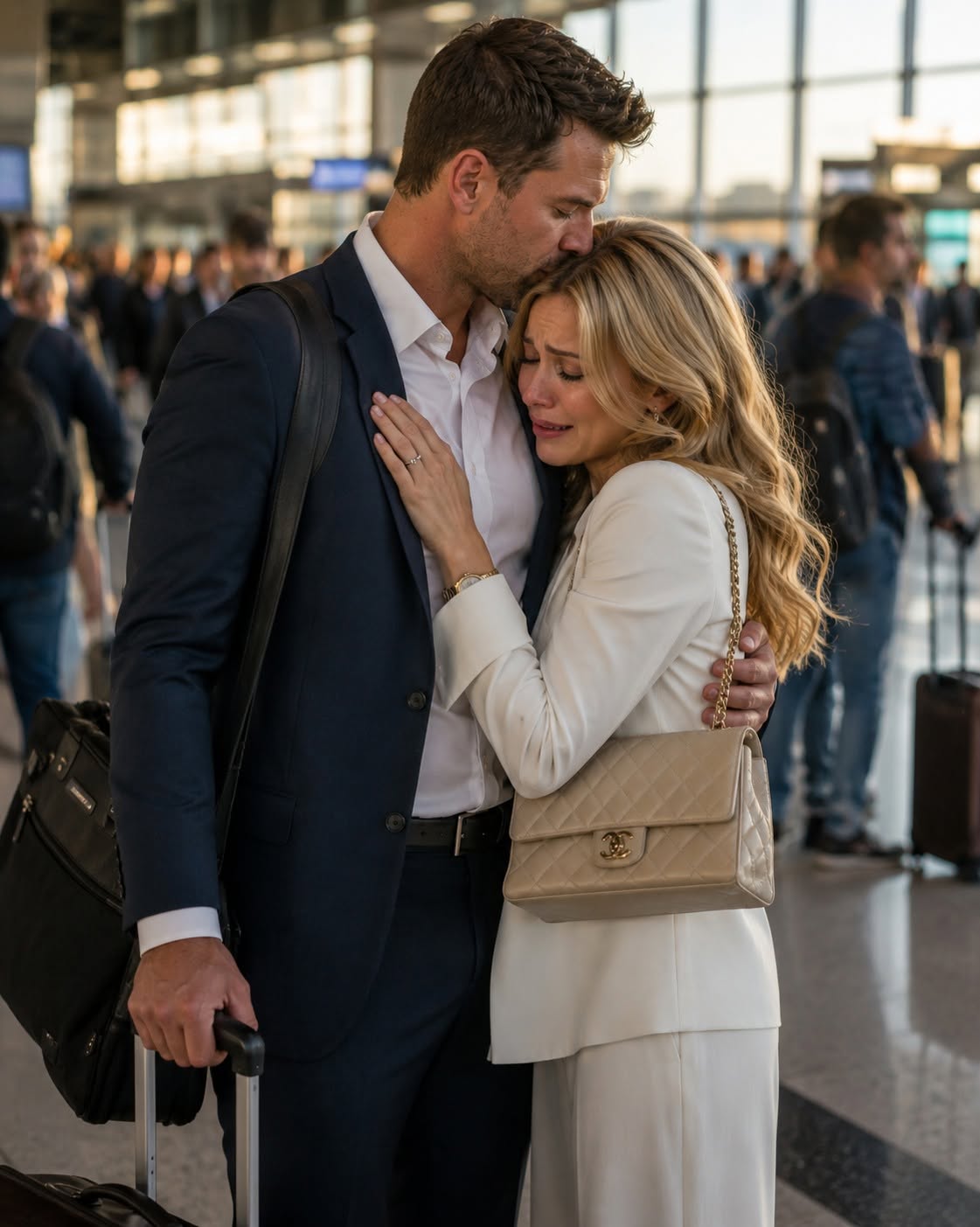
I waited for her near baggage claim, in the same airport where I had cried in Lucas’s arms days earlier. The memory felt strangely distant now, like something that had happened to a woman I used to know.
Then Clara appeared.
She was smaller than I expected, carrying a worn leather bag and looking around as if the air itself might be uncertain. When she saw me, she stopped.
Neither of us moved.
People flowed around us. Suitcases rolled. Children complained. A man laughed into his phone.
Clara took one step forward.
I did too.
Then we were hugging.
Not gracefully. Not like sisters in films who somehow understand the shape of each other immediately. It was awkward at first, our bags between us, our arms unsure.
Then she whispered, “You smell like lavender.”
I laughed and cried at the same time.
“So do you.”
At Miriam’s office, the brass key opened safe deposit box 19.
Inside was not money.
It was music.
Stacks of handwritten sheet music tied with ribbon. Cassette tapes labeled in Mom’s neat script. A few old photographs. Two letters. And a legal document Miriam had never seen, sealed in an envelope marked:
To my daughters.
Miriam read it first, then slowly lowered herself into her chair.
“What is it?” I asked.
She looked at Clara and me with eyes bright behind her glasses.
“Your mother created a foundation.”
Clara frowned. “A foundation?”
“Not active yet. Drafted, signed, but never funded. She intended that if the Palm Springs land was ever sold, her daughters would direct her share toward something called The Mercer House for Music and Healing.”
The room went quiet.
Miriam handed us the document.
My mother had written a mission statement in her own words.
A place for children who carry grief, displacement, or silence. A place where music gives them language before pain convinces them they have none.
Clara pressed the page flat with trembling fingers.
“I teach children like that,” she whispered.
I looked at her.
“Of course you do.”
There are coincidences that feel random, and others that feel like threads finally pulled into light.
The final letter was addressed to both of us.
My dear girls,
If you are reading this together, then some mercy found its way through my mistakes.
Anne, you were the child I kept and loved in daylight.
Clara, you were the child I loved in silence.
There is no sentence I can write that will make that fair. I was young, frightened, and surrounded by people who told me secrecy was kindness. I believed them because believing them let me survive. But surviving is not the same as doing right.
I wanted to bring you back to each other. I was slower than fear and weaker than love required. For that, I am sorry.
But there is something I learned late. Family is not only what happens before the wound. Sometimes family is what happens after truth is finally allowed into the room.
The land near Palm Springs was never meant to make anyone rich. It was meant to become a place where something broken could be made useful. If the choice ever comes to you, do not let greedy people turn it into glass towers with empty rooms. Build something with windows open to music.
I love you both.
Mom
Clara folded over the table and wept.
I reached for her.
She reached back.
Miriam turned away toward the window, giving us privacy, though her own shoulders trembled.
For the first time, my mother’s silence did not feel only like abandonment. It felt like a locked room she had been trying, imperfectly and desperately, to open.
The weeks that followed did not unfold like a dramatic ending.
They unfolded like real life.
Slowly.
With paperwork.
With phone calls.
With anger that came in waves and grief that arrived at inconvenient times.
Lucas returned to Denver after his legal options narrowed. He did not come to the house. Daniel made sure of that. Through his attorney, Lucas denied everything at first. Then the evidence grew heavier: forged signatures, emails, title records, bank alerts, doorbell footage from Clara’s house, Theo’s documents, Melanie’s cooperation, the storage unit rented under my mother’s maiden name with payments traced to him.
Eventually, denial became negotiation.
The marriage ended through proper channels.
The joint savings were protected. My inheritance was traced and separated. Lucas lost any claim to funds he had attempted to misappropriate. Desert Vista Holdings collapsed under investigation and civil action. The forged property agreement was voided.
There were consequences.
Legal ones.
Financial ones.
Public enough to prevent him from quietly building the next lie, but not so theatrical that my life became a stage for his downfall.
Melanie moved in with Theo for a while. She wrote me one more letter, not asking forgiveness, only telling me that her baby would carry her last name and that she had begun working with investigators. I read the letter twice, then placed it in a folder marked Evidence and another place in my heart marked Human.
Forgiveness did not arrive like sunlight.
But bitterness did not become my home either.
Clara stayed in Denver for three weeks.
At first, we were careful with each other. We asked small questions. Coffee or tea? Window open or closed? Did Mom sing while cooking? Did your adoptive mother hum when nervous?
Then the questions deepened.
“What was she like when she was happy?” Clara asked one evening.
We sat on the kitchen floor, surrounded by Mom’s journals and old photographs. Rain tapped softly against the windows.
“She danced badly,” I said.
Clara smiled through tears.
“So do I.”
“She burned toast constantly.”
“I burn rice.”
“She hated carnations.”
Clara gasped. “Me too.”
We laughed until we cried.
Not because shared dislikes proved anything, but because each tiny overlap felt like a stitch.
In one photo, Mom stood at a piano with me on her lap. In another, a baby I now knew was Clara slept wrapped in a yellow blanket. Mom had kept both.
Daylight and silence.
Both loved.
Both lost.
Both found.
One afternoon, Clara played one of Mom’s compositions on the piano in my living room. I had almost sold that piano years ago, but Lucas said it was too difficult to move and not worth the trouble.
For once, his dismissal had preserved something precious.
Clara sat at the bench, her fingers hovering above the keys.
“I’m nervous,” she said.
“It’s just me.”
“That’s why.”
The first notes were tentative.
Then the melody opened.
It was simple at first, almost like a lullaby. Then another theme entered beneath it, richer, lower, answering the first. Two melodies moving separately, touching, drifting apart, finding each other again.
I sat on the sofa with Mom’s letter in my lap and listened as the room changed around us.
Not haunted.
Filled.
When Clara finished, neither of us spoke.
On the final page of the sheet music, Mom had written a title.
For My Girls, When They Meet.
Clara laughed once, broken and bright.
“She believed it would happen.”
I touched the paper.
“Maybe she needed to.”
“No,” Clara said, looking at me. “Maybe she knew something we didn’t.”
The Palm Springs land became the last unresolved thread.
A developer made a new offer. A better one. Clean, generous, legitimate. Enough money to secure both our futures and still fund the foundation.
For three days, I considered it.
So did Clara.
Then the charitable trust’s representative joined a call from California. She was an older woman named Beatrice Lin, director of the music school connected to Clara’s childhood.
When Clara appeared on the screen, Beatrice stared.
“Oh,” she said softly.
Clara leaned closer. “Do we know each other?”
Beatrice covered her mouth.
“I knew your mother,” she said.
“My adoptive mother?”
“Yes. And Evelyn.”
The room went still.
Beatrice explained that decades earlier, Evelyn had come to the music school under the pretense of donating old sheet music. Really, she had wanted to see Clara from a distance. Clara was four years old then, sitting cross-legged in a beginner’s class, tapping rhythm sticks together with fierce concentration.
“Evelyn stood in the hallway and cried,” Beatrice said. “She made me promise not to interfere with your adoption. But she donated every year after that. Always anonymously. Always with a note that said, For the little ones who need a song.”
Clara pressed her hand to her chest.
“She saw me?”
“Once,” Beatrice said. “Only once. She said if she stayed longer, she would break every promise she had made.”
A final missing piece slid into place.
Not enough to erase pain.
Enough to reshape it.
My mother had not forgotten.
She had watched from the edge of the life she thought she had no right to enter.
Beatrice then revealed the last unexpected connection.
“The land trust’s thirty percent was donated to us by Clara’s adoptive parents after they passed,” she said. “They believed Evelyn’s land should one day serve Evelyn’s dream. They didn’t know the whole story. But they knew enough.”
Clara stared at the screen.
“My parents knew?”
“They knew your birth mother loved you,” Beatrice said. “And they wanted you to have that truth when you were ready.”
Clara cried then, but she was smiling.
After the call, we knew what to do.
We did not sell to the developer.
Instead, with Miriam, Daniel, Beatrice, and the trust, we restructured the land into something neither Lucas nor any developer had imagined.
Eighteen months later, Clara and I stood beneath a wide desert sky while a brass sign was unveiled at the entrance of a restored adobe building surrounded by young olive trees.
THE MERCER HOUSE
Music, Memory, and Healing
Children ran across the courtyard carrying small drums and violin cases. Parents stood in clusters, some smiling, some wiping their eyes. Inside, practice rooms waited with open doors. A garden had been planted with lavender because Clara insisted, and hummingbird feeders hung beneath the eaves because of Mom’s gold pin.
The old land had not become luxury condos.
It had become windows open to music.
I stood beside Clara as the first notes rose from inside the building: children’s voices singing one of Mom’s simple melodies.
Clara slipped her hand into mine.
“She would have loved this,” she said.
I looked at the sunlit courtyard, at Miriam speaking with Beatrice near the entrance, at Daniel laughing with Theo beside a table of lemonade, at lives crossing gently where secrets had once stood guard.
“Yes,” I said. “She would have.”
Clara squeezed my hand.
“Do you ever think about him?”
Lucas.
The name no longer struck like a blade. It landed like a stone dropped far away.
“Sometimes,” I said. “But not the way I used to.”
“How do you think about him?”
I watched a little girl sit at a piano through an open doorway. Her teacher placed a patient hand over hers, guiding her toward the first note.
“I think some people spend their whole lives trying to turn love into ownership,” I said. “And they never understand that love is the one thing that disappears when you try to steal it.”
Clara nodded.
Then she smiled.
“Mom would have written that down.”
“She would have made it shorter.”
“She would have made it rhyme.”
We laughed.
Later that afternoon, after the speeches and music and ribbon cutting, Clara led me to a quiet room at the back of the house. There was a piano inside and two framed photographs on the wall.
One showed Mom holding me as a baby.
The other showed Clara at four years old in her music class, rhythm sticks lifted midair, face bright with concentration.
Between the photographs hung a small gold hummingbird pin.
I touched the frame.
For years, I thought my marriage ending would be the great fracture of my life. The moment everything broke.
But standing in that room with my sister beside me, I understood something I could not have known at the airport.
Some endings are not doors closing.
Some are walls falling.
Through the opening came truth. Painful, imperfect, necessary truth. Through it came a sister. A mother more complicated and more loving than memory had allowed. A home built from land nearly stolen. A melody written years before either of us was ready to hear it.
Clara sat at the piano.
“Will you play with me?” she asked.
“I barely remember how.”
“Then I’ll teach you.”
I sat beside her on the bench.
Our shoulders touched.
She placed my fingers on the keys, then rested hers nearby.
“Start here,” she said.
The note rang out clear and small.
Another followed.
Then another.
Outside, children laughed in the courtyard. Wind moved through the olive trees. Somewhere above us, unseen but near, hummingbirds flashed briefly in the desert light.
And for the first time in a long time, I did not feel like a woman abandoned at the edge of someone else’s future.
I felt like a daughter.
A sister.
A beginning.
THE END
