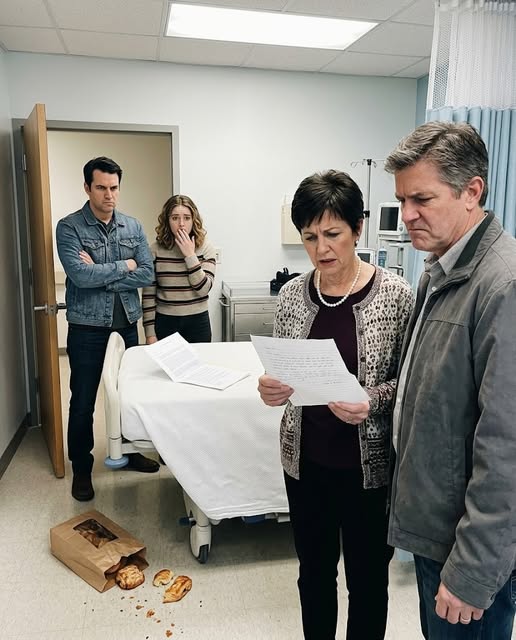
They Ignored Her ICU Call, Then Found the Empty Bed



The ICU did not look like a room to Lena.
It looked like a place where the world made its final decisions under fluorescent lights.
Everything was too bright and too clean.


The walls were white, the curtains were pale blue, and the polished rails of the hospital bed reflected her face in warped silver strips.
Machines breathed and clicked around her.
Tubes ran beneath tape on her arms.


Her throat ached where the breathing tube had been.
The air smelled of antiseptic, plastic, and something falsely citrus, as if someone had tried to cover fear with lemon cleaner.
A monitor beside her counted each heartbeat in a green line.

Beep.
Beep.
Beep.
Each sound felt like proof that she was still here, though Lena was not sure who here was supposed to matter to.
Her last clear memory before the hospital was the carpet at work.
Gray, with thin blue threads woven through it.


She remembered staring at those threads after her legs folded beneath her.
A spreadsheet had been open on her computer.
Coffee had spilled near her hand.


Someone had shouted her name from far away.
Then came the sirens, the ceiling lights, and strangers telling her not to close her eyes.
When she woke in the ICU, a nurse with kind, tired eyes was standing beside her bed.
The badge on the nurse’s chest read JANELLE.
Janelle checked the tape on Lena’s arm and pressed two fingers to her wrist.
She spoke with the calm steadiness of someone who had learned how to keep panic out of her voice, even when panic belonged in the room.

Lena, stay with me.
Lena tried to answer, but her voice was a dry scrape.
Her body felt borrowed and broken.
Every breath hurt.
Every movement pulled at something.
Janelle adjusted the blanket over her and glanced toward the chart.


Do you have an emergency contact?
The question should have been simple.
Instead, it opened a hollow place under Lena’s ribs.
Emergency contact.
Such a clean phrase for such a messy hope.
It suggested there was someone out there waiting to be called.
Someone who would hear her name and run.
Someone who would forget dinner reservations, meetings, traffic, grudges, pride, and every old injury because their daughter was lying in a hospital bed.
Lena already knew better.
But the answer came anyway, trained into her by blood and years.
My parents.
Janelle took out the phone and placed the call on speaker while keeping one hand near Lena’s IV line.
Lena stared at the device as it rang.
Once.
Twice.
Three times.
Her mother answered with laughter and restaurant music behind her.
Hello?
Janelle straightened.
Ma’am, this is County Hospital ICU.
Your daughter, Lena, has been admitted.
We need you to come immediately.
There was a pause.
Not long.
Just long enough for Lena’s heart to rise like a child looking toward a doorway.
Oh, her mother said.
We are at dinner with our son and his new girlfriend.
Is it urgent?
Janelle’s expression tightened.
She collapsed at work.
Doctors are concerned about internal bleeding.
She may not survive the night.
The silence that followed was worse than a scream.
Lena could picture the table.
Her mother in pearls.
Her father scanning the menu like the prices mattered more
than the call.
Her brother Mark sitting beside a woman Lena had never met, smiling under warm restaurant lights, proud to be the son they had always treated like the center of the family.
Then her father’s voice came through the speaker.


We will pray.
Nothing else.
Not what hospital.


Not how bad is it.
Not tell her we love her.
Not we are on our way.

Just we will pray.
Janelle’s eyes flicked to Lena, and Lena hated the pity she saw there.
It was soft, but it still burned.
Sir, Janelle said carefully, your daughter’s condition is critical.
We will pray, he repeated.
The line went dead.


Lena could not cry properly because of the tube and the oxygen, but tears slid sideways into her hair.
She stared at the ceiling tiles until they blurred into white squares.
Somewhere inside her, a door closed.


Not loudly.
Not dramatically.
Just completely.
Janelle lowered the phone.
Is there someone else we can call? A friend? A neighbor? Anyone?
For a moment Lena thought of all the almost-people in her life.
The elderly neighbor who left soup at her door when she had the flu.
The security guard at work who always told her to get home safe.
The barista who remembered she hated whipped cream.
People who knew tiny things about her, which was more than her parents had cared to know.
But she had spent too many years learning not to need anyone.
No, she whispered.
That night, the hospital moved around her like a storm.
Doctors came and went.
She heard the words hemorrhage, transfusion, unstable.

She was wheeled through a hallway under passing lights.
Janelle squeezed her hand before the operating room doors opened.
You are not alone, Janelle said.
Lena wanted to believe her, so she held on to that sentence when the anesthesia pulled her under.
She woke two days later to pain so sharp it felt like fire stitched into her abdomen.
A young doctor told her the surgery had gone well.
He told her she had lost a dangerous amount of blood.
He told her she was lucky.
Lucky.
The word sat in her mouth like a stone.
She was alive.
Her parents still had not come.
There were no missed calls.
No flowers.
No frantic messages.
No mother weeping in the hallway.
No father standing stiffly by the door, ashamed but present.
Only Janelle, who checked on her before and after shifts, and hospital staff who treated her with more tenderness than the people who had raised her.
On the third day, Lena asked for her phone.
The first thing she saw was Mark’s post.
He was standing between their parents and his girlfriend under golden restaurant lights.
Everyone looked polished, smiling, untouched by disaster.
Mark’s arm was around the woman’s waist.
Their mother glowed with pride.
Their father held a glass of red wine.
The caption read: Perfect night with family.
Lena stared at those four words until her vision blurred.
Perfect night with family.
While she was bleeding into her own body.
While a nurse begged them to come.
While surgeons fought for her life under white lights.
Something inside Lena changed then.
It was not rage, at least not at first.
Rage would have been hot.
This was cold.
Clear.
Final.
She asked Janelle for paper.



Janelle brought a yellow legal pad and a pen.
You need help writing?
Lena shook her head.

Her hands trembled so badly at first that the letters crawled crookedly across the page.
Still, she wrote.
She wrote about being eight years old and waiting in the school office with a fever while her mother said she could not leave Mark’s soccer practice.

She wrote about being ten and eating cereal for dinner because her parents had gone out to celebrate Mark’s award and forgotten to leave food.
She wrote about her sixteenth birthday, when her mother bought Mark new cleats on the same day she told Lena the cake could wait until the weekend.
She wrote about the scholarship letter she had brought home at seventeen.

Her father had glanced at it once and said college debt was foolish for a girl who would probably get married anyway.
Then he had spent nearly twice the amount on Mark’s first car.
She wrote about Christmas mornings when she washed dishes while Mark opened gifts.
She wrote about hospital visits where she had driven her mother to appointments, paid pharmacy bills, and answered late-night calls, only to be forgotten when she was the one lying under a monitor.
She wrote until the pain medicine made her sleep.
Then she woke and wrote again.
On the fifth day, Janelle entered the room and found Lena staring at a photograph on her phone.
Who is that? Janelle asked.
Mark’s girlfriend, Lena said.
The woman in the photo looked young, nervous, and happy in the way people look before they understand what kind of family table they have been invited to.
Lena had found her public profile.
Her name was Claire.
She was a preschool teacher.
Her posts were full of children’s drawings, rescue dogs, and small hopeful captions about starting over after a difficult past.
Lena looked at Claire’s smiling face for a long time.
What did he tell her about me? Lena murmured.
Janelle did not answer.
The next day, Lena found out.
Claire sent a message through social media.
It was short and hesitant.
Hi Lena.
I know we have never met.
Mark said you do not really speak to the family and that things are complicated.
I just wanted to say I hope someday we can meet.
Lena read the message twice.
Things are complicated.
That was how cruel people wrapped the truth when they wanted strangers to blame the victim.
She did not reply immediately.
Instead, she opened an old folder on her cloud storage.
Inside were photos of receipts, screenshots of messages, and one photograph she had almost deleted a hundred times.
It showed Mark at twenty-two, standing in their parents’ kitchen, holding an envelope addressed to Lena.
It was the scholarship renewal check she had been waiting for that year.
Behind him, their father was laughing.
Their mother was looking away.
Lena had taken the photo accidentally while trying to record them admitting what they had done.
The check had vanished the next day.
So had her chance to return to school that semester.
For years, Lena had told herself it was not worth fighting.
She had worked two jobs.
She had built a life out of scraps.
She had let
