
Lena used to believe a home announced itself by ordinary sounds.
The refrigerator clicking on after midnight.
A child’s bare feet slapping against the hallway floor.
Rain ticking against the split-level windows in Tacoma, Washington, while the heat vent rattled under the kitchen sink.
For years, she had tried to make those sounds louder than Evan’s anger.
She had tried to fill the house with cartoons, pancakes, folded laundry, library books, and Noah’s dinosaur drawings taped crookedly to the refrigerator.
She had tried to make a marriage look survivable by keeping every terrifying part of it behind closed doors.
The house had three bedrooms, old wiring, and a narrow staircase that creaked on the fourth step.
Evan always complained about that step.
He said the house was falling apart.
He said Lena wasted money on small things.
He said she had no idea how hard he worked.
He said a lot of things in a voice that turned ordinary rooms into places where she measured her breathing.
Lena had married him seven years earlier, before Noah, before the bank app, before she knew how quickly a man could turn a question into an interrogation.
Back then, Evan had been charming in public and intense in private.
He remembered what she ordered at restaurants.

He scraped ice off her windshield before work.
He told her he wanted a family that stayed together no matter what.
At twenty-six, Lena thought that sounded like devotion.
At thirty-three, she understood it had been a warning.
Their son Noah was five, small for his age, with a soft voice and serious brown eyes.
He loved plastic dinosaurs, peanut butter toast, and the little fishing-boat emoji beside his grandfather’s contact in Lena’s phone.
That emoji mattered because Lena’s father, Carl, had taken Noah fishing once at Point Defiance, where Noah had caught nothing but talked about it for weeks.
After that, Carl became Grandpa Boat in Noah’s mind.
If something needed fixing, Grandpa Boat fixed it.
If a toy wheel came loose, Grandpa Boat had a screwdriver.
If the porch light burned out, Grandpa Boat brought a ladder.
If Lena’s car made a grinding noise, Grandpa Boat listened with one hand on the hood and said, “Start it again.”
Lena had never told Noah that some things were too broken for a screwdriver.
She had also never told Carl the truth about Evan.
She told herself she was protecting her father’s heart.
She told herself she did not want to make family dinners awkward.
She told herself every bruise had an explanation that sounded almost believable if nobody asked a second question.
A cabinet door.
A fall in the garage.
A bad night.
A clumsy mistake.
Shame is patient that way.
It will sit beside you for years and call itself privacy.
The week before everything changed, Lena opened a separate savings account at Tacoma First Credit Union.
She did it on her lunch break while eating a granola bar in her parked car.
The account held seventy-three dollars.
That was all.
Twenty dollars from grocery change.
Thirty from birthday money her sister had slipped into a card.
Twenty-three from cash she had saved by pretending she forgot to buy herself shampoo and using Noah’s baby wash instead.
She did not call it an escape fund.
Not out loud.
But she took a screenshot of the account number.
She wrote the customer service number on the back of a receipt.
She changed her phone passcode at 1:12 p.m. on a Tuesday and then changed it back at 1:19 because Evan hated when things changed without his permission.
Those seven minutes frightened her more than they should have.
By Friday, the seventy-three dollars was still there.
By Saturday, Evan found it.
The fight began at 8:17 p.m.
Noah was supposed to be in bed, but he had come downstairs with his stuffed dinosaur because the hall nightlight had flickered out.
Lena was standing near the counter, rinsing a mug, when Evan picked up her phone from the kitchen table.
He had never asked before taking it.
He simply took things.
Her phone.
Her keys.
Her explanations.
“What is this?” he asked.
Lena turned and saw the bank app open on the screen.
For one second, the whole kitchen narrowed to the glow in his hand.
The refrigerator hummed behind her.
Water ran into the sink.
The ceiling light buzzed faintly because the wiring had needed repair for months.
“It’s just savings,” she said.
His eyes lifted slowly.
“Your savings?”
The way he said your made it sound obscene.
“It’s seventy-three dollars, Evan.”
He laughed once, but there was no humor in it.
“So now you’re hiding money.”
“No.”
“You think I’m stupid?”
“No.”
“You think you’re leaving me?”
Lena looked toward the hallway and saw Noah standing there in dinosaur pajamas, barefoot, clutching the stuffed toy to his chest.
His mouth was open, but no sound had come out yet.
“No,” Lena said again.
This time it was a lie.
Sometimes survival is not bravery.
Sometimes it is choosing the smallest answer that might keep the room from exploding.
Evan stepped closer.
The mug slipped against the sink and made a small ceramic knock.
Lena remembered that sound later because it was the last ordinary sound before the violence.
His hand struck her across the face first.
Her head turned hard enough that the corner of the counter blurred.
Noah screamed.
Evan shouted something about respect, money, and lies, but the words came apart in Lena’s ears.
The chair went over.
One of its legs scraped across the tile in a long ugly line.
Lena tried to move away from him, but her hip hit the counter and her foot slid.
Then her ribs struck the edge.
The crack inside her chest was not loud.
It was worse than loud.
It was clean.
It was final.
It stole every word from her mouth.
She dropped to the kitchen floor with one hand pressed to her side and the other reaching for nothing.
The tile was cold against her cheek.
The taste of copper filled her mouth.
Every breath felt like a blade being drawn slowly through her.
Noah screamed again from the hallway.
Evan looked at him.
Then he looked down at Lena.
In that moment, Lena saw no confusion in his face.
No panic.
No horror at what he had done.
Only calculation.
How much damage could be explained.
How much fear could be managed.
How much silence he still owned.
“Clean yourself up,” he said.
Then he looked at Noah.
“And teach him not to cry like that.”
He walked to the entryway and took Lena’s car keys from the hook by the door.
That hook had always bothered her.
It was such a small thing, three brass hooks screwed into painted wood, but Evan had turned it into a symbol.
His keys.
Her keys.
Control arranged neatly by the front door.
When he left, the door slammed hard enough to make the ceiling light flicker.
The old wiring buzzed overhead.
His truck engine started outside.
The tires spat gravel.
Then the house went quiet in a way that did not feel safe.
Lena tried to pull air into her lungs and failed.
A thin, broken sound came out instead.
Noah came to her slowly.
He was crying, but not loudly anymore.
His little face had gone pale, and his stuffed dinosaur dangled from one hand.
“Mama?” he whispered.
Lena wanted to say she was okay.
She wanted to say go upstairs.
She wanted to say none of this was his fault.
But her ribs locked around the breath, and all she could do was stare at him.
Children know when adults are lying.
Noah looked at the overturned chair.
He looked at her phone on the floor.
Then something changed in his face.
Not because he understood marriage.
Not because he understood abuse.
Because he understood tools.
A phone was a tool.
Grandpa was a tool.
Grandpa fixed things.
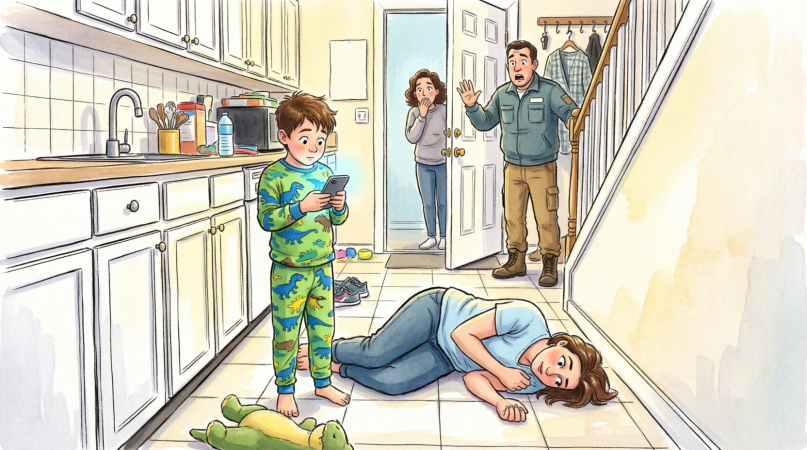
Noah crawled over the tile, picked up the phone, and held it with both hands.
“This is what Grandpa is for,” he said.
His thumb shook as he pressed the contact with the little fishing-boat emoji.
Carl answered on the second ring.
“Hey, bug,” he started, using his nickname for Noah.
But Noah cut him off.
“Grandpa, come now,” he whispered.
There was a silence.
Then Carl’s voice sharpened.
“What happened?”
“Mama can’t breathe.”
Lena closed her eyes.
There were sentences that changed a family forever, and her five-year-old had just spoken one.
“Is she bleeding?” Carl asked.
Noah leaned close and studied her face with heartbreaking seriousness.
“No,” he said. “But she sounds broken.”
Broken.
That was the word Lena had spent years avoiding.
Broken was not tired.
Broken was not private.
Broken was not a rough patch or a hard season or a marriage that needed prayer.
Broken was cold tile under her cheek and her child holding a phone like a lifeline.
“Put the phone by her mouth,” Carl said.
Noah obeyed.
“Lena,” Carl said.
His voice changed then.
It was softer, but not weak.
“Listen to me. Do not move. I’m calling 911 on the other phone. I’m coming too.”
Lena tried to answer.
Only a thin scrape of air came out.
“No talking,” Carl said. “Tap once if Evan did this.”
Lena lifted her finger and tapped the tile once.
The silence that followed was heavy enough to fill the room.
Carl had been a dock foreman for thirty years.
He had seen men crushed by equipment, men cut by cables, men too proud to admit they were hurt until their knees gave out.
He knew what injury sounded like.
He also knew what fear sounded like.
“Noah, buddy,” he said, his voice controlled, “go unlock the front door. Then come right back to your mom. Do not go outside.”
Noah ran.
Lena heard the chain slide.
She heard the deadbolt turn.
She heard his socks slip on the wood near the entryway.
Then she heard an engine outside.
Her body reacted before her mind did.
Her breath caught.
Pain exploded bright and white behind her eyes.
Noah came back into the kitchen with the phone still in his hand.
His lips were trembling.
“Mama,” he said, “Daddy’s truck is in the driveway again.”
The front door opened.
Evan stepped inside.
His boots sounded too loud against the entryway floor.
He had returned without his jacket zipped, without the look of a man who had cooled down.
His eyes went straight to the phone in Noah’s hands.
“Who did you call?” he asked.
Noah backed toward Lena.
The child was small.
The phone looked huge in his hands.
And through the speaker, Carl said, loud and clear, “Me.”
Evan stopped.
It was the first time that night anyone had made him stop.
His eyes shifted from Noah to Lena to the open door behind him.
“You don’t know what happened,” Evan said.
His voice had changed.
The private cruelty had thinned.
That was something Lena would remember later.
Abusers know when an audience enters the room.
They do not become different people.
They become careful people.
“I know my daughter tapped once,” Carl said.
Evan’s jaw tightened.
Noah pressed the phone closer to his chest.
Lena could see the white marks on his little knuckles.
“Give me the phone,” Evan said.
“No,” Noah whispered.
The word was so small it almost disappeared.
But it did not disappear.
Carl heard it.
So did Evan.
Then sirens sounded in the distance.
Not loud yet.
Not close yet.
But coming.
Evan’s face changed again.
“You called the police?” he asked.
“I called everybody,” Carl said.
At 8:31 p.m., while Evan stood in the hallway and Lena lay on the kitchen tile, her phone buzzed with a notification from Tacoma First Credit Union.
New login attempt.
Lena saw the banner because the cracked screen faced the ceiling.
Evan saw it too.
For half a second, his rage gave way to something uglier.
Fear.
Not fear for Lena.
Fear of being documented.
The bank notification mattered later.
So did the 911 recording.
So did Noah’s call log.
So did the neighbor’s doorbell camera, which caught Evan leaving at 8:25 p.m. with Lena’s car keys in his hand and returning six minutes later.
So did the hospital intake form that listed two cracked ribs, facial bruising, and a defensive injury on Lena’s wrist.
At the time, none of those things felt like evidence.
They felt like scattered pieces of a night Lena might not survive.
But Carl was already building a record.
He stayed on the phone until the first officer entered the house.
He told Noah to step back.
He told Lena not to move.
He told Evan, in a voice colder than anything Lena had ever heard from him, “Do not make one more mistake in front of that child.”
Evan turned toward the doorway just as headlights swept across the wall.
Carl arrived before the ambulance.
He did not rush Evan.
He did not swing.
He did not become the kind of man Evan wanted him to become.
He walked through the open door, took one look at his daughter on the floor, and went still.
That stillness frightened Evan more than shouting would have.
The officers separated them.
One stood between Evan and Noah.
Another knelt beside Lena and asked her name, the date, and whether she could take a full breath.
She could not.
Noah kept crying silently until Carl crouched in front of him.
“You did exactly right,” Carl said.
Noah shook his head.
“Daddy said not to cry.”
Carl’s face broke then.
Only for a second.
Then he pulled himself together because Lena needed him whole.
“Crying is not the problem,” he said. “Hurting people is the problem.”
The ambulance ride blurred into ceiling lights, straps, oxygen, and pain that came in waves.
At the hospital, Lena gave her statement in pieces.
A nurse named Maria wrote down what she could say.
An officer photographed the bruise forming along her cheek.
Another officer bagged her shirt because there was blood near the collar where her lip had split.
Carl sat with Noah in the waiting area and let him hold the fishing-boat keychain from his pocket.
Noah would not let go of it.
When the doctor confirmed the cracked ribs, Lena cried for the first time.
Not because of the pain.
Because a medical record now said what she had been too ashamed to say.
Something had broken.
Someone had broken it.
And it had a name.
Evan was arrested that night.
He told the officers Lena had fallen.
He told them she was unstable.
He told them Carl had always hated him.
Then one officer played the 911 audio back in the report room.
Noah’s voice came through first.
“Grandpa, come now. Mama can’t breathe.”
After that, Evan’s story started losing pieces.
The prosecutor later called the evidence unusually clear.
There was the call log.
There was the bank timestamp.
There was the neighbor’s camera.
There was the missing car key ring found in Evan’s jacket pocket.
There was the hospital intake form.
There was Lena’s one-tap answer preserved in Carl’s contemporaneous 911 relay.
And there was Noah.
They did not make him testify in open court.
Lena insisted on that.
No child should have to climb back into the worst room of his life to prove adults failed him.
Instead, the case moved through statements, recordings, medical documentation, and the kind of slow legal process that made Lena feel both protected and exposed.
Evan pleaded down after the recording and video evidence were reviewed.
The court issued a protective order.
Lena received temporary full custody.
Her sister helped her move into Carl’s house for three months.
The first week there, Noah slept on a mattress beside Lena’s bed and woke at every truck sound.
Carl replaced the nightlight in the hallway with one shaped like a moon.
He also installed a new deadbolt, though Lena told him they were safe.
“I know,” he said. “This one is for me.”
Healing did not arrive like a parade.
It arrived like paperwork.
Police reports.
Counseling appointments.
Custody hearings.
A new bank account.
A new phone passcode.
A copy of the protective order folded into the side pocket of Lena’s purse.
It arrived like Noah laughing in the backyard one afternoon and then stopping to ask if laughing too loud was okay.
It arrived like Lena saying, “Yes, baby. In this house, loud is okay.”
Months later, when Lena finally returned to the Tacoma house with Carl and a deputy to collect the rest of her things, the kitchen looked smaller than she remembered.
The tile had been cleaned.
The chair was upright.
The hook by the door was empty.
For a moment, she stood in the same spot where Noah had held the phone.
Her father stood beside her without speaking.
The refrigerator hummed.
The old light buzzed.
Water dripped once in the sink.
Lena waited for shame to rise.
It did not.
What came instead was grief, sharp and clean, followed by something steadier.
Her son had not saved her because he was brave in the way adults praise children for surviving terrible things.
He had saved her because he had been taught that help existed.
That mattered.
For years, Lena had thought silence was the thing keeping her family together.
In the end, silence had been the thing endangering them.
A five-year-old broke it with a phone call.
A grandfather answered.
And a broken woman on a kitchen floor learned that the door out had been there all along.
She just had not been the one strong enough to open it first.
Noah was.
Years later, Lena would still remember the exact words.
“This is what Grandpa is for.”
And every time she heard them in her mind, she no longer heard only terror.
She heard cold tile, a buzzing light, a child’s shaking voice, and the first sound of help coming through the speaker.
She heard the moment broken stopped being the end of her story.
She heard the moment it became evidence.
She heard the moment her son called someone who came…
PART2: A 5-Year-Old Called Grandpa After His Mother Couldn’t Breathe-iwachan
The morning after the arrest, Lena woke to the sound of Noah breathing beside her.
For a moment she forgot where she was.
Then the pain in her ribs reminded her.
Carl’s guest room.
The hospital band still around her wrist.
The protective order folded inside her purse.
Everything came rushing back.
Noah was curled on a mattress beside her bed, clutching the fishing-boat keychain in one hand.
Sunlight slipped through the curtains.
The room smelled like coffee.
Safe.
For the first time in years, safe.
A knock sounded at the door.
Carl stepped inside carrying two mugs.
One coffee.
One hot chocolate.
He handed the chocolate to Noah even though the boy was still asleep.
“Planning ahead,” Carl said quietly.
Lena almost smiled.
Then she noticed the expression on her father’s face.
Something was wrong.



“What happened?” she asked.
Carl set the coffee down.
“The detective called.”
Her stomach tightened.
“What now?”
Carl pulled a small flash drive from his pocket.
“The officers collected evidence from the house.”
Lena stared at it.
“What kind of evidence?”
Carl hesitated.
Then he answered.
“The security camera.”
Lena frowned.
“We don’t have a security camera.”
Carl nodded slowly.
“No. But your neighbor does.”
A cold feeling moved through her chest.
The neighbor’s camera faced part of the driveway.
Part of the front window.
Part of the kitchen.
Not enough to see everything.
Enough to hear.
Lena felt sick.
“What did it record?”
Carl looked away.
For the first time since she was a child, her father seemed unable to meet her eyes.
“It recorded more than one night.”
The room went silent.
Noah stirred in his sleep.
Carl continued carefully.
“The police reviewed several months.”
Lena’s pulse began to pound.
Several months.
Months.
Not one incident.
Not one bad night.
Months.
Carl swallowed.
“They heard him.”
The words landed like stones.
Every insult.
Every threat.
Every time Evan believed nobody was listening.
The camera had listened.
And now the police had too.
Lena closed her eyes.
For years she had worried nobody would believe her.
Now she was terrified they finally would.
Because the recording proved something she had spent years denying.
This had never been an accident.
It had never been anger.
It had been a pattern.
And patterns are much harder to explain away.
Then Carl said something that made her blood run cold.
“That’s not the worst part.”
Lena opened her eyes.
“What do you mean?”
Carl slid a printed photograph across the bed.
A screenshot from the footage.
A date stamp.
Three weeks earlier.
Evan standing beside his truck.
Talking to someone.
A woman.
Not Lena.
Not anyone Lena recognized.
Carl’s voice became very quiet.
“The detective wants to know who she is.”
Because according to the timestamp…
The woman had been visiting the house for months.
PART 3: THE WOMAN IN THE DRIVEWAY
Lena stared at the photograph until the edges blurred.
The woman was standing beside Evan’s truck.
Brown coat.
Dark hair.
A baseball cap pulled low over her eyes.
Nothing about her looked familiar.
Yet there she was.
Outside Lena’s home.
Three weeks before the assault.
“Who is she?” Lena asked.
Carl shook his head.
“The detective hoped you would know.”
Lena looked again.
The timestamp showed a Tuesday afternoon.
2:14 p.m.
She had been at work.
Noah had been at preschool.
Evan had told her he was working overtime.
A sudden memory surfaced.
That same Tuesday, Evan had come home with flowers.
Yellow tulips.
He never bought flowers.
Not after the first year of marriage.
When Lena asked why, he had smiled and said:
“Do I need a reason to do something nice?”
At the time, she had felt guilty for questioning it.
Now the memory made her stomach turn.
The flowers had not been for her.
They had been guilt.
Covering something.
Hiding something.
The detective called an hour later.
His name was Detective Mason Reed.
His voice was calm but direct.
“We identified the woman.”
Lena gripped the phone tighter.
“And?”
There was a pause.
Then:
“Her name is Rachel Harmon.”
The name meant nothing.
“Who is she?”
“According to phone records, she’s been in contact with your husband for eleven months.”
Eleven months.
Lena felt the room tilt.
Almost a year.
Almost a year of lies.
Detective Reed continued.
“They exchanged over four thousand messages.”
Carl muttered something under his breath.
Lena couldn’t speak.
Four thousand.
That wasn’t an affair.
That was another life.
Another relationship.
Another version of Evan she had never seen.
“We also discovered something else,” Reed said.
His tone changed.
The way doctors sound before delivering bad news.
“What?” Lena whispered.
“The woman filed a police report against Evan two years ago.”
The room froze.
Lena sat upright despite the pain.
“What kind of report?”
“Harassment. Threats. Property damage.”
Carl’s jaw tightened.
“But she withdrew it before charges were filed.”
Lena felt cold.
Very cold.
Because suddenly a pattern was appearing.
Not one victim.
Not one story.
Not one bad relationship.
A pattern.
And patterns don’t begin with you.
They begin long before you arrive.
“What does she say happened?” Lena asked.
“She agreed to speak with us.”
The detective paused.
“She says she left him because she became afraid of him.”
Lena closed her eyes.
For seven years she had believed she was somehow failing her marriage.
Too emotional.
Too sensitive.
Too difficult.
That was what Evan always said.
Now a complete stranger was describing the same fear.
The same control.
The same threats.
The same man.
When the call ended, Carl sat beside her.
Neither spoke for a long time.
Finally, Noah wandered into the room carrying his dinosaur.
His eyes moved between the adults.
“Mama?”
Lena forced a smile.
“Yes, baby?”
“Are we staying here forever?”
The question pierced her heart.
Children ask simple questions.
Adults hear complicated answers.
“I don’t know,” she admitted.
Noah nodded thoughtfully.
Then he climbed onto the bed beside her.
“Good.”
“Good?”
He rested his head against her shoulder.
“Because Grandpa’s house feels safer.”
Lena wrapped an arm around him.
Tears burned behind her eyes.
A five-year-old should not know the difference between a safe house and an unsafe one.
But Noah did.
Because Evan had taught him.
And now Lena would spend the rest of her life teaching him something better.
That evening, Detective Reed called again.
His voice sounded urgent.
“We need you to come in tomorrow.”
“Why?”
Another pause.
Then:
“We recovered deleted files from your husband’s laptop.”
Lena felt her pulse jump.
“What kind of files?”
The detective exhaled slowly.
“The kind that suggest the assault on Saturday wasn’t spontaneous.”
Every muscle in Lena’s body went rigid.
“What are you saying?”
The detective’s answer changed everything.
“We believe Evan knew you were planning to leave.”
And according to the recovered messages…
He had been preparing for it.
PART 4: THE PLAN
The next morning, Lena sat in Detective Reed’s office with a paper cup of coffee she couldn’t drink.
The room smelled faintly of printer toner and old carpet.
Carl sat beside her.
Noah was with Lena’s sister across town.
For once, Lena was grateful her son wasn’t hearing any of this.
Detective Reed closed the door.
Then he placed a thick folder on the table.
“Evan’s laptop.”
Lena stared at it.
The black cover looked ordinary.
Harmless.
Like every other laptop in America.
Yet somehow it felt dangerous.
“We recovered several deleted documents,” Reed said.
Carl folded his arms.
“What kind of documents?”
The detective opened the folder.
The first page contained screenshots.
Emails.
Notes.
Spreadsheets.
Lena’s stomach tightened.
Because every document had her name on it.
“What is this?”
Reed slid the papers toward her.
“It’s a timeline.”
“A timeline?”
“For you.”
The words felt unreal.
Lena looked closer.
There were dates.
Appointments.
Phone records.
Work schedules.
Visits with friends.
Bank activity.
Even grocery purchases.
Her hands began shaking.
“Oh my God.”
For years, she had thought Evan simply paid attention.
Now she understood.
He had been tracking her.
Systematically.
Carefully.
Obsessively.
Carl’s face darkened.
“That son of a—”
Reed raised a hand.
“There’s more.”
The next document was worse.
Much worse.
A spreadsheet.
Columns.
Names.
Addresses.
Phone numbers.
Lena recognized them immediately.
Her sister.
Her father.
Her coworkers.
Friends.
Neighbors.
Anyone who might help her.
Anyone who might protect her.
Anyone who might convince her to leave.
“What is this?” Lena whispered.
Reed answered quietly.
“We believe these were people he considered threats.”
Threats.
The word made her feel sick.
Not criminals.
Not enemies.
Family.
People who loved her.
People who cared.
People who made escape possible.
Carl stared at the page.
His own name sat at the top of the list.
Highlighted in red.
For a long moment, nobody spoke.
Then Reed turned another page.
This one contained notes.
Handwritten notes.
Evan’s notes.
Lena recognized his writing instantly.
The sight of it made her skin crawl.
One line had been underlined three times.
IF SHE LEAVES, EVERYTHING CHANGES.
Below it:
NOAH MAKES HER STAY.
Lena stopped breathing.
Carl immediately leaned forward.
“What does that mean?”
The detective’s expression hardened.
“We’re still trying to determine that.”
But Lena already knew.
Deep down, she knew.
Noah wasn’t a child to Evan.
Not in that sentence.
Not in those notes.
He was leverage.
Pressure.
A tool.
A way to control her.
And that realization terrified her more than any bruise ever had.
Reed opened the final section of the folder.
“This is why we asked you to come.”
Inside was a printed email.
Unsent.
Saved as a draft.
Never delivered.
The subject line read:
Emergency Custody Petition
Lena blinked.
“What?”
Reed pointed to the date.
Three days before the assault.
Three days.
Three days before her ribs were cracked.
Three days before Noah made the phone call.
Three days before everything exploded.
The document accused Lena of instability.
Alcohol abuse.
Neglect.
Financial irresponsibility.
Every accusation was false.
Every word was a lie.
Yet the document looked professional.
Prepared.
Ready.
As if someone had spent months building it.
Lena suddenly remembered dozens of strange moments.
Evan taking photos during arguments.
Evan saving screenshots.
Evan encouraging her to have a glass of wine after stressful days.
Evan recording conversations.
Not because he was protecting himself.
Because he was preparing something.
A case.
A story.
A version of reality he intended to sell.
The detective spoke carefully.
“We believe he expected you to leave.”
Lena nodded slowly.
“And?”
Reed met her eyes.
“We believe he intended to take Noah.”
The room went completely silent.
Carl’s chair scraped against the floor.
His hands clenched into fists.
Lena felt cold from head to toe.
Noah.
Everything always came back to Noah.
The money wasn’t about money.
The control wasn’t about control.
The violence wasn’t even about anger.
It was about ownership.
Evan believed people belonged to him.
His wife.
His child.
His house.
His life.
His rules.
And when ownership is threatened…
Some people become dangerous.
Detective Reed closed the folder.
“We requested a deeper search warrant.”
Lena swallowed.
“What else are you looking for?”
The detective hesitated.
Long enough to make her nervous.
Then he answered.
“Storage units.”
Carl frowned.
“Storage units?”
Reed nodded.
“We found monthly payments connected to an account we didn’t know existed.”
Lena felt her pulse jump.
A secret storage unit.
Another secret.
Another hidden part of Evan’s life.
“What do you think is inside?” she asked.
The detective looked down at his notes.
Then back up.
“We don’t know.”
He paused.
“But based on everything we’ve found so far…”
His voice became very quiet.
“We don’t think Evan was planning for a divorce.”
Lena stared at him.
“Then what was he planning for?”
Detective Reed slid a photograph across the table.
A picture taken the previous evening.
The storage unit door had finally been opened.
Inside were dozens of boxes.
Every single one labeled with the same name.
LENA.
And stacked against the back wall…
was a locked metal cabinet the detectives still hadn’t managed to open.
PART 5: THE STORAGE UNIT
The storage facility sat on the edge of Tacoma between a tire warehouse and a fenced construction yard.
Gray metal buildings.
Security cameras.
Rows of numbered doors.
Nothing unusual.
Nothing memorable.
Yet every detective present looked tense.
Lena felt it immediately.
Carl felt it too.
Detective Reed met them outside.
His expression was grim.
“The cabinet is open.”
Lena’s stomach tightened.
“What was inside?”
Reed didn’t answer right away.
Instead, he led them into the unit.
The air smelled like dust and cardboard.
The first thing Lena noticed was the labels.
Every box carried her name.
LENA.
LENA – WORK.
LENA – FAMILY.
LENA – FRIENDS.
LENA – FINANCES.
Years.
Years of records.
Years of observation.
Years of obsession.
Carl stopped beside one box and lifted the lid.
Inside were photographs.
Hundreds of them.
Pictures of Lena shopping.
Lena leaving work.
Lena picking up Noah from preschool.
Lena at family barbecues.
Lena walking through parking lots.
Some photos were so old she barely recognized herself.
Others were recent.
Very recent.
A cold chill traveled through her body.
The photos weren’t memories.
They were surveillance.
Evidence.
Documentation.
Collection.
Someone had been building a file on her.
And that someone had been her husband.
“Jesus,” Carl whispered.
Reed nodded.
“That wasn’t the worst part.”
He pointed toward a folding table near the back wall.
Lena walked closer.
Then stopped.
Her knees nearly gave out.
Because spread across the table was a map.
A giant map of Washington State.
Pinned to it were dozens of notes.
Colored markers.
Photographs.
Addresses.
Dates.
Schedules.
Routes.
Her routes.
Her father’s routes.
Noah’s school routes.
Everywhere they regularly went.
Everywhere they could be found.
Lena felt sick.
This wasn’t anger.
This wasn’t jealousy.
This was planning.
Careful planning.
And suddenly the room felt much smaller.
Detective Reed pointed to one section.
A small town nearly three hours away.
A cabin rental.
Several notes attached.
Lena read one.
QUIET.
NO NEIGHBORS.
CASH ACCEPTED.
Her blood ran cold.
“What is this?”
Reed answered carefully.
“We don’t know yet.”
But everyone in the room knew he was lying.
He had a theory.
A terrible theory.
And he wasn’t ready to say it out loud.
Then another detective emerged from behind the cabinet.
“Reed.”
The room turned.
The detective held a notebook.
Old.
Worn.
Black leather.
“What did you find?” Reed asked.
The detective looked directly at Lena.
Then at Carl.
“We found a journal.”
Silence.
“A journal?”
The detective nodded.
“Seven years.”
Lena’s pulse stopped.
Seven years.
The exact length of her marriage.
The detective opened the notebook.
The pages were filled with Evan’s handwriting.
Thousands of entries.
Thousands.
Page after page.
Observation after observation.
Control after control.
Plan after plan.
Then the detective turned to a marked page.
His expression changed.
Something inside him visibly hardened.
“What is it?” Carl asked.
The detective swallowed.
Then read aloud.
“If Noah ever chooses her side, I will make sure he regrets it.”
The room froze.
Lena couldn’t breathe.
Carl’s face lost all color.
Nobody moved.
Nobody spoke.
The words simply hung there.
Heavy.
Ugly.
Unforgivable.
Then the detective turned another page.
And everything got worse.
Because the next entry had been written the night before the assault.
And it began with six words that made every officer in the room look at each other.
SHE IS RUNNING OUT OF TIME.
PART 6: THE JOURNAL
Detective Reed spent the next two days reading the journal.
Every page.
Every note.
Every entry.
By the third day, he requested additional investigators.
By the fourth, the prosecutor’s office became involved.
By the fifth, Lena received a call asking her to come back to the station.
Immediately.
The request alone frightened her.
Reed normally sounded calm.
Today he sounded urgent.
When Lena arrived, several unfamiliar people occupied the conference room.
Two detectives.
A prosecutor.
A victim advocate.
Stacks of paperwork.
Carl sat beside her.
Nobody smiled.
Nobody made small talk.
Reed closed the door.
Then he placed the journal on the table.
“We need to ask you some questions.”
Lena nodded.
“Okay.”
The detective opened to a page from four years earlier.
“Did your dog disappear?”
The question stunned her.
“What?”
“Your dog.”
Lena stared.
Then a memory surfaced.
Rusty.
Golden retriever.
Friendly.
Gentle.
Noah had loved him.
One day Rusty simply vanished.
Evan told her the dog probably wandered off.
The family searched for weeks.
They never found him.
Tears suddenly filled Lena’s eyes.
“Yes.”
The detective looked down.
Then read from the journal.
“‘Removed distraction. Emotional attachment successfully eliminated.’”
Carl exploded from his chair.
“What?”
Reed stood immediately.
“Carl.”
“No!”
Carl pointed at the notebook.
“What does that mean?”
The room fell silent.
Nobody wanted to answer.
Because everyone was thinking the same thing.
Lena covered her mouth.
Rusty.
Sweet Rusty.
The dog who slept beside Noah’s crib.
The dog who disappeared without a trace.
The detective slowly turned another page.
“Did your sister stop visiting for a while?”
Lena blinked.
“Yes.”
Three years ago.
Her sister suddenly became distant.
Cancelled visits.
Stopped calling.
Avoided family gatherings.
Then one day everything returned to normal.
No explanation.
No reason.
The detective read another passage.
“‘Convinced sister I was protecting Lena. Relationship disruption successful.’”
Carl cursed under his breath.
The prosecutor looked sick.
One page.
One page after another.
Every relationship.
Every friendship.
Every support system.
Evan had been attacking them quietly for years.
Separating Lena from help.
Separating Lena from safety.
Separating Lena from reality.
The journal wasn’t just evidence.
It was a blueprint.
A record of psychological warfare.
And then Reed reached the entry that changed the entire case.
His hand stopped.
The room became very quiet.
“What?” Lena asked.
Nobody answered.
“What is it?”
The prosecutor looked at Reed.
Reed looked at the prosecutor.
Finally he spoke.
“This entry references another woman.”
Rachel.
The woman from the driveway.
Lena felt her pulse jump.
“What about her?”
Reed slid a photograph across the table.
Lena immediately recognized Rachel Harmon.
But she looked younger.
Happier.
Unaware.
The photo was dated nearly ten years ago.
Before Lena.
Before Noah.
Before everything.
Then Reed read a sentence from the journal.
“‘Rachel escaped. I won’t make that mistake again.’”
Lena felt ice move through her veins.
Escape.
Not leave.
Escape.
A single word.
One word.
And suddenly Rachel’s old police report felt much more important.
Much more dangerous.
Much more unfinished.
Then Reed delivered the news that changed everything.
“We found Rachel.”
Lena sat forward.
“Where?”
The detective took a breath.
“She agreed to meet you.”
The room fell silent.
Because for the first time…
Someone else was finally ready to tell the truth about Evan.
PART 7: RACHEL’S STORY
Rachel Harmon arrived carrying a thick folder.
Nothing else.
No purse.
No coffee.
No small talk.
Just the folder.
The moment Lena saw her, she understood something.
Rachel wasn’t nervous.
Rachel was tired.
The kind of tired that comes from carrying fear for years.
They sat across from each other.
For a long moment neither spoke.
Then Rachel looked directly at Lena.
“I’m sorry.”
Lena blinked.
“For what?”
Rachel’s eyes filled with tears.
“For not finding you sooner.”
The room went silent.
Rachel opened the folder.
Inside were photographs.
Emails.
Messages.
Police reports.
Restraining-order paperwork.
Everything carefully organized.
Everything documented.
Everything familiar.
Because it was the same story.
Different victim.
Same man.
“He tracked me.”
Photo.
“He isolated me.”
Document.
“He controlled my money.”
Bank record.
“He threatened people I loved.”
Police report.
One item after another.
One year after another.
The pattern became impossible to ignore.
Then Rachel removed a final photograph.
Her hands shook.
Lena looked down.
And froze.
The picture showed a little girl.
Maybe six years old.
Smiling.
Holding a bicycle.
Dark hair.
Bright eyes.
Happy.
“Who is she?”
Rachel stared at the photograph.
For several seconds she couldn’t speak.
When she finally did, her voice cracked.
“My daughter.”
Lena frowned.
“What does she have to do with Evan?”
Rachel’s tears began falling.
Because the answer was something nobody in the room expected.
Rachel whispered:
“She disappeared three months after I left him.”
Every person in the room went still.
The detectives.
The prosecutor.
Carl.
Everyone.
Rachel closed her eyes.
“The police never connected him.”
Lena felt her heart pounding.
“But you think—”
“I know.”
Rachel’s voice was steady now.
Terrifyingly steady.
“I know what he did.”
The room fell completely silent.
Because suddenly this wasn’t just a story about domestic violence anymore.
This was becoming something far darker.
And for the first time since the arrest…
Detective Reed looked genuinely afraid of what they might uncover next…
PART3: A 5-Year-Old Called Grandpa After His Mother Couldn’t Breathe-iwachan
PART 8: THE PHOTOGRAPH
Nobody spoke for several seconds after Rachel’s words.
The little girl in the photograph seemed to stare back at them.
Smiling.
Alive.
Unaware.
Rachel carefully wiped her eyes.
“Her name was Emily.”
Was.
Not is.
Lena felt a knot tighten in her stomach.
“What happened?” she asked softly.
Rachel looked down at the picture.
“She vanished.”
Detective Reed leaned forward.
“You told us before that the case went cold.”
Rachel nodded.
“It did.”
“Then why are you so certain Evan was involved?”
Rachel slowly reached into the folder.
She removed another photograph.
Then another.


Then another.
The room fell silent.
Each picture showed the same thing.
Emily.
But she wasn’t alone.
In the background of one photograph stood a familiar truck.
In another, a familiar jacket.
In another, a familiar face.
Evan.
Not clearly.
Not enough for an arrest.
But enough to raise questions.
A lot of questions.
Rachel’s voice trembled.
“I reported every single one of these.”
The prosecutor studied the photos.
“The police dismissed them.”
“They said I was obsessed.”
Rachel laughed bitterly.
“They said I couldn’t accept the breakup.”
Carl’s jaw tightened.
Reed remained silent.
Rachel continued.
“Then Emily disappeared.”
Nobody interrupted.
“Three months later, I received a package.”
Lena’s pulse jumped.
“A package?”
Rachel nodded.
“No return address.”
“What was inside?”
Rachel swallowed.
Then reached into the folder one last time.
A drawing.
Crayons.
Construction paper.
A child’s drawing.
A little girl holding hands with a man.
The drawing was signed.
Emily.
And on the back, written in black marker, were six words.
YOU SHOULD HAVE STAYED QUIET.
The room went cold.
Every detective exchanged looks.
Because this wasn’t evidence of a bad marriage.
This was evidence of terror.
Years of it.
And suddenly everyone understood why Rachel had never stopped being afraid.
Then Detective Reed spoke.
“What happened to the drawing afterward?”
Rachel stared at him.
“I kept it.”
“Why?”
Rachel’s answer chilled the room.
“Because it smelled like Evan’s cologne.”
PART 9: THE SEARCH WARRANT
The next forty-eight hours changed everything.
The prosecutor requested additional warrants.
Additional investigators.
Additional resources.
No longer because of Lena.
No longer because of Rachel.
Because of patterns.
Patterns create cases.
And the deeper investigators looked, the more patterns they found.
By Friday afternoon, Detective Reed returned to the storage unit.
This time with a forensic team.
Every box was opened.
Every document cataloged.
Every photograph examined.
Hundreds of items.
Thousands of pages.
Then one investigator discovered something unusual.
A false bottom inside one of the boxes.
The box was labeled:
LENA – FINANCES.
Inside the hidden compartment was a flash drive.
Tiny.
Black.
Ordinary.
Yet the moment Reed plugged it into a forensic computer, the room became silent.
Folders.
Dozens of them.
Names.
Dates.
Locations.
Victims.
The word victims made Reed stop breathing for a second.
Victims.
Plural.
Not Rachel.
Not Lena.
Plural.
The first folder contained Rachel’s name.
The second contained Lena’s.
The third contained a woman nobody recognized.
Then a fourth.
Then a fifth.
And a sixth.
Six different women.
Six separate files.
Each containing photographs.
Schedules.
Financial information.
Family contacts.
Work records.
Personal notes.
Years of surveillance.
Years.
One investigator whispered:
“My God.”
Reed agreed.
Because suddenly the case was becoming much larger than anyone imagined.
Then they opened the final folder.
Unlike the others, it had no woman’s name.
Only one word.
NEXT.
Nobody touched the keyboard.
Nobody spoke.
Finally Reed clicked.
The folder opened.
Inside was a single photograph.
The picture showed a smiling woman pushing a stroller through a grocery store parking lot.
The photo had been taken only three weeks earlier.
Someone had circled her face in red.
And beneath it were three typed words.
POTENTIAL CANDIDATE IDENTIFIED.
The room went completely silent.
Because the implications were horrifying.
Evan hadn’t stopped.
He wasn’t finished.
He had already started looking for someone new.
PART 10: NOAH’S NIGHTMARE
While detectives worked the case, Noah fought a different battle.
The nightmares began two weeks after the arrest.
At first they came quietly.
A cry in the middle of the night.
A sudden wake-up.
A frightened whisper.
Then they became worse.
One night Lena woke to find him standing beside her bed.
Not crying.
Just standing there.
Frozen.
His dinosaur hanging from one hand.
“Noah?”
He looked at her.
Wide eyes.
Terrified eyes.
“Mama?”
“Yes, baby.”
His voice shook.
“What if Daddy finds us?”
The question hit harder than any broken rib.
Lena sat up slowly.
Pain still lingered in her side.
But this hurt more.
She lifted him into bed.
Noah immediately wrapped both arms around her.
Like he needed proof she was real.
Like he needed proof she was still there.
“He won’t find us.”
Noah didn’t answer.
Children know when adults are guessing.
After a moment he whispered:
“I heard him.”
Lena froze.
“What do you mean?”
Noah buried his face against her shoulder.
“The night before.”
A chill moved through her body.
“The night before what?”
“The night before he hurt you.”
Lena stopped breathing.
Because she suddenly remembered.
The storage-unit journal.
The planning.
The notes.
The timeline.
“What did you hear, sweetheart?”
Noah’s voice became tiny.
“I was supposed to be asleep.”
Lena held him tighter.
“But I wasn’t.”
The room felt very still.
Very quiet.
Then Noah whispered something that changed everything.
“I heard Daddy talking on the phone.”
Lena’s heart pounded.
“What did he say?”
Noah closed his eyes.
Trying to remember.
Trying to be brave.
Finally he answered.
“He said if you left, he would make sure nobody ever found us.”
Silence.
Absolute silence.
Lena felt every drop of blood drain from her face.
Noah continued.
“I thought he meant a game.”
A tear rolled down his cheek.
“But now I don’t think it was a game.”
Lena couldn’t speak.
Couldn’t breathe.
Couldn’t move.
Because somewhere across Tacoma, Detective Reed was investigating a missing child case connected to Evan.
And now her five-year-old son had just remembered a threat that suddenly sounded far more serious than anyone wanted to believe.
The next morning, Lena called Detective Reed.
She told him everything Noah remembered.
There was a long pause on the line.
Then Reed quietly said:
“Don’t leave your father’s house today.”
Lena’s stomach dropped.
“Why?”
The detective’s answer terrified her.
“Because we found something in Evan’s phone.”
A pause.
Then:
“And I think someone has been watching the house.”
PART 11: THE WATCHER
Lena did not sleep after Detective Reed’s warning.
She sat at Carl’s kitchen table long after sunrise, staring through the window above the sink.
The coffee in her mug had gone cold.
Outside, the neighborhood looked normal.
A mail carrier.
A dog walker.
A teenager riding a bike.
Normal.
But normal had stopped meaning safe a long time ago.
Carl noticed immediately.
“You’ve checked that window six times.”
Lena looked away.
“Seven.”
Carl sighed.
“Reed’s got you scared.”
“No.”
Carl raised an eyebrow.
“Then why are you counting strangers?”
Before Lena could answer, a black SUV rolled slowly past the house.
Not speeding.
Not stopping.
Just rolling.
Slow enough to notice.
Too slow to ignore.
Both of them watched it.
Neither spoke.
The SUV disappeared around the corner.
Then Carl quietly stood up.
“Stay here.”
Lena already knew that tone.
The retired dock foreman was about to investigate.
Ten minutes later he returned.
His expression was unreadable.
“What happened?”
Carl sat down.
“The SUV is parked three streets over.”
Lena felt her stomach tighten.
“And?”
“Nobody inside.”
Silence.
“Maybe it’s nothing.”
Carl didn’t answer.
That frightened her more.
Because Carl was not a man who frightened easily.
Then his phone rang.
Detective Reed.
Carl answered immediately.
“Tell me.”
He listened.
His face hardened.
Then he said:
“Understood.”
When he hung up, Lena already knew she wouldn’t like the answer.
“What happened?”
Carl looked directly at her.
“The SUV belongs to someone connected to Evan.”
The room went cold.
“Who?”
“A private investigator.”
Lena blinked.
“What?”
Carl nodded.
“A licensed private investigator.”
Nothing made sense.
Why would Evan hire a private investigator?
Then Carl spoke the words that changed everything.
“He hired her eight months ago.”
Eight months.
Months before the assault.
Months before the storage unit.
Months before the arrest.
Months before Lena had even opened the seventy-three-dollar savings account.
Someone had been watching her.
Long before she realized she needed to escape.
And according to Detective Reed…
The investigator wasn’t cooperating.
PART 12: THE INVESTIGATOR
Her name was Dana Pierce.
Forty-two years old.
Former insurance investigator.
No criminal history.
No obvious connection to Evan.
Yet her name appeared dozens of times in his records.
Phone logs.
Payments.
Emails.
Photographs.
Detective Reed laid everything across the conference table.
Lena stared at the files.
“She followed me?”
Reed nodded.
“For months.”
The realization made Lena feel sick.
Someone had photographed her.
Tracked her.
Recorded her movements.
Not because they hated her.
Because they were being paid.
Carl folded his arms.
“Has she been arrested?”
“No.”
“Why not?”
Reed sighed.
“Because technically she believed she was conducting surveillance for a custody dispute.”
The room fell silent.
A custody dispute.
Evan had lied to her too.
The detective slid another document across the table.
Dana’s original contract.
The purpose listed on the paperwork made Lena’s stomach drop.
DOCUMENT EVIDENCE OF MATERNAL INSTABILITY.
Carl muttered a curse.
Lena looked down.
Every photograph.
Every report.
Every note.
All designed to create one story.
One narrative.
One lie.
The unstable mother.
The concerned father.
The child needing protection.
The plan had been building for nearly a year.
Then Reed opened a separate folder.
“This is where things get interesting.”
Inside were emails.
Hundreds of emails.
Most were routine.
Surveillance updates.
Schedules.
Locations.
Observations.
Then one stood out.
Reed tapped it.
“Read this.”
Lena did.
Halfway through, her heart nearly stopped.
The email wasn’t from Dana.
It was to Dana.
From Evan.
The message contained only one sentence.
IF SOMETHING HAPPENS, DELETE EVERYTHING.
The room became silent.
Carl leaned forward.
“When was that sent?”
Reed checked his notes.
“The morning of the assault.”
Lena felt ice move through her veins.
The morning.
Not after.
Before.
As if Evan already knew something was coming.
As if he expected consequences.
As if he knew exactly how dangerous his plans had become.
Then Reed spoke carefully.
“We interviewed Dana yesterday.”
Lena looked up.
“And?”
The detective hesitated.
Long enough to worry her.
Then:
“She says she quit.”
“When?”
“Two weeks before the assault.”
That made no sense.
“Why?”
Reed handed Lena a transcript.
One highlighted sentence immediately caught her eye.
I THOUGHT HE WANTED CUSTODY.
I REALIZED HE WANTED OWNERSHIP.
The room went completely silent.
Because there is a difference.
A very important difference.
And Dana Pierce had recognized it before anyone else.
Then Reed revealed the part she hadn’t told investigators publicly.
The part that made everyone uneasy.
The part that kept him awake at night.
Dana believed Evan wasn’t working alone.
PART 13: THE SECOND PHONE
Detective Reed found the second phone by accident.
Most criminals hide things.
Evan archived things.
Organized things.
Documented things.
That habit was finally destroying him.
The phone was discovered during a forensic search of the storage-unit inventory.
Old model.
Cheap.
Prepaid.
Hidden inside a toolbox.
At first investigators assumed it was irrelevant.
Then they powered it on.
The contact list contained only four numbers.
Rachel.
Dana.
An unknown number.
And one contact labeled simply:
M.
Nothing else.
No last name.
No details.
Just M.
Reed immediately requested records.
Within hours they discovered something strange.
The unknown number belonged to nobody.
Burner phone.
Discarded.
Gone.
But M remained active.
Very active.
Hundreds of calls.
Hundreds.
Many lasting over an hour.
Often late at night.
Often after incidents involving Rachel.
After arguments involving Lena.
After key events in the journal.
Whoever M was, they mattered.
A lot.
Lena sat across from Reed while he explained everything.
“Do you know anyone whose name starts with M?”
She thought.
Friends.
Coworkers.
Family.
Neighbors.
Nothing fit.
Then a memory surfaced.
Tiny.
Almost forgotten.
“Megan.”
Reed looked up.
“Who’s Megan?”
Lena swallowed.
“Evan’s mother.”
The room went silent.
Carl immediately sat forward.
“No.”
But Lena was already thinking.
Thinking about family dinners.
Thinking about excuses.
Thinking about the way Megan always defended Evan.
The way she blamed stress.
Blamed work.
Blamed misunderstandings.
Blamed everyone except him.
Every single time.
Reed slowly opened a file.
Then turned it around.
Phone records.
Address records.
Bank records.
One line had been highlighted.
Megan Turner had paid the rental fees on the storage unit for three years.
Three years.
The room became perfectly still.
Carl’s face darkened.
Lena felt her pulse racing.
Because suddenly an awful possibility emerged.
What if Megan knew?
Not everything.
Not every detail.
But enough.
Enough to help.
Enough to hide things.
Enough to look away.
Then Reed spoke quietly.
“We’re bringing her in.”
Lena nodded slowly.
“When?”
The detective checked his watch.
“She’s already here.”
And down the hallway, behind a closed interview-room door…
Evan’s mother had just begun talking.
PART 14: MEGAN’S INTERVIEW
Megan Turner did not look like a criminal.
She looked like a grandmother.
Gray sweater.
Neatly styled hair.
Reading glasses hanging from a chain around her neck.
The kind of woman who brought casseroles to church potlucks.
The kind of woman neighbors trusted.
The kind of woman nobody would suspect.
Detective Reed sat across from her in Interview Room Three.
A recorder rested on the table between them.
Megan folded her hands.
Calm.
Controlled.
Prepared.
“You understand why you’re here?” Reed asked.
“Because my son is in trouble.”
“Your son is charged with felony assault.”
Megan sighed.
“As I said. Trouble.”
Reed watched her carefully.
Most parents panicked.
Most parents cried.
Most parents demanded explanations.
Megan did none of those things.
Instead, she seemed annoyed.
As though the entire situation was inconvenient.
Reed slid a photograph across the table.
The storage unit.
The boxes.
The evidence.
The receipts.
“Your name appears on the rental agreement.”
Megan adjusted her glasses.
“Yes.”
“Why?”
“My son asked me to help.”
“And you didn’t ask questions?”
She shrugged.
“He said he was protecting himself.”
“From whom?”
A pause.
Then:
“His wife.”
The answer hung in the room.
Reed studied her.
Not the words.
The certainty.
The absolute certainty.
Megan believed it.
Or wanted to.
“What exactly did he tell you?”
Again, she answered without hesitation.
“He said Lena was unstable.”
The detective opened a file.
Hospital records.
Police reports.
Photographs.
Medical documentation.
Everything.
He spread them across the table.
Then he asked quietly:
“Does this look unstable to you?”
For the first time, Megan looked uncomfortable.
Only briefly.
Then it vanished.
“He said she hurt herself.”
Reed leaned back.
There it was.
The lie.
The same lie.
The same story.
The same excuse.
Years of it.
Then he asked the question that mattered.
“When did your son start lying to you?”
Megan’s face changed.
A tiny change.
Almost invisible.
But Reed saw it.
Because suddenly she wasn’t defending Evan.
She was remembering him.
And that frightened her.
Then she whispered something so softly he almost missed it.
“He was thirteen.”
Reed sat forward.
“What happened when he was thirteen?”
The older woman closed her eyes.
And for the first time during the interview…
She looked afraid.
PART 15: THE FIRST INCIDENT
Megan stared at the table for nearly a minute.
The recorder continued running.
The room remained silent.
Finally, she spoke.
“There was a dog.”
Detective Reed waited.
“A neighbor’s dog.”
The words came slowly.
Painfully.
As though she had buried them years ago.
“It disappeared.”
Reed’s stomach tightened.
Because he already knew another dog had disappeared.
Rusty.
Noah’s golden retriever.
“What happened?” he asked.
Megan swallowed.
“Evan said he found it injured.”
The detective remained silent.
“He told us he tried to help.”
A pause.
“He lied.”
The room felt colder.
Megan’s eyes filled with tears.
Real tears.
The first genuine emotion Reed had seen from her.
“When we found the dog…”
Her voice broke.
“…it wasn’t injured.”
Silence.
Absolute silence.
The detective suddenly understood why she had never spoken about this before.
Because saying it out loud made it real.
“What happened after that?”
“We sent him to counseling.”
Reed nodded.
“And?”
“He charmed the counselor.”
Of course he did.
Megan laughed bitterly.
“He charmed everyone.”
Teachers.
Neighbors.
Coaches.
Girlfriends.
Employers.
Everyone.
Everyone except the people who lived with him.
Because they saw the version nobody else saw.
The private version.
The calculating version.
The version that kept score.
Then Megan said something that made Reed’s pulse jump.
“There was another incident.”
“What kind?”
She looked down.
“A girl.”
The detective froze.
A girl.
Not Rachel.
Not Lena.
Someone earlier.
Much earlier.
“What happened?”
Megan’s answer came in a whisper.
“She disappeared.”
The room became completely silent.
“What do you mean disappeared?”
“We never knew.”
The detective leaned forward.
“What was her name?”
Megan closed her eyes.
Trying to remember.
Then she opened them.
And spoke two words that immediately changed everything.
“Emily’s mother.”
The world seemed to stop.
Because Rachel had told them Emily disappeared years later.
But now another girl had vanished before Rachel ever entered Evan’s life.
And suddenly the pattern stretched much further back than anyone imagined…
PART4: A 5-Year-Old Called Grandpa After His Mother Couldn’t Breathe-iwachan
PART 16: THE BOX IN THE ATTIC
That night, Megan called Detective Reed.
At 11:43 p.m.
Her voice sounded shaken.
Different.
Not defensive.
Not angry.
Terrified.
“I remembered something.”
Reed sat upright immediately.
“What?”
“A box.”
Silence.
“What box?”
“My husband’s attic.”
Reed grabbed a pen.
Megan continued.
“When Evan left for college, his father found something.”
The detective listened carefully.
“What?”
“We argued about it.”
A pause.
“He wanted to call the police.”
The room seemed to shrink.
“What was inside the box?”


Megan’s breathing became audible.
As though simply remembering was difficult.
“Photographs.”
Reed froze.
Not again.
Please not again.
But Megan wasn’t finished.
“There were notebooks too.”
His pulse quickened.
“About who?”
“Girls.”
Silence.
Complete silence.
The detective slowly stood from his chair.
“What happened to the box?”
Megan’s answer arrived immediately.
“My husband burned it.”
Reed closed his eyes.
Evidence.
Gone.
Destroyed.
Years ago.
Yet one detail bothered him.
“Why are you telling me this now?”
Megan didn’t answer immediately.
When she finally spoke, her voice trembled.
“Because I found another one.”
Reed’s heart stopped.
“What?”
“A second box.”
The detective stared at the wall.
Notebooks.
Photographs.
Records.
Again.
How many times had this happened?
How many times had people looked away?
Then Megan whispered:
“It has Noah’s name on it.”
The detective was already reaching for his keys.
Because whatever was inside that box…
He needed to see it before anyone else did.
PART 17: NOAH’S BOX
Detective Reed arrived at Megan Turner’s house at 12:21 a.m.
Two patrol officers arrived with him.
Not because he expected trouble.
Because he no longer trusted surprises.
Megan met them at the door.
She looked exhausted.
Older than she had that morning.
As though every secret she carried was finally demanding payment.
“The attic,” she said quietly.
No one wasted time.
The attic access was in the hallway ceiling.
A folding ladder dropped down with a metallic clatter.
Dust drifted through the air.
The smell of old insulation filled the house.
Megan climbed first.
Then Reed.
Then one of the officers.
The attic wasn’t large.
Just storage.
Christmas decorations.
Old furniture.
Boxes covered in years of dust.
But one box stood apart.
Newer cardboard.
Newer tape.
And written across the side in black marker:
NOAH.
Nobody spoke.
Reed knelt beside it.
His stomach tightened.
Carefully, he cut the tape.
The lid opened.
Inside were photographs.
Dozens.
Noah at preschool.
Noah at the playground.
Noah at Carl’s house.
Noah eating ice cream.
Noah sleeping in the back seat of a car.
The detective felt sick.
These weren’t family photos.
They were surveillance photos.
Collected.
Organized.
Cataloged.
Underneath them sat a notebook.
Reed opened it.
Page one.
NOAH TURNER.
AGE: 5.
LIKES:
DINOSAURS.
PEANUT BUTTER TOAST.
GRANDPA CARL.
The detective stopped breathing.
Because it wasn’t a father’s scrapbook.
It was a profile.
A file.
A study.
Every page contained observations.
Habits.
Routines.
Preferences.
Fears.
Weaknesses.
One section had been highlighted.
COMFORT OBJECTS.
The list included Noah’s stuffed dinosaur.
His moon-shaped nightlight.
His fishing-boat keychain.
Every source of comfort.
Every source of security.
The room grew colder.
Then Reed turned another page.
And found something worse.
A hand-drawn map.
Carl’s property.
Every entrance.
Every window.
Every exterior door.
Every camera location.
The officers exchanged looks.
Nobody needed to say it.
This wasn’t preparation for custody.
This was preparation for access.
Then Reed found the final page.
Only one sentence had been written there.
If necessary, separate child first.
The attic fell silent.
Because suddenly everyone understood.
The box wasn’t about Noah.
The box was about taking Noah.
And somewhere in a jail cell across Tacoma…
Evan still believed he would get the chance.
PART 18: THE VISITOR
The next afternoon, Carl answered a knock at the door.
Three sharp knocks.
Nothing unusual.
Yet something about them felt wrong.
Carl opened the door halfway.
A woman stood outside.
Mid-sixties.
White hair.
Nervous eyes.
A leather purse clutched tightly against her chest.
“Can I help you?” Carl asked.
The woman looked past him.
Toward the house.
Toward the hallway.
Toward the place where Noah was watching cartoons.
Then she whispered:
“I need to speak to Lena.”
Carl immediately became cautious.
“About what?”
The woman’s eyes filled with tears.
“About Evan.”
Inside the house, Lena heard her name.
A few moments later they sat together at the kitchen table.
The woman introduced herself.
“Patricia Mills.”
The name meant nothing.
Until she added:
“I was married to Evan’s father.”
Silence.
Carl sat straighter.
Lena stared.
“You were his stepmother?”
Patricia nodded.
For several seconds nobody spoke.
Then Patricia reached into her purse.
And removed a thick envelope.
Yellowed.
Old.
Years old.
She pushed it across the table.
Lena opened it carefully.
Inside were letters.
Court documents.
Therapy records.
Police reports.
The dates stretched back nearly twenty years.
“What is this?” Lena asked.
Patricia looked down.
“The history nobody wanted to talk about.”
Carl exchanged a glance with Lena.
Patricia continued.
“Evan didn’t become this way overnight.”
Her voice shook.
“He learned things.”
The room became very still.
“From who?” Lena asked.
Patricia looked away.
Then answered.
“His father.”
Silence.
Absolute silence.
Because suddenly a possibility emerged.
A terrible possibility.
Patterns.
Again.
Patterns.
Not beginning with Evan.
Beginning before him.
Patricia swallowed.
Then added:
“There was another woman before Rachel.”
Lena’s pulse jumped.
“What happened to her?”
Patricia closed her eyes.
When she opened them again, they were full of regret.
“Nobody knows.”
The room went cold.
Because that was now the third missing woman connected to the same family.
And Detective Reed was beginning to realize this case might be far older than anyone imagined.
PART 19: THE LETTER
Among the papers Patricia brought, one item immediately caught Detective Reed’s attention.
A sealed envelope.
Unopened.
Addressed to:
TO WHOEVER FINALLY LISTENS.
The handwriting belonged to Evan’s father.
The envelope had been hidden among old documents for nearly eighteen years.
Nobody knew it existed.
Until now.
Reed opened it carefully.
Inside was a four-page letter.
The first sentence made his blood run cold.
If my son ever hurts someone, this is why.
The room became silent.
Patricia covered her mouth.
Carl leaned forward.
Lena felt her pulse pounding.
Reed continued reading.
The letter described years of troubling behavior.
Manipulation.
Cruelty.
Obsession.
Control.
Lying.
Tracking.
Threatening.
The exact same behaviors appearing decades later in Evan.
Then the letter reached a section highlighted in red ink.
I found photographs.
Hundreds of photographs.
The room froze.
Again.
Photographs.
Always photographs.
The letter continued.
I found journals.
Lists.
Schedules.
Maps.
Plans.
Everything.
Patricia began crying.
Because the similarities were undeniable.
Evan hadn’t copied his father accidentally.
He had copied him perfectly.
Then Reed reached the final paragraph.
And suddenly his voice stopped.
“What?” Lena asked.
Nobody answered.
“What does it say?”
The detective slowly looked up.
His face had gone pale.
Because the last paragraph contained a name.
A name nobody expected.
A name connected to a woman who disappeared twenty-three years earlier.
And according to the letter…
She wasn’t missing.
At least not when the letter was written.
She was hiding.
From Evan’s father.
And she had left behind something that could expose the entire family.
PART 20: THE NAME IN THE LETTER
The name was Sarah Whitmore.
Nobody in the room recognized it.
Not Lena.
Not Carl.
Not Patricia.
Yet Detective Reed couldn’t stop staring at the page.
Because beside Sarah’s name was an address.
Not current.
Not complete.
But enough.
An old rural route outside Olympia.
Twenty-three years old.
The kind of lead investigators usually dismissed.
Too old.
Too cold.
Too dead.
But this case had stopped behaving normally weeks ago.
Reed folded the letter carefully.
“Find her.”
One of the detectives nodded.
“You really think she’s alive?”
Reed looked at the letter.
Then at Patricia.
Then at Lena.
“I think somebody wanted us to find her.”
Three days later, they did.
Sarah Whitmore was sixty-two years old.
Living under a different last name.
In a small coastal town nearly two hours away.
When Detective Reed called her, she hung up immediately.
When he called again, she threatened to contact an attorney.
When he mentioned Evan Turner’s name…
The line went silent.
Then Sarah whispered:
“Is he dead?”
Reed’s pulse jumped.
“No.”
A long pause.
Then:
“Then I don’t want to talk.”
But before she disconnected, Reed managed to ask one final question.
“Did Evan’s father ever hurt you?”
Sarah’s answer came instantly.
“Every day.”
Then she hung up.
The next morning she agreed to meet.
And when she arrived carrying a locked metal case…
Detective Reed realized she had been waiting twenty-three years for someone to ask.
PART 21: SARAH’S EVIDENCE
The metal case looked ordinary.
Scuffed.
Old.
Heavy.
Sarah placed it on the conference-room table.
Then rested both hands on top of it.
As if she had spent years protecting whatever was inside.
“Nobody believed me,” she said quietly.
The room remained silent.
“Not the police.”
Not the courts.
Not neighbors.
Not family.
Nobody.
Sarah looked at Lena.
Then at Rachel.
Then at the photograph of Noah sitting on the table beside Detective Reed’s notes.
Her eyes softened.
“He has a son now?”
Lena nodded.
“Five.”
Sarah closed her eyes.
For a moment she looked heartbroken.
Then she opened the case.
Inside were journals.
Photographs.
Cassette tapes.
Letters.
Receipts.
Dozens of items.
Years of documentation.
Years.
The room became perfectly still.
Because everyone was seeing the same thing.
History repeating itself.
Again.
And again.
And again.
Sarah pulled out one particular journal.
“This belonged to his father.”
Patricia immediately recognized it.
“Oh my God.”
The handwriting.
The cover.
The initials.
No doubt.
It was genuine.
Sarah carefully opened it.
The pages were filled with names.
Women’s names.
Dates.
Locations.
Observations.
Patterns.
Exactly like Evan’s journals.
Exactly.
Lena felt chills run through her body.
Because suddenly she wasn’t looking at one dangerous man.
She was looking at a legacy.
Then Sarah turned to a marked page.
And revealed the entry that changed everything.
One line had been circled.
TWENTY YEARS OLD. EASY TO ISOLATE.
The room fell silent.
Because that wasn’t a relationship.
It wasn’t love.
It wasn’t even obsession.
It was selection.
Targeting.
Predation.
And suddenly Detective Reed understood why Sarah had carried this case for twenty-three years.
She wasn’t preserving memories.
She was preserving warnings.
PART 22: THE TAPE
The cassette tape looked ancient.
Yellow label.
Handwritten date.
Faded ink.
Sarah carefully held it up.
“I never played this for anyone.”
Detective Reed frowned.
“Why not?”
Sarah laughed bitterly.
“Because I was afraid.”
Nobody judged her.
Nobody blamed her.
Fear had already shaped too many lives in this room.
A technician located an old tape player.
The machine clicked.
Whirred.
Then began playing.
Static.
More static.
Then voices.
A man.
A woman.
The room became silent.
Because everyone immediately recognized the man.
Evan’s father.
Older.
Calm.
Dangerously calm.
The woman sounded terrified.
The recording quality was poor.
But one sentence came through clearly.
“You don’t own me.”
Silence.
Then the man’s response.
Cold.
Controlled.
Chilling.
“If I can’t have you, nobody will.”
Lena felt her blood run cold.
Rachel closed her eyes.
Sarah stared at the table.
Because she had heard those words before.
Not from the father.
From the son.
Different voice.
Same message.
The tape continued.
The argument grew louder.
Then suddenly ended.
A door slammed.
Footsteps.
Silence.
The recording stopped.
Nobody moved.
Nobody spoke.
Then Detective Reed noticed something.
A date.
Written on the label.
His heart nearly stopped.
Because the recording was made three days before a woman disappeared.
Three days.
Exactly three.
The same timing that appeared over and over in Evan’s journals.
Three days before Rachel left.
Three days before Lena opened the savings account.
Three days before violence.
Three days before escalation.
A pattern.
Again.
Always the pattern.
Then the technician spoke.
“There’s more.”
Everyone looked up.
The tape wasn’t finished.
There was another recording hidden on the reverse side.
And according to the label…
It had been recorded twenty years later.
By someone else.
Someone with the last name Turner.
PART 23: SIDE B
Nobody spoke while the technician flipped the cassette.
The room felt smaller.
He pressed PLAY.
For several seconds, only static filled the speaker.
Then a voice appeared.
Young.
Male.
Uneasy.
Lena immediately felt a chill.
Because she knew that voice.
Evan.
Not the Evan she married.
Not the polished adult version.
Younger.
Maybe eighteen.
Maybe nineteen.
The recording quality crackled.
Then his voice became clear.
“If somebody finds this, I need them to know I tried.”
The room froze.
Rachel looked up.
Carl frowned.
Detective Reed leaned forward.
Nobody had expected this.
Not a threat.
Not a confession.
A warning.
The tape continued.
“He says I’m weak.”
Static.
“He says I think too much.”
Another pause.
Then:
“I found the journals.”
Silence.
Absolute silence.
Patricia covered her mouth.
The voice on the tape sounded scared.
Actually scared.
The kind of fear nobody had ever associated with Evan.
Then came another sentence.
One that changed everything.
“I think my father hurt those women.”
The room went still.
Because this wasn’t the voice of a predator.
It was the voice of a witness.
A witness twenty years ago.
The tape continued.
“If anything happens to me…”
Static swallowed part of the sentence.
Then:
“…the key is under the dock.”
Detective Reed’s head snapped up.
The dock.
Carl immediately recognized the reference.
So did Patricia.
There was only one dock that mattered.
The old Turner family fishing cabin on the coast.
A place abandoned years ago.
A place nobody had searched.
The tape ended abruptly.
Click.
Silence.
The room remained frozen.
Because for the first time since the investigation began…
They had a physical location.
And according to the tape…
Something had been hidden there for twenty years.
PART 24: THE CABIN
The Turner fishing cabin sat alone on the shoreline.
Gray weathered boards.
Broken shutters.
Salt-stained windows.
The Pacific wind howled through the trees.
Detective Reed arrived with a warrant team.
Carl came too.
Nobody trusted coincidence anymore.
The cabin looked abandoned.
And mostly was.
Dust covered everything.
Spiderwebs filled the corners.
Furniture sat beneath white sheets.
Yet someone had clearly been there.
Recently.
One boot print.
Fresh.
Near the back door.
Reed noticed it immediately.
His pulse quickened.
Someone had visited.
Not years ago.
Recently.
The team spread out.
Bedroom.
Kitchen.
Attic.
Basement.
Nothing.
Then Carl stepped onto the old dock.
The wood groaned beneath his boots.
Waves crashed below.
He remembered bringing Noah fishing.
He remembered teaching him knots.
He remembered hearing a five-year-old say:
“This is what Grandpa is for.”
The memory tightened something inside his chest.
Then he saw it.
A loose board.
One board slightly different from the others.
Carl crouched.
Pulled.
The board lifted.
Beneath it sat a rusted metal box.
“Reed.”
Everyone turned.
Within moments the box rested on the dock.
Locked.
Heavy.
Old.
The exact kind of container someone would use to hide secrets.
The lock required only a few seconds to cut.
Then the lid opened.
Inside were documents.
Photographs.
Journals.
Receipts.
Letters.
Years of evidence.
Years.
Reed stared.
Sarah stared.
Patricia began crying.
Because everything Evan had described on the tape was real.
The hidden archive existed.
And at the bottom of the box lay one final item.
A sealed envelope.
Addressed to:
MY SON.
The handwriting belonged to Evan’s father.
Nobody moved.
Nobody spoke.
Because suddenly they understood.
This wasn’t evidence hidden from Evan.
It was evidence hidden for him.
PART 25: THE LETTER TO EVAN
The envelope was yellow with age.
The paper nearly brittle.
Yet the handwriting remained clear.
MY SON.
Detective Reed carefully opened it.
Inside was a six-page letter.
He began reading.
The first paragraph made everyone uncomfortable.
The second made them uneasy.
The third made the room fall silent.
Because the letter wasn’t an apology.
It wasn’t remorse.
It wasn’t regret.
It was instruction.
A guide.
A manual.
A father teaching a son.
Line after line.
Control her money.
Control her friends.
Control her confidence.
Control her choices.
Control her fear.
Lena felt sick.
Rachel looked away.
Patricia cried openly.
Because every tactic described in the letter had appeared in Evan’s marriage.
Every single one.
Then Reed reached a handwritten note near the bottom.
Different ink.
Different handwriting.
Not the father.
Evan.
Younger Evan.
The same age as the recording on the tape.
The note simply read:
NO.
One word.
Just one.
But it changed everything.
Because suddenly the tape made sense.
The journals.
The hidden box.
The warning.
The fear.
At some point, young Evan had understood exactly what his father was.
And rejected it.
At least temporarily.
Then Reed found a second note written years later.
Same handwriting.
Same person.
Different message.
This one read:
HE WAS RIGHT.
The room went silent.
Carl slowly sat down.
Because those three words explained more than anyone wanted to admit.
Somewhere between the first note and the second…
Something had happened.
Something that transformed a frightened young man into the man who cracked Lena’s ribs.
Something important.
Something investigators still didn’t understand.
Then Reed discovered a photograph tucked into the final page.
The image showed Evan at nineteen years old.
Standing beside another person.
A man.
Unknown.
Unfamiliar.
Yet written across the back was a name.
Marcus Hale.
The same Marcus Hale whose phone number appeared hundreds of times in the mysterious contact labeled M.
And according to the newest records…
Marcus had disappeared six years ago……
PART5: A 5-Year-Old Called Grandpa After His Mother Couldn’t Breathe-iwachan
PART 26: MARCUS HALE
The photograph sat in the center of the conference table.
Everyone stared at it.
Young Evan looked different.
Not innocent.
But not hardened.
Not yet.
Standing beside him was Marcus Hale.
Tall.
Dark-haired.
Early twenties.
One arm slung casually over Evan’s shoulder.
They looked like friends.
Brothers, almost.
Detective Reed had already run the name.
The results were strange.
Very strange.
Marcus Hale existed.
Then suddenly he didn’t.
No death certificate.
No confirmed burial.
No criminal record.



No social media after six years ago.
No driver’s license renewals.
No employment records.
Nothing.
It was as if Marcus stepped off the edge of the world.
And vanished.
“What was he to Evan?” Lena asked.
Reed shook his head.
“We don’t know.”
Patricia looked at the photograph.
Then her face changed.
The room noticed immediately.
“What?” Carl asked.
Patricia swallowed.
“I’ve seen him before.”
Silence.
Absolute silence.
Reed leaned forward.
“Where?”
The older woman stared at the photo.
Trying to remember.
Then it came back.
“The cabin.”
Everyone froze.
“What?”
“The fishing cabin.”
Patricia pointed at Marcus.
“He was there.”
“When?”
“Years ago.”
The room became perfectly still.
“With Evan?”
Patricia nodded.
“Every weekend.”
A cold feeling settled over the table.
Because suddenly Marcus wasn’t a random friend.
He was part of the story.
A major part.
Then Patricia whispered something that made Reed’s pulse jump.
“The last time I saw him, they were fighting.”
“What about?”
“I don’t know.”
She paused.
Then:
“But Marcus looked scared.”
The room went silent.
Because nobody had ever described Marcus as dangerous.
Only Evan.
Then Patricia added one final detail.
“The next week he was gone.”
Gone.
The same word again.
Always gone.
Always disappearing.
Always vanishing.
And Detective Reed was starting to hate that word.
PART 27: THE BANK BOX
Three days later, investigators got a break.
An old bank record surfaced.
Not Evan’s.
Marcus’s.
A safety-deposit box.
Unclaimed.
Untouched.
For six years.
The box existed at a small bank in Olympia.
Nobody had accessed it since Marcus disappeared.
Detective Reed obtained a warrant.
By noon the next day, they stood inside the bank vault.
Cold air.
Concrete walls.
Steel doors.
Silence.
A manager brought out the box.
Small.
Metal.
Ordinary.
Yet everyone felt the tension.
Because dead ends don’t leave safety-deposit boxes behind.
The manager unlocked it.
Then stepped away.
Reed opened the lid.
Inside sat three items.
A flash drive.
A notebook.
A sealed envelope.
Nothing else.
The envelope carried a handwritten note.
IF YOU’RE READING THIS, SOMETHING HAPPENED TO ME.
Nobody spoke.
The words felt heavy.
Prepared.
Expected.
Marcus had anticipated danger.
Years before he vanished.
Reed carefully unfolded the letter.
The first sentence made his stomach tighten.
Evan knows what his father did.
Silence.
Then another line.
Evan found evidence.
Another.
He promised me he would go to the police.
The room exchanged looks.
Because this wasn’t the Evan anyone knew.
This was the younger version.
The one from the tape.
The one who said no.
Then Reed reached the next paragraph.
And everything changed.
Because according to Marcus…
Someone else discovered the evidence first.
Someone still alive.
Someone connected to every part of this case.
Someone nobody suspected.
The name on the page made Reed stare.
Then slowly look up.
“Megan.”
The room froze.
Evan’s mother.
Not Patricia.
Not Carl.
Not Rachel.
Megan.
And suddenly years of silence looked very different.
PART 28: MEGAN’S SECRET
Megan arrived at the station less than an hour later.
This time she looked exhausted.
Not defensive.
Not angry.
Defeated.
The letter sat on the table between her and Detective Reed.
She recognized Marcus’s handwriting immediately.
Her eyes closed.
For several seconds she said nothing.
Then she whispered:
“I hoped that box would never be found.”
The room became silent.
Lena sat beside Carl.
Rachel sat across from them.
Nobody moved.
Nobody interrupted.
Finally Reed asked:
“What did Marcus mean?”
Megan’s eyes filled with tears.
Because she already knew.
She had known for years.
Longer than anyone.
“Marcus wanted to expose my husband.”
The room froze.
Not Evan.
His father.
The original investigation.
The original victims.
The original secrets.
Megan continued.
“He found the journals.”
The same journals.
Always the journals.
Always the records.
Always the evidence.
“He convinced Evan to help him.”
Lena felt her pulse quicken.
Because suddenly the younger Evan made sense.
The tape.
The fear.
The warnings.
Everything.
For a brief moment in his life…
Evan had been trying to do the right thing.
Then Reed asked the question nobody wanted to ask.
“What happened?”
Megan broke.
Completely.
Years of control collapsed.
Years of guilt.
Years of silence.
Everything.
“He died.”
The words echoed through the room.
Carl frowned.
“Marcus?”
She nodded.
The room waited.
“How?”
Megan covered her face.
Then whispered:
“He drowned.”
Silence.
Absolute silence.
Because everyone remembered the fishing cabin.
The dock.
The water.
The hidden evidence.
The coast.
Then Megan said something that chilled every person present.
“He was terrified of water.”
Nobody spoke.
Nobody needed to.
Because people who fear water don’t usually drown accidentally.
And suddenly Marcus Hale’s disappearance looked less like a mystery…
and more like a homicide.
PART 29: THE NIGHT MARCUS DIED
Marcus Hale disappeared on October 14.
That much investigators knew.
What they didn’t know was what happened between sunset and midnight.
Until the flash drive was opened.
The forensic team spent six hours recovering damaged files.
Most were corrupted.
A few survived.
One file was labeled:
CABIN_OCT14.
The timestamp was 8:43 p.m.
Detective Reed played it.
The screen showed darkness at first.
Then the image steadied.
Someone was recording from inside a truck.
Rain hammered the windshield.
The fishing cabin sat ahead, illuminated by weak yellow porch lights.
The camera zoomed.
Three figures stood near the dock.
One was clearly Marcus.
One was Evan.
The third person remained hidden by shadows.
Nobody spoke in the conference room.
The video continued.
Marcus appeared agitated.
Angry.
Pointing toward the cabin.
Toward the evidence.
Toward something investigators still didn’t fully understand.
Then a voice became audible.
Marcus.
“You promised.”
Static.
Rain.
Wind.
Then again.
“You said we’d take it to the police.”
The room froze.
Because suddenly the letter was being confirmed.
Marcus had believed Evan would help expose everything.
The video shook.
The person filming moved.
Then another voice appeared.
Evan.
Young.
Scared.
“I changed my mind.”
Marcus stepped closer.
The argument intensified.
The recording blurred.
The rain worsened.
Then the image suddenly cut out.
Gone.
No ending.
No resolution.
No answer.
Only darkness.
The room remained silent.
Because everyone knew the next confirmed fact.
Marcus was never seen again.
And whatever happened after that moment…
Someone had worked very hard to hide it.
PART 30: NOAH’S DRAWING
While investigators focused on Marcus, Noah was sitting at Carl’s kitchen table with crayons.
Drawing dinosaurs.
Drawing boats.
Drawing ordinary things.
The kind of things children should be thinking about.
Then Lena noticed something.
A second page.
Folded beneath the others.
“Mama?”
“Yes, baby?”
Noah slid the paper toward her.
“I remembered something.”
Her heart tightened.
The drawing showed the fishing cabin.
Not perfectly.
A child’s version.
But recognizable.
The dock.
The trees.
The shoreline.
Lena stared.
“Where did you see this?”
Noah shrugged.
“Daddy showed me.”
The room went silent.
Carl looked up immediately.
“What?”
Noah pointed at the drawing.
“We went there.”
Lena’s pulse jumped.
“When?”
The little boy frowned.
Thinking.
Trying to remember.
Then:
“The weekend before Grandpa called the police.”
Silence.
Absolute silence.
Carl slowly put down his coffee.
Lena felt cold.
Very cold.
Because according to every record they had…
Evan wasn’t supposed to have taken Noah to the cabin.
Not recently.
Not at all.
Then Noah pointed to something he had drawn near the water.
A small square shape.
“What is that?”
Noah answered immediately.
“The box.”
Carl and Lena exchanged a look.
The box.
The hidden box.
The one beneath the dock.
The one nobody knew existed.
Except apparently Noah.
Then the little boy said something that stopped the room cold.
“Daddy was mad because the box was gone.”
Nobody moved.
Nobody breathed.
Because the hidden evidence had been discovered only recently.
Yet Noah was describing a conversation that happened weeks earlier.
Meaning Evan had already checked the hiding place.
Already knew about the box.
Already expected something to be there.
And whatever he expected to find…
It wasn’t.
PART 31: THE FOURTH JOURNAL
The notebook was discovered in the most unlikely place imaginable.
A public-library archive.
Tucked inside a donated box of maritime-history materials.
The librarian found it by accident.
The cover contained no title.
No name.
No markings.
Just black leather.
Old.
Worn.
Ordinary.
Until she opened it.
Inside were journal entries.
Turner journal entries.
The librarian recognized the name from the news.
Then immediately contacted police.
When Detective Reed examined the journal, he understood why.
It wasn’t Evan’s.
It wasn’t his father’s.
It belonged to Marcus.
The room became silent as Reed opened the first page.
October 2.
I don’t trust him anymore.
Another page.
October 5.
He’s changing.
Another.
October 8.
He’s starting to sound like his father.
The words landed heavily.
Because Marcus had witnessed the transformation in real time.
Page after page described the same thing.
Fear.
Concern.
Confusion.
A friend watching another friend become someone else.
Then Reed reached the final completed entry.
October 14.
The day Marcus disappeared.
The handwriting shook.
The ink smeared.
As if written quickly.
As if written by someone frightened.
The final sentence covered nearly the entire page.
If anything happens to me, it wasn’t his father.
It was Evan.
The room went completely silent.
No speculation.
No theories.
No assumptions.
Just a direct accusation.
Written hours before Marcus vanished.
Then Reed turned the page.
And discovered something nobody expected.
A final note.
Added later.
Different ink.
Different handwriting.
Only four words.
HE KNOWS ABOUT NOAH.
The room froze.
Because Marcus had been dead for six years.
Yet somehow…
Someone had added a message afterward.
PART 32: THE HANDWRITING
The message at the bottom of Marcus’s journal haunted everyone.
HE KNOWS ABOUT NOAH.
Four words.
That was all.
Yet those four words changed the direction of the investigation.
Because Marcus had been dead for six years.
He could not have written them.
Someone else had.
The journal was immediately sent to a handwriting expert.
Forty-eight hours later, the results arrived.
Detective Reed stared at the report.
Then read it again.
Then a third time.
Because he thought he had misunderstood.
He hadn’t.
The handwriting belonged to Sarah Whitmore.
The woman who had hidden evidence for twenty-three years.
The woman who survived Evan’s father.
The woman who carried the metal case.
Sarah arrived at the station that afternoon.
She looked exhausted.
Almost relieved.
As if she had known this moment would eventually come.
Reed placed the journal on the table.
“You wrote the note.”
Sarah nodded.
No denial.
No excuses.
Just truth.
“When?”
“Three weeks ago.”
The room fell silent.
Three weeks.
Before the arrest.
Before Noah’s phone call.
Before everything exploded.
“How did you know about Noah?”
Sarah looked down.
Then answered quietly.
“Because Evan contacted me.”
Lena froze.
“What?”
Sarah nodded.
“He found me.”
The room became perfectly still.
After twenty-three years of hiding…
Evan had found her.
“Why?” Reed asked.
Sarah swallowed.
“He wanted something.”
“What?”
The older woman looked directly at Lena.
Then at the photograph of Noah sitting on the table.
And finally she whispered:
“He wanted to know if family patterns can be broken.”
Nobody spoke.
Because somehow that answer was more disturbing than a threat.
Much more disturbing.
Then Sarah continued.
“He asked if someone raised by a monster can become a good father.”
Lena felt a chill run through her body.
Because that sounded nothing like the Evan she knew.
Nothing.
Then Sarah said something else.
Something nobody expected.
“I told him yes.”
Silence.
“He cried.”
The room froze.
Because suddenly the story was becoming much more complicated.
And much more dangerous.
Because if Sarah was telling the truth…
Then Evan knew exactly what he was becoming.
And he had been terrified of it.
PART 33: THE JAIL VISIT
For the first time since his arrest, Lena agreed to see Evan.
Not alone.
Never alone.
Detective Reed arranged everything.
Security officers remained nearby.
The protective order remained active.
The meeting lasted exactly fifteen minutes.
No more.
No less.
When Evan entered the room, Lena barely recognized him.
Gone was the confidence.
Gone was the control.
Gone was the certainty.
He looked exhausted.
Older.
Smaller somehow.
The silence stretched between them.
Finally Evan spoke.
“How’s Noah?”
Lena stared.
Not because of the question.
Because of the way he asked it.
Not ownership.
Not control.
Fear.
Actual fear.
“You don’t get to ask that.”
He nodded.
“I know.”
Silence again.
Then Evan did something unexpected.
He pushed a folded piece of paper across the table.
Lena didn’t touch it.
“What is it?”
“Read it later.”
“No.”
“It’s for Noah.”
Lena laughed bitterly.
“No.”
Pain crossed his face.
Real pain.
Not anger.
Not manipulation.
Pain.
Then he whispered:
“I never wanted him involved.”
The words hit Lena like a slap.
“You cracked my ribs.”
Evan closed his eyes.
“I know.”
“You terrified our son.”
“I know.”
“You planned to take him.”
He looked down.
A long silence followed.
Then:
“Not the way you think.”
Lena felt her anger rising.
“Then explain.”
Evan stared at the table.
For several seconds he said nothing.
Finally he spoke.
“The box.”
Lena froze.
Noah’s box.
The photographs.
The maps.
The plans.
Everything.
Evan’s voice became barely audible.
“It wasn’t a kidnapping plan.”
Nobody moved.
Nobody interrupted.
Then he whispered the sentence that changed everything.
“It was an escape plan.”
Silence.
Absolute silence.
Because suddenly every assumption in the case shifted.
And Lena no longer knew what to believe…
PART6: A 5-Year-Old Called Grandpa After His Mother Couldn’t Breathe-iwachan
PART 34: THE LETTER FOR NOAH
Lena waited until midnight before opening the paper.
Carl sat beside her.
The house was quiet.
Noah was asleep.
The moon-shaped nightlight glowed softly down the hallway.
For several minutes she simply stared at the envelope.
Then she opened it.
Inside was a handwritten letter.
Only one page.
Addressed to Noah.
Lena began reading.
Buddy,
If you’re reading this, it means I failed.
The words immediately made her uncomfortable.
She continued.
You once asked me if monsters know they’re monsters.
I told you no.
That wasn’t true.
Sometimes they do.
Sometimes they know every day.
Sometimes they spend years pretending they can control it.
Sometimes they’re wrong.
Lena stopped breathing.
Carl slowly looked away.
The letter continued.


You should know something about Grandpa Carl.
He’s the kind of man I wanted to be.
Not the kind of man I became.
A tear rolled down Lena’s cheek before she realized it.
Because Noah adored Carl.
And apparently…
So had Evan.
At least once.
Then came the final paragraph.
The paragraph that made her hands shake.
There’s a blue tackle box under the cabin floor.
Not the dock.
The floor.
If Detective Reed hasn’t found it yet, tell him to look there.
It’s where I hid the truth.
The letter ended with three words.
Love,
Dad
Silence filled the kitchen.
Because the cabin had already been searched.
Twice.
Yet nobody had found a blue tackle box.
And according to Evan…
That box contained the truth.
PART 35: THE TACKLE BOX
Detective Reed returned to the cabin before sunrise.
This time he brought a construction team.
The floorboards came up one section at a time.
Dust.
Nails.
Rotting wood.
Nothing.
Then an officer called out.
“Got something.”
Everyone rushed over.
Beneath a section of flooring near the fireplace sat a blue metal tackle box.
Small.
Rusty.
Locked.
Exactly where Evan described.
Reed stared at it.
His pulse racing.
Because every major discovery in this case had come from hidden boxes.
Every one.
The lock was cut.
The lid opened.
Inside were photographs.
Documents.
Receipts.
A flash drive.
And one sealed statement.
Written by Evan.
Signed.
Dated.
Not recent.
Six years old.
The same week Marcus disappeared.
Reed opened it carefully.
The first sentence made the room go silent.
My father killed Marcus Hale.
Nobody moved.
Nobody spoke.
The statement continued.
Page after page.
Details.
Locations.
Witness accounts.
Evidence.
Everything.
According to Evan, Marcus confronted his father at the cabin.
The argument turned violent.
Marcus fell from the dock.
His father prevented him from climbing out.
Then threatened Evan into silence.
The room became perfectly still.
Because if true…
Everything changed.
Marcus hadn’t disappeared.
He had been murdered.
Then Reed reached the final page.
The final paragraph.
And his stomach dropped.
Because Evan had written one last confession.
A confession not about Marcus.
Not about his father.
About Lena.
About Noah.
About the assault.
The final sentence read:
The night I hurt Lena, I finally became him.
Silence filled the cabin.
The waves crashed outside.
The wind rattled the old windows.
And for the first time since this investigation began…
Detective Reed believed he was looking at the complete truth.
Or at least the closest version of it anyone would ever get.
PART 36: THE PLEA
The courtroom was quieter than Lena expected.
No dramatic speeches.
No television cameras.
No surprises.
Just paperwork.
Lawyers.
Judges.
And consequences.
Lena sat beside Carl.
Noah was not there.
She had made that decision months ago.
Her son had already carried enough of the story.
He did not need to carry the ending too.
Evan entered wearing county jail clothing.
His hands were cuffed.
His shoulders slumped.
For the first time since she had known him, he looked like a man who understood exactly what he had done.
The prosecutor stood.
The judge reviewed the agreement.
Assault.
Domestic violence.
Child endangerment.
Witness intimidation.
Additional charges connected to evidence destruction.
One by one.
Each read into the record.
Each impossible to ignore.
The judge finally looked at Evan.
“How do you plead?”
Silence.
The room waited.
Then Evan answered.
“Guilty.”
No excuses.
No explanations.
No blaming Lena.
No blaming stress.
No blaming alcohol.
No blaming childhood.
Just one word.
Guilty.
Lena hadn’t expected relief.
Yet relief arrived anyway.
Not joy.
Not victory.
Relief.
Because for years she had been forced to argue with lies.
Now she was hearing truth.
At least part of it.
The hearing ended less than an hour later.
As everyone stood to leave, Evan looked toward Lena.
Not at Carl.
Not at the attorneys.
At Lena.
For a moment she thought he might speak.
Instead, he simply nodded once.
A small nod.
The kind people give when they know there are no words left.
Then officers led him away.
And for the first time in seven years…
Lena did not feel responsible for what happened next.
PART 37: NOAH’S QUESTION
Healing never arrived all at once.
It arrived in strange moments.
A full night’s sleep.
A laugh that wasn’t interrupted by fear.
A grocery trip without checking over her shoulder.
A morning without dread.
Months passed.
Spring became summer.
One afternoon Lena and Noah sat beside the water at Point Defiance.
The same place Grandpa Carl had taken him fishing years earlier.
The same place that created the fishing-boat emoji.
Noah skipped a stone across the water.
It bounced twice.
Then sank.
“Mom?”
Lena smiled.
“Yeah?”
The little boy stared at the waves.
“Am I like him?”
The question hit harder than she expected.
For a moment she couldn’t answer.
Noah kept looking at the water.
“People say I look like him.”
Lena understood immediately.
Not appearance.
Fear.
The fear that children carry when someone dangerous shares their blood.
She moved closer.
“Noah.”
He looked up.
“You are not your father.”
The boy remained silent.
So she continued.
“You know why?”
A small shrug.
“Because when somebody was hurt…”
Tears immediately filled her eyes.
“…you called for help.”
Noah blinked.
“You remember that?”
Lena laughed softly through tears.
“Every day.”
The little boy looked back toward the water.
Then quietly asked:
“Was that brave?”
Lena wrapped an arm around his shoulders.
“No.”
He frowned.
“No?”
She kissed the top of his head.
“It was love.”
For a long time neither spoke.
Then Noah smiled.
And for the first time in years…
The smile reached his eyes.
PART 38: GRANDPA BOAT
Carl never liked attention.
Never liked speeches.
Never liked being called a hero.
So naturally, the town gave him an award.
The community center filled with neighbors.
Teachers.
Police officers.
Friends.
People whose lives he had quietly helped over the years.
Carl looked miserable.
Lena found it hilarious.
Noah loved every second.
When the mayor handed Carl the plaque, Noah practically vibrated with excitement.
“That’s Grandpa Boat!”
The entire room laughed.
Carl buried his face in one hand.
The mayor smiled.
“Grandpa Boat?”
Noah nodded proudly.
“He’s who you call when something breaks.”
Silence followed.
The good kind.
The emotional kind.
Then several people quietly wiped their eyes.
Because everyone in the room knew the story.
Not every detail.
Not every wound.
But enough.
Enough to understand what Noah meant.
Carl finally stood.
Cleared his throat.
Looked uncomfortable.
Then delivered the shortest speech in local history.
“I just answered the phone.”
The room laughed.
But Lena felt tears burn behind her eyes.
Because that wasn’t true.
Carl had answered the phone.
Called 911.
Protected Noah.
Protected Lena.
Sat through hearings.
Installed locks.
Attended counseling appointments.
Helped them rebuild.
He had done a thousand things.
Yet somehow still believed he had done nothing special.
After the ceremony, Noah climbed into his grandfather’s lap.
“You saved us.”
Carl looked away immediately.
The older man’s eyes had become suspiciously wet.
“No, buddy.”
“Yes, you did.”
Carl smiled softly.
Then pointed at Noah.
“No.”
He tapped the boy’s chest.
“You did.”
PART 39: THE CALL
Five years later.
The phone rang at exactly 8:31 p.m.
The time made Lena smile.
Because she remembered another 8:31 p.m.
A very different one.
This time the call came from school.
Nothing serious.
A forgotten backpack.
A schedule change.
Normal life.
Ordinary life.
The kind of life that once seemed impossible.
Noah—now ten years old—sat at the kitchen table doing homework.
Carl worked on a fishing reel nearby.
The refrigerator hummed.
The kitchen light buzzed softly.
Ordinary sounds.
The same sounds Lena once associated with fear.
Now they felt different.
Safe.
Comfortable.
Home.
The phone call ended.
Noah looked up.
“Who was it?”
“School.”
He nodded.
Then returned to his math.
A minute later he paused.
“Mom?”
“Yeah?”
“Do you still keep that recording?”
Lena knew exactly which recording he meant.
The 911 call.
The one that changed everything.
The one she had listened to only twice.
Once in court.
Once afterward.
“Yes.”
Noah thought for a moment.
Then smiled.
“Good.”
“Why?”
The boy shrugged.
“Because sometimes people forget they were brave.”
The room became very quiet.
Carl slowly looked away.
Lena couldn’t speak.
Because her son had grown up.
Not despite that night.
But beyond it.
And somehow he had become exactly the person she hoped he would be.
PART 40: THIS IS WHAT GRANDPA IS FOR
Ten years after the phone call, Noah stood at a podium.
Hundreds of people filled the room.
Family.
Friends.
Colleagues.
And one very stubborn grandfather sitting in the front row.
Carl’s hair was completely white now.
His fishing-boat keychain still hung from his pocket.
Some things never changed.
Noah smiled at the crowd.
Then unfolded a sheet of paper.
“This speech is supposed to be about leadership.”
A few people laughed.
“So naturally I’m going to talk about my grandfather.”
More laughter.
Carl immediately looked embarrassed.
The audience loved it.
Noah continued.
“When I was five years old, something happened that changed my life.”
The room became silent.
Not everyone knew the story.
But Carl did.
Lena did.
And their eyes met across the crowd.
“For a long time, I thought courage meant not being afraid.”
Noah paused.
Then smiled.
“I was wrong.”
The audience listened.
“Courage is being terrified and making the call anyway.”
Lena felt tears forming.
Carl stared at the floor.
Noah unfolded a small piece of paper.
Old.
Worn.
Protected for years.
The audience couldn’t see what it was.
But Lena recognized it immediately.
The paper contained a transcript.
One sentence highlighted.
The sentence that saved her life.
Noah looked toward his grandfather.
Then read the words aloud.
“This is what Grandpa is for.”
The room went completely silent.
Carl covered his eyes.
Lena cried openly.
And for a moment nobody moved.
Because everyone understood something important.
The story had never really been about violence.
Or courtrooms.
Or evidence.
Or hidden journals.
It was about a child who believed help existed.
A grandfather who answered.
And a woman who learned that asking for help isn’t weakness.
It’s the first step toward freedom.
The audience stood.
Applause filled the room.
Carl shook his head.
Embarrassed as always.
Noah laughed.
Lena laughed too.
And beneath the noise, beneath the applause, beneath the years that had passed, she could still hear a tiny voice holding a phone with both hands.
“Grandpa, come now.”
The voice that changed everything.
The voice that made help arrive.
The voice that turned the worst night of her life into the beginning of the rest of it…
PART7: A 5-Year-Old Called Grandpa After His Mother Couldn’t Breathe-iwachan
Fifteen years later.
The package arrived on a Tuesday morning.
Noah Turner almost threw it away.
The box was plain brown cardboard.
No return address.
No company logo.
No shipping information he recognized.
Just his name.
NOAH TURNER.
Printed neatly across the front.
Noah carried it into his office and dropped it onto his desk.
Outside the large window, Seattle moved through another rainy morning.
Cars.
Umbrellas.
Ferries crossing Elliott Bay.
Normal life.
The kind of life his mother had fought to give him.
At twenty-five years old, Noah worked as a family-services advocate.
Most people didn’t know why.
His coworkers assumed he simply cared about helping families.
Only a few knew the truth.
Only a few knew that one phone call had changed his entire life.
The package sat unopened for nearly an hour.
Then curiosity won.



Noah cut the tape.
Inside was a single object.
A fishing-boat keychain.
Noah froze.
His grandfather’s fishing-boat keychain.
The exact design.
The exact colors.
The exact model.
His pulse immediately quickened.
Grandpa Carl still carried his keychain every day.
So why was an identical one sitting in this box?
Beneath it lay a folded note.
Noah unfolded it slowly.
The handwriting wasn’t familiar.
But the message was.
Three words.
Three impossible words.
HE WAS WATCHING.
Noah stared.
Reading the sentence again.
And again.
And again.
Then he noticed something written underneath.
Smaller.
Almost hidden.
A date.
October 14.
The same date Marcus Hale disappeared.
The same date connected to the cabin.
The same date buried throughout the investigation.
Noah felt cold.
Very cold.
Because someone had deliberately sent this.
Someone who knew the story.
Someone who knew details that had never become public.
Then his office phone rang.
The caller ID showed a name.
Grandpa Carl.
Noah answered immediately.
“Grandpa?”
The old man’s voice sounded shaken.
Terrified.
And Noah had never heard Grandpa Carl sound terrified before.
“Buddy,” Carl whispered.
“Listen carefully.”
Noah stood.
“What happened?”
Silence.
Then Carl said the last thing Noah expected to hear.
“Someone just left a box on my porch.”
And inside it…
was a photograph of Marcus Hale taken three months ago.
PART 42: THE PHOTOGRAPH
For three seconds, Noah forgot how to breathe.
The office around him disappeared.
The rain outside the window disappeared.
Everything disappeared except his grandfather’s voice on the phone.
“Grandpa…”
His throat felt dry.
“Say that again.”
On the other end of the line, Carl sounded older than Noah had ever heard him.
“A photograph.”
Noah grabbed his jacket.
“Of Marcus?”
“Yes.”
Noah was already moving toward the elevator.
“Three months ago?”
“That’s what the date says.”
The elevator doors opened.
Noah stepped inside.
His pulse hammered against his ribs.
Because there were only two possibilities.
Either someone had created a fake photograph.
Or Marcus Hale had somehow been alive all this time.
Neither possibility made any sense.
“Don’t touch anything else,” Noah said.
“I haven’t.”
“I’m coming.”
The drive felt endless.
Rain blurred the windshield.
Traffic crawled.
Every red light felt personal.
By the time Noah reached Carl’s house, forty-three minutes had passed.
The old house looked exactly the same.
The moon-shaped nightlight still glowed in the hallway window.
The porch swing still creaked in the wind.
The fishing rods still leaned against the garage.
Home.
Yet something felt wrong.
Very wrong.
Carl was waiting inside.
The photograph sat on the kitchen table.
Beside it rested the cardboard box.
No return address.
No fingerprints visible.
Nothing useful.
Noah approached slowly.
Then he saw the image.
And his stomach dropped.
The photograph was real.
Not obviously edited.
Not obviously fake.
It showed a man standing near a marina.
Gray jacket.
Baseball cap.
Older.
Much older.
But unmistakable.
Marcus Hale.
The date stamp in the corner read:
Three months earlier.
Noah sat down heavily.
“This isn’t possible.”
Carl nodded.
“I know.”
The room fell silent.
Then Noah noticed something else.
Something hidden near the edge of the photo.
A reflection.
Tiny.
Barely visible.
Reflected in the marina office window.
A second person.
Someone holding the camera.
Carl leaned closer.
“What is that?”
Noah narrowed his eyes.
The image was blurry.
But not too blurry.
A woman.
Standing behind the photographer.
Watching Marcus.
Watching the picture being taken.
And around her neck hung a silver necklace.
A silver necklace shaped like a fishing boat.
The exact same fishing boat that appeared in the package.
The exact same fishing boat Carl had carried for years.
The exact same fishing boat someone had just mailed to Noah.
The room went cold.
Because suddenly this wasn’t random.
Someone was sending messages.
Specific messages.
Personal messages.
Then Carl quietly pointed to the back of the photograph.
“Look.”
Noah turned it over.
His blood immediately froze.
Because written in black ink were seven words.
MARCUS DIDN’T DIE THAT NIGHT.
HE RAN.
For a long moment neither man spoke.
Then Carl whispered:
“Oh God.”
And Noah realized something terrifying.
If Marcus really survived…
Then someone had lied for fifteen years.
And that someone might still be alive.
PART 43: THE MARINA
Noah barely slept.
By sunrise, he was sitting across from Detective Mason Reed.
Older now.
More gray hair.
Same sharp eyes.
Same habit of tapping a pen when he was thinking.
The moment Reed saw the photograph, he stopped tapping.
For a long time he simply stared.
Then he said something Noah never expected to hear.
“I know that marina.”
Silence.
Carl leaned forward.
“What?”
Reed pointed at the background.
“The fuel dock.”
Then at a weathered sign.
Then at a blue storage shed.
“I’ve been there.”
Noah’s pulse jumped.
“Where is it?”
“Port Angeles.”
Three hours away.
The room immediately became busy.
Maps.
Phone calls.
Searches.
Records.
Within an hour they were on the road.
The rain followed them the entire drive.
By noon, they stood on the same dock shown in the photograph.
The marina manager was seventy years old.
Suspicious.
Grumpy.
And surprisingly helpful once he saw Reed’s badge.
The old man studied the photograph.
Then nodded.
“I know him.”
The world seemed to stop.
“What?” Noah asked.
The manager pointed directly at Marcus.
“That’s Daniel.”
Nobody spoke.
Daniel?
The manager shrugged.
“At least that’s what he called himself.”
Noah felt his pulse racing.
“How long has he been here?”
The old man thought.
“Ten years maybe.”
Ten years.
Not dead.
Not missing.
Alive.
Living under another name.
The realization hit like a truck.
Then the manager added:
“Haven’t seen him recently though.”
Noah’s stomach tightened.
“How recently?”
The old man frowned.
“Three months.”
The exact date of the photograph.
The exact date.
Then the manager pointed toward the water.
“He left after receiving a letter.”
The room went silent.
Because letters had started this story.
Letters had hidden evidence.
Letters had exposed secrets.
And now another letter had apparently sent Marcus running.
Again.
PART 44: THE LETTER
The marina manager remembered the day clearly.
Mostly because Marcus had looked terrified.
“Never saw him like that before.”
Noah listened carefully.
“What happened?”
The old man scratched his beard.
“Mail arrived.”
Simple.
Ordinary.
Yet everyone in the room knew it wasn’t.
Marcus had lived quietly for years.
Worked odd jobs.
Kept to himself.
Paid cash.
Avoided attention.
Then one letter arrived.
And suddenly everything changed.
“Did you see who sent it?”
The manager shook his head.
“No.”
“Did he tell you anything?”
The old man hesitated.
Then nodded slowly.
“One thing.”
The room became silent.
“What?”
The manager looked directly at Noah.
“He said he thought the nightmare was finally over.”
A chill moved through the room.
Then the manager continued.
“After he read the letter…”
He paused.
“…he said he was wrong.”
Silence.
Absolute silence.
Noah exchanged a glance with Reed.
Because somebody had found Marcus.
After fifteen years.
Somebody who knew where he was hiding.
Then the manager led them to a small rented cabin near the harbor.
Marcus’s cabin.
The lease had expired three months earlier.
Nobody had entered since.
The door creaked open.
Dust floated through the air.
The place looked abandoned.
Yet not empty.
A mug sat beside the sink.
A jacket hung near the door.
A chessboard remained set up on a table.
The kind of details people leave behind when they expect to return.
Then Noah noticed something.
A notebook.
Half-hidden beneath the couch.
His heart immediately began racing.
Because every major twist in his family’s story started with a notebook.
He picked it up.
Opened it.
And froze.
The first page contained only one sentence.
IF YOU FOUND THIS, THEY FOUND ME FIRST.
PART 45: MARCUS’S FINAL NOTE
The handwriting matched.
Detective Reed confirmed it within minutes.
Marcus.
Without question.
The notebook contained only twelve pages.
Yet every page felt heavier than the last.
Noah sat at the small kitchen table and began reading.
Page one:
I never drowned.
Page two:
Evan saved my life.
The room froze.
Carl blinked.
Reed looked up sharply.
Because that single sentence shattered fifteen years of assumptions.
Noah continued reading.
The words became harder.
More complicated.
More painful.
According to Marcus, the confrontation at the dock happened exactly as investigators believed.
His father became violent.
Marcus fell into the water.
But before he disappeared beneath the surface…
Someone jumped in after him.
Evan.
Young Evan.
Terrified Evan.
The Evan from the tape.
The Evan who had not yet become the man who hurt Lena.
Marcus described everything.
The freezing water.
The darkness.
The fear.
Then Evan pulling him toward shore.
Helping him escape.
Helping him disappear.
Helping him survive.
The room sat in stunned silence.
Then Noah turned the page.
And everything changed again.
Because the next sentence read:
Years later, he became the thing he once saved me from.
Noah closed his eyes.
There it was.
The tragedy.
The entire tragedy.
Not a monster born evil.
A damaged person who knew better.
Who once chose differently.
Who later failed.
The notebook continued.
Marcus had remained hidden because Evan begged him to.
Because exposing the truth would destroy multiple lives.
Because both young men were afraid.
Because fear makes people choose terrible things.
Then Noah reached the final page.
The handwriting became shakier.
More rushed.
More frightened.
The last paragraph read:
If you’re reading this, I may already be gone again.
Not dead.
Gone.
Hiding.
Running.
The way he had spent half his life.
Then came one final sentence.
One final clue.
One final mystery.
The sentence made Noah’s blood run cold.
I finally learned who sent the letter.
And it wasn’t anyone named Turner.
PART 46: THE NAME
The final page of Marcus’s notebook contained something investigators somehow missed the first time.
A folded corner.
Tiny.
Easy to overlook.
Detective Reed noticed it while reviewing photographs of the notebook later that night.
Within minutes, Noah, Carl, and Reed were back at the marina cabin.
The notebook sat under bright evidence lights.
Carefully, Reed unfolded the corner.
Two words appeared.
Just two.
ELLA MORROW.
Nobody recognized the name.
Not Noah.
Not Carl.
Not even Reed.
Yet Marcus had hidden it deliberately.
That meant it mattered.
A lot.
By midnight they had a file.
Ella Morrow.
Age thirty-four.
Archivist.
Historical researcher.
Lives in Spokane.
No criminal record.
No obvious connection to Marcus.
No obvious connection to Evan.
Nothing.
And that bothered Reed.
Because people rarely appear from nowhere.
At 1:17 a.m., another detail surfaced.
Ella had visited Tacoma fifteen years earlier.
Exactly fifteen years.
The same year Marcus disappeared.
The same year the original investigation ended.
The same year everyone stopped looking.
Noah stared at the report.
“Who is she?”
Reed didn’t answer immediately.
Instead, he slid a photograph across the table.
Ella.
Standing beside someone.
An older man.
The image was grainy.
But Carl immediately recognized him.
His face lost all color.
“No.”
Noah turned.
“What?”
Carl pointed.
His finger shaking.
“That’s Marcus.”
The room froze.
The photograph had been taken four months earlier.
And Marcus was standing right beside her.
PART 47: ELLA
Three days later they found her.
Not hiding.
Not running.
Working.
Ella Morrow spent her days cataloging historical records inside a small university archive.
When Detective Reed introduced himself, she didn’t seem surprised.
That worried him.
A lot.
She looked at Noah.
Then at Carl.
Then quietly said:
“It took longer than I expected.”
Silence.
Absolute silence.
Noah’s pulse quickened.
“You knew we’d come?”
Ella nodded.
“Marcus said you would.”
The room froze.
Marcus said.
Present tense.
Not said years ago.
Not used to say.
Said.
Recently.
Noah immediately noticed.
“So he’s alive.”
Ella closed her eyes.
For a moment she looked exhausted.
Then:
“Yes.”
The room seemed to stop breathing.
Carl sat heavily in a chair.
Detective Reed simply stared.
Because after fifteen years of mystery, speculation, and fear…
The answer had arrived in a single word.
Yes.
Marcus Hale was alive.
Then Noah asked the obvious question.
“Where is he?”
Ella looked away.
The silence lasted too long.
Much too long.
Finally she whispered:
“I don’t know anymore.”
That answer frightened Reed more than if she had said dead.
Because it meant Marcus was missing again.
And this time he disappeared voluntarily.
Then Ella reached into her desk drawer.
She removed a sealed envelope.
Addressed to Noah.
The handwriting belonged to Marcus.
“If I vanished,” she said quietly, “he told me to give you this.”
Noah stared at the envelope.
His hands suddenly felt unsteady.
Because somewhere between the marina photograph and this moment…
The mystery had become personal.
PART 48: THE SECOND LETTER
The envelope contained six pages.
Marcus’s handwriting filled every line.
Noah began reading.
The room remained silent.
The first page wasn’t a confession.
It wasn’t evidence.
It wasn’t even a clue.
It was an apology.
To Lena.
To Carl.
To Noah.
For disappearing.
For staying silent.
For letting other people carry the weight.
Noah turned the page.
Then another.
Then another.
Halfway through, the tone changed.
Marcus began describing the weeks before the photograph.
Someone had been following him.
Watching him.
Not occasionally.
Constantly.
The same car.
The same faces.
The same feeling.
At first he thought paranoia had finally caught up with him.
Then he found proof.
Photographs.
Notes.
Tracking devices.
The exact same tactics once used by Evan.
The exact same tactics once used by Evan’s father.
The realization terrified him.
Because neither of those men could be responsible anymore.
One was dead.
The other was in prison.
Yet someone had learned the methods.
Someone had inherited the pattern.
Then Noah reached the final page.
And everything changed.
Marcus wrote:
I finally discovered who was watching me.
I wish I hadn’t.
Silence.
Noah kept reading.
The next sentence made his blood run cold.
Because the watcher wasn’t a stranger.
Wasn’t an investigator.
Wasn’t a criminal.
It was someone who had been present from the beginning.
Someone who attended hearings.
Someone who sat through testimony.
Someone who watched Noah grow up.
The letter ended before revealing the name.
Instead, Marcus left instructions.
Look inside Grandpa Carl’s tackle box.
The green one.
Bottom compartment.
The room went silent.
Carl slowly looked up.
Because he had owned that tackle box for twenty years.
And he had absolutely no idea what Marcus was talking about.
PART 49: THE GREEN TACKLE BOX
Carl’s green tackle box sat exactly where it had sat for years.
On a shelf in the garage.
Between old fishing reels and a rusted toolbox.
Nothing special.
Nothing unusual.
At least that’s what Carl thought.
Until now.
The four of them stood around it.
Noah.
Carl.
Detective Reed.
Ella.
The garage felt strangely quiet.
Rain tapped softly against the roof.
Carl picked up the tackle box.
“This thing?”
Ella nodded.
“Marcus was very specific.”
Carl frowned.
“I’ve owned this for twenty years.”
Reed knelt beside him.
“Open it.”
The lid creaked.
Fishing lures.
Hooks.
Weights.
Line.
Exactly what everyone expected.
Nothing more.
Carl looked at Noah.
“See?”
Then Reed noticed something.
The bottom seemed thicker than it should.
Not by much.
Half an inch maybe.
Just enough.
The detective tapped it.
Hollow.
The garage immediately fell silent.
Carl stared.
“What the hell?”
Nobody answered.
Because suddenly everyone understood.
The compartment wasn’t part of the original tackle box.
Someone had built it.
Years ago.
Reed carefully pried the panel loose.
A small envelope rested inside.
Yellowed with age.
Covered in dust.
Carl sat down heavily.
Because he had carried that tackle box on dozens of fishing trips.
For years.
Without knowing.
The envelope contained only one photograph.
No note.
No explanation.
Just a photograph.
The image showed Carl.
Taken fifteen years earlier.
Standing outside the courthouse after Evan’s sentencing.
Carl looked tired.
Protective.
Focused on Lena and Noah.
But he wasn’t alone.
Standing fifty feet behind him was another person.
Watching.
The figure wore sunglasses.
A baseball cap.
And a silver fishing-boat necklace.
The same necklace from the marina photograph.
The same necklace from the package.
The same necklace that connected everything.
Then Noah flipped the photograph over.
His blood instantly ran cold.
Because written on the back was one sentence.
YOU’VE BEEN LOOKING AT HER FOR YEARS.
PART 50: THE WOMAN IN THE PHOTOGRAPH
The room remained silent.
Nobody moved.
Nobody spoke.
Everyone stared at the image.
At the woman standing behind Carl.
Watching.
Waiting.
Observing.
The photograph was fifteen years old.
Fifteen.
Which meant whoever she was…
She had been present from the beginning.
Detective Reed enlarged the image digitally.
Pixel by pixel.
Slowly.
Carefully.
The face remained blurry.
But not completely.
A jawline.
A scar near the eyebrow.
Distinctive features.
Just enough.
Ella suddenly stood.
The movement startled everyone.
She looked pale.
Very pale.
“You know her.”
Reed’s voice wasn’t a question.
Ella nodded.
Slowly.
Reluctantly.
Fearfully.
The room waited.
Finally she whispered:
“Her name is Claire.”
Silence.
“Claire who?”
Ella swallowed.
“Marcus never told me her last name.”
That answer frustrated everyone.
But Ella wasn’t finished.
“I met her once.”
“When?”
“Four months ago.”
The same period as the marina photograph.
The same period Marcus began running again.
The same period the packages started.
The same period everything restarted.
Then Ella said something nobody expected.
“Marcus trusted her.”
The room froze.
Trusted.
Not feared.
Not avoided.
Trusted.
Then why was he hiding?
Why was he running?
Why leave warnings?
Why disappear?
The contradiction bothered Noah immediately.
“What changed?”
Ella closed her eyes.
The memory clearly hurt.
Then she answered.
“Marcus discovered who she really was.”
Silence.
Absolute silence.
“Who was she?”
Ella looked directly at Noah.
Then at Carl.
Then at the photograph.
And finally whispered:
“She was related to one of the missing women.”
The room seemed to tilt.
Because suddenly the mystery wasn’t ending.
It was getting bigger.
PART 51: CLAIRE’S TRUTH
Detective Reed spent three days finding Claire.
Three long days.
Noah barely slept.
Carl barely spoke.
The feeling was familiar.
Too familiar.
Like the early days of the original case.
The waiting.
The uncertainty.
The fear.
Then Reed finally called.
“We found her.”
Noah arrived at the station twenty minutes later.
Claire was already there.
Forties.
Sharp eyes.
Calm posture.
Nothing about her seemed threatening.
Nothing.
Yet Noah immediately understood why Marcus trusted her.
She radiated certainty.
The kind people lean on during storms.
Claire looked at Noah.
For a long moment she said nothing.
Then:
“You look like your mother.”
Noah froze.
Not because of the comment.
Because of the emotion behind it.
Sadness.
Genuine sadness.
Then Claire turned to Reed.
“I suppose you found the photograph.”
Nobody answered.
She took their silence as confirmation.
Then she reached into her bag.
And placed a faded newspaper clipping on the table.
Twenty-three years old.
The headline made Noah’s stomach drop.
LOCAL WOMAN DISAPPEARS.
Beneath the headline sat a photograph.
A smiling young woman.
The same woman from Sarah Whitmore’s evidence.
The same woman connected to Evan’s father.
The same woman everyone believed vanished forever.
Claire touched the photograph gently.
Then whispered:
“She was my mother.”
The room became completely silent.
Because suddenly Claire wasn’t investigating the mystery.
She had been living it her entire life.
And according to the expression on her face…
She hadn’t come to destroy Noah’s family.
She had come to warn them.
About something far worse than Evan.
Far worse than Marcus.
Far worse than anyone had imagined.
Then she spoke the sentence that changed everything.
“My mother wasn’t the last victim.”
And somewhere deep inside, Noah realized the story wasn’t about the past anymore.
It was about whoever had continued the pattern after everyone thought it ended…
PART8: A 5-Year-Old Called Grandpa After His Mother Couldn’t Breathe-iwachan
PART 52: THE LIST
Nobody spoke after Claire’s warning.
The silence stretched across the interview room.
Detective Reed finally broke it.
“What do you mean she wasn’t the last victim?”
Claire reached into her bag.
Then removed a thin folder.
The edges were worn.
The papers inside had clearly been handled many times.
For years.
She placed it on the table.
“This.”
Noah opened it.
His pulse immediately quickened.
Names.
Photographs.
Dates.
Women.
Lots of women.
Not two.


Not three.
Not even ten.
Twenty-seven.
Twenty-seven women.
Some had disappeared.
Some had escaped.
Some had filed police reports.
Some had simply vanished from public records.
The timeline stretched across nearly forty years.
Forty.
The room became perfectly still.
Because patterns were one thing.
Twenty-seven victims were something else entirely.
Then Noah noticed something strange.
Several names had check marks beside them.
Others did not.
“What do the check marks mean?”
Claire hesitated.
Long enough to worry everyone.
Then she answered.
“They survived.”
Silence.
Absolute silence.
Noah looked again.
Only eight names had check marks.
Eight.
Out of twenty-seven.
A terrible feeling settled over the room.
Then Reed noticed the final page.
The newest page.
The newest name.
No photograph.
No check mark.
Just one name written recently.
Fresh ink.
Only months old.
The room froze.
Because the name wasn’t unfamiliar.
It wasn’t random.
Everyone recognized it immediately.
ELLA MORROW.
Ella stared at the page.
Her face drained of color.
Because somehow…
Someone had added her to the list.
PART 53: THE SAFE HOUSE
That night, Reed moved Ella into protective custody.
She argued.
Refused.
Complained.
Then finally agreed when Noah showed her the list.
The safe house sat outside Tacoma.
Small.
Quiet.
Anonymous.
The kind of place designed not to attract attention.
Two officers remained outside.
Another monitored cameras.
Everything looked secure.
Everything looked safe.
Which is why the phone call at 2:17 a.m. terrified Reed.
The officer on duty sounded shaken.
“Sir.”
“What happened?”
A pause.
Then:
“Someone got inside.”
Reed was already standing.
“What?”
The officer swallowed.
“Nobody saw them.”
The room went cold.
Nobody saw them.
No alarms.
No broken windows.
No forced entry.
Nothing.
Yet someone entered.
And left something behind.
By sunrise, Reed stood inside Ella’s temporary bedroom.
The officers looked embarrassed.
Furious.
Confused.
The bed remained untouched.
The doors remained locked.
Yet resting on the pillow was a single object.
A silver fishing-boat necklace.
The same one.
Again.
Always the same one.
Reed stared at it.
His stomach tightening.
Because whoever was behind this wasn’t threatening people.
Not directly.
They were demonstrating something.
Access.
Capability.
Control.
The exact tactics Evan once used.
The exact tactics his father once used.
Then Reed noticed something attached to the necklace.
A small folded note.
Only four words.
YOU’RE LOOKING BACKWARD.
The room fell silent.
Because suddenly Reed realized something disturbing.
Maybe the answer wasn’t hidden in the past.
Maybe it was happening right now.
PART 54: THE CAMERA FOOTAGE
Detective Reed reviewed six hours of footage.
Then reviewed it again.
Then a third time.
Still nothing.
Nobody entered.
Nobody exited.
No suspicious vehicles.
No suspicious people.
Nothing.
It made no sense.
Then a young forensic analyst noticed something strange.
“Pause.”
Reed stopped the video.
The analyst pointed toward the screen.
“There.”
At first Reed saw nothing.
Then he noticed it.
A reflection.
Tiny.
Barely visible.
Appearing for less than two seconds in a glass patio door.
Someone standing outside the camera’s viewing angle.
Watching.
The analyst enhanced the image.
Slowly.
Carefully.
The figure remained blurry.
But one detail became clear.
The person was holding something.
A camera.
Not a weapon.
Not tools.
A camera.
Reed felt a chill.
Photographs.
Again.
Always photographs.
The same obsession.
The same pattern.
Then the analyst enlarged another frame.
This one clearer.
The figure turned slightly.
Just enough.
The room became completely silent.
Because the face wasn’t unknown.
Reed recognized it instantly.
So did Noah.
So did Carl.
The figure wasn’t Claire.
Wasn’t Ella.
Wasn’t Marcus.
It was someone everyone trusted.
Someone who had been helping the investigation.
Someone who had sat in the same rooms.
Read the same evidence.
Heard the same secrets.
And according to the timestamp…
That person had been watching all along.
PART 55: THE FACE IN THE REFLECTION
The room felt smaller.
Detective Reed stared at the enhanced image.
Then looked away.
Then looked back again.
Because some truths take a moment to become real.
Noah stood beside him.
Carl sat silently near the wall.
The forensic analyst didn’t speak.
Nobody did.
The face in the reflection was unmistakable.
Sarah Whitmore.
The woman who carried the metal case.
The woman who preserved evidence for twenty-three years.
The woman everyone considered a survivor.
The room remained silent.
Finally Noah whispered:
“No.”
Reed wished he could agree.
But the image was clear.
Too clear.
Sarah.
Watching the safe house.
Holding a camera.
Present.
Again.
The analyst broke the silence.
“There may be another explanation.”
Everyone turned.
The analyst pointed to the timestamp.
“The image was captured at 2:09 a.m.”
Reed frowned.
“So?”
“The necklace appeared at 2:17.”
The room went still.
Eight minutes.
Only eight minutes.
Meaning Sarah couldn’t simply have photographed the house earlier.
She was there immediately before the necklace appeared.
The timing was impossible to ignore.
Carl slowly stood.
His expression hurt more than anger would have.
“Find her.”
Nobody argued.
Because for the first time…
Sarah Whitmore had become a suspect.
PART 56: SARAH’S HOUSE
Sarah’s house sat alone near the coastline.
Small.
White.
Weathered by decades of salt and wind.
Detective Reed arrived with a warrant.
Noah came too.
Partly because he wanted answers.
Mostly because he needed them.
The front door was unlocked.
That immediately felt wrong.
Very wrong.
Reed pushed it open.
The house was quiet.
Too quiet.
Every room appeared untouched.
Coffee cup in the sink.
Reading glasses on the kitchen table.
A blanket draped over the couch.
The signs of ordinary life.
Yet Sarah was nowhere.
No car.
No phone.
No Sarah.
Then Noah noticed something on the dining-room table.
A single photograph.
Waiting.
Almost deliberately.
He picked it up.
The image showed Sarah.
Young.
Maybe twenty years old.
Standing beside another woman.
Both smiling.
Both alive.
Both happy.
Noah turned the picture over.
His pulse instantly quickened.
The handwriting belonged to Sarah.
The message contained only one sentence.
I WAS NEVER THE ONE YOU SHOULD FEAR.
Silence.
Absolute silence.
Because suddenly Reed realized something.
Sarah hadn’t fled.
She had left a message.
A warning.
Then one of the officers called from upstairs.
“Detective.”
Everyone rushed toward the voice.
The officer stood inside a spare bedroom.
The walls were covered with photographs.
Hundreds.
Maybe thousands.
Every victim.
Every case.
Every lead.
Every disappearance.
Decades of research.
Decades of obsession.
Decades of investigation.
Sarah hadn’t been hiding evidence.
She had been building a map.
And in the center of that map sat a single name circled in red ink.
The name nobody expected.
Detective Mason Reed.
PART 57: THE FILE
Nobody spoke.
The room became perfectly still.
Reed stared at the wall.
His own name.
Circled.
Highlighted.
Connected to dozens of strings and notes.
It looked insane.
It looked impossible.
It looked terrifying.
Noah finally broke the silence.
“What does this mean?”
Nobody answered.
Because nobody knew.
Then Reed stepped closer.
And saw something important.
The notes weren’t accusations.
They weren’t threats.
They were questions.
Dates.
Assignments.
Transfers.
Witness lists.
Case files.
Patterns.
A lot of patterns.
The detective began reading.
Slowly.
Carefully.
Then his stomach dropped.
Because Sarah wasn’t investigating him.
She was investigating someone around him.
Someone connected to him.
Someone with access.
One photograph caught his attention.
A police academy graduation picture from twenty-two years earlier.
Young officers smiling for the camera.
One face had been marked repeatedly.
Again.
And again.
And again.
Noah moved beside him.
“Who is that?”
Reed didn’t answer immediately.
Because he already knew.
The face belonged to someone he had trusted most of his career.
Someone who helped investigate Lena’s case.
Someone who handled evidence.
Someone who attended interviews.
Someone who had access to everything.
Finally Reed whispered the name.
“Tom Keller.”
The room froze.
Because Tom Keller wasn’t a suspect.
He was a detective.
A veteran detective.
A respected detective.
And according to Sarah’s wall…
He had been connected to every major case for nearly twenty years.
Then Reed noticed a final note pinned beneath Keller’s photograph.
Written in Sarah’s handwriting.
Three words.
HE KNOWS FIRST.
The room fell silent.
Because suddenly every mystery felt much closer.
And much more dangerous.
Than anyone imagined.
PART 58: TOM KELLER
Tom Keller didn’t run.
That surprised everyone.
Most guilty people run.
Most innocent people panic.
Tom did neither.
When Detective Reed called him, he simply said:
“Should I bring a lawyer?”
The question immediately raised every alarm.
Two hours later, Tom sat inside Interview Room Three.
The same room used for dozens of major cases.
The same room where Megan Turner had cried.
The same room where Claire told her story.
The same room where secrets always seemed to surface.
Tom looked tired.
Older than Reed remembered.
Gray around the temples.
Reading glasses in his shirt pocket.
Nothing about him looked dangerous.
Yet Reed couldn’t stop thinking about Sarah’s wall.
The photographs.
The notes.
The patterns.
The years.
Finally Reed slid a photograph across the table.
Sarah’s wall.
Tom’s face circled in red.
Tom stared at it.
Then sighed.
A long, weary sigh.
Not surprise.
Recognition.
The room froze.
“You’ve seen this before.”
Tom nodded.
“Yes.”
Silence.
Noah exchanged a glance with Reed.
Because that answer changed everything.
“When?”
Tom leaned back.
“Three years ago.”
The room became perfectly still.
“What?”
Tom rubbed his forehead.
“Sarah approached me.”
Nobody spoke.
“She thought I was involved.”
Reed stared.
“And?”
Tom laughed softly.
Without humor.
“I told her she was chasing the wrong person.”
The detective leaned forward.
“Who was she chasing?”
Tom looked directly at him.
Then whispered:
“Me.”
Silence.
Absolute silence.
Then Tom added:
“Which is exactly what somebody wanted.”
Because according to Tom…
Sarah had spent years investigating the wrong target.
And someone had been helping her do it.
PART 59: THE BOX OF RECORDINGS
Tom arrived at his house that evening carrying a cardboard box.
Old.
Dusty.
Heavy.
He set it on the conference-room table.
Then pushed it toward Reed.
“Open it.”
Inside sat dozens of cassette tapes.
Labeled.
Organized.
Dated.
Years worth.
Noah immediately felt a chill.
Because old recordings had changed everything before.
One tape in particular caught Reed’s attention.
The label read:
SARAH – 2012
Another:
SARAH – 2015
Another:
SARAH – 2018
The room became silent.
“What are these?”
Tom answered immediately.
“Meetings.”
“What meetings?”
Tom looked exhausted.
“The meetings where Sarah tried to convince me someone was still continuing the pattern.”
Noah frowned.
“Someone?”
Tom nodded.
“Not Evan.”
“Not his father.”
“Someone else.”
The room grew quiet.
Because that theory sounded ridiculous.
Until Tom said the next words.
“At first I thought she was paranoid.”
The detective pointed at the tapes.
“What changed?”
Tom didn’t answer.
Instead he selected one tape.
The most recent.
The label read:
APRIL 3
Three months earlier.
The tape clicked.
Static.
Then Sarah’s voice appeared.
Older.
Tired.
Afraid.
The room listened.
Tom’s recorded voice asked:
“What are you afraid of?”
A pause.
Then Sarah answered.
Five words.
Five simple words.
The room immediately went silent.
“He’s finally making mistakes.”
Nobody moved.
Nobody breathed.
Because Sarah sounded relieved.
Not frightened.
Relieved.
As though she had been waiting years for something.
Then Tom asked another question.
“Who?”
The tape crackled.
Then Sarah answered.
The name sent a chill through the room.
Not because it was unexpected.
Because it was familiar.
Very familiar.
The name was Claire.
PART 60: CLAIRE’S SECRET
Noah felt physically sick.
Claire.
Again.
The woman whose mother disappeared.
The woman who helped them.
The woman who warned them.
The woman Marcus trusted.
It made no sense.
None.
The tape continued.
Sarah’s voice shook slightly.
“She’s too close.”
Tom asked:
“Too close to what?”
Sarah answered immediately.
“Everything.”
Silence.
Then another sentence.
“She knows things she shouldn’t know.”
The recording ended there.
The room sat in stunned silence.
Finally Noah stood.
“No.”
Nobody looked at him.
Because everyone was thinking the same thing.
Noah remembered Claire’s grief.
Her mother’s photograph.
The newspaper clipping.
The years she spent searching.
It felt real.
All of it.
Then Reed quietly spoke.
“Maybe it was.”
The room froze.
Because suddenly another possibility emerged.
A terrible possibility.
What if Claire was both things?
Victim.
And something else.
Then a younger detective rushed into the room.
Breathing hard.
Holding a folder.
“Detective.”
Reed looked up.
“What?”
The younger officer swallowed.
“We found Claire’s vehicle.”
Silence.
“Where?”
The officer handed over the report.
The location made Noah’s stomach drop.
Because the vehicle had been discovered parked outside an abandoned warehouse.
Not just any warehouse.
The exact warehouse where Marcus Hale’s last cellphone signal had been recorded three months earlier.
The room went completely silent.
Because after weeks of chasing clues…
The trail had finally led somewhere real.
And according to the newest evidence…
Claire had been there.
PART 61: THE WAREHOUSE
The warehouse stood near Tacoma’s old industrial waterfront.
Three stories.
Broken windows.
Rusting metal doors.
The kind of building most people ignored.
The kind of building secrets loved.
Detective Reed arrived first.
Noah and Carl followed minutes later.
Police tape already surrounded part of the property.
Officers moved quietly.
Nobody joked.
Nobody smiled.
Because Marcus Hale’s trail had finally led somewhere real.
Reed met them at the entrance.
“You need to see this.”
His voice was tight.
Controlled.
Which meant something bad waited inside.
The warehouse smelled like dust and seawater.
Their footsteps echoed through the darkness.
Then they reached the second floor.
And stopped.
The room ahead looked familiar.
Terrifyingly familiar.
Photographs covered the walls.
Hundreds of them.
Noah.
Carl.
Lena.
Claire.
Sarah.
Marcus.
Detective Reed.
Everyone.
Years of photographs.
Years of surveillance.
Years.
Noah felt sick.
Because this wasn’t a random hideout.
This was a command center.
A place where someone had watched all of them.
For a very long time.
Then Reed pointed toward a desk in the center of the room.
A laptop sat open.
Still running.
Someone had been there recently.
Very recently.
The screen displayed a single file.
One file.
One title.
The title made Noah’s blood run cold.
PROJECT BOAT.
The room fell silent.
Because only one thing connected every chapter of this story.
The fishing boat.
The symbol.
The keychain.
The phone call.
The beginning.
And now, apparently…
The end.
PART 62: PROJECT BOAT
Nobody touched the laptop at first.
The glow from the screen illuminated the dark warehouse.
PROJECT BOAT.
Two words.
That was all.
Yet somehow they felt heavier than every journal, every photograph, and every hidden box that came before.
Detective Reed finally sat down.
Carefully.
The mouse moved.
The file opened.
Inside were folders.
Dozens of folders.
Each labeled with a year.
2001.
2002.
2003.
All the way to the present.
Twenty-five years of records.
Twenty-five.
The room became silent.
Because no single person should have possessed that much information.
Not legally.
Not secretly.
Not at all.
Reed opened the oldest folder.
A photograph appeared.
A little girl holding a bicycle.
Rachel’s daughter Emily.
The room froze.
Another folder.
A missing woman from Claire’s newspaper clipping.
Another.
Marcus.
Another.
Sarah.
Another.
Lena.
Another.
Noah.
Everyone.
Every victim.
Every witness.
Every investigator.
Everyone connected to the story.
Noah stared at the screen.
“Who built this?”
Nobody answered.
Then Reed opened a document labeled PURPOSE.
The first sentence appeared.
PROJECT BOAT EXISTS TO TRACK THE PATTERN.
Silence.
Absolute silence.
Then the next line.
IF THE PATTERN RETURNS, SOMEONE MUST BE READY.
Carl slowly sat down.
Because suddenly this didn’t look like the work of a predator.
It looked like the work of someone preparing for one.
Then Reed reached the bottom of the document.
The signature made his stomach drop.
MARCUS HALE.
The room froze.
Because somehow Marcus hadn’t just survived.
He had spent fifteen years building an investigation.
PART 63: THE VIDEO MESSAGE
The final folder contained a video.
Timestamp:
Four months earlier.
The same period Marcus disappeared.
Again.
The same period the packages began.
Again.
The same period Claire entered the story.
Again.
Noah clicked PLAY.
The screen flickered.
Then Marcus appeared.
Older.
Gray around the beard.
Lines around the eyes.
Alive.
Unmistakably alive.
For a moment nobody breathed.
Because after fifteen years of uncertainty…
There he was.
Marcus looked directly into the camera.
“If you’re watching this, I ran out of time.”
The room remained silent.
His voice was steady.
But tired.
Very tired.
Marcus continued.
“For fifteen years I believed I was tracking one person.”
A pause.
Then:
“I was wrong.”
Noah felt a chill.
Because every major twist in this story started with those words.
I was wrong.
Marcus leaned forward.
“The pattern isn’t a person.”
Silence.
“The pattern is a network.”
The room froze.
A network.
Not one predator.
Not one family.
Not one generation.
A network.
People sharing information.
Sharing methods.
Sharing victims.
The exact same manipulation techniques.
The exact same surveillance methods.
The exact same control.
Marcus looked exhausted.
“As soon as I understood that…”
He paused.
“…they noticed me.”
Nobody moved.
Then Marcus delivered the sentence that changed everything.
“The person helping me most was never Claire.”
The room became perfectly still.
Because only one question mattered now.
Who was it?
Marcus answered immediately.
“Her name is Olivia.”
Nobody recognized the name.
Nobody.
Then the video ended.
Just like that.
Black screen.
Silence.
And another mystery…
PART9: (END) A 5-Year-Old Called Grandpa After His Mother Couldn’t Breathe-iwachan
PART 64: OLIVIA
Detective Reed found Olivia within twenty-four hours.
Not because she was hiding.
Because she wanted to be found.
When officers arrived at her apartment, she was already waiting.
Coffee on the table.
Documents prepared.
Evidence organized.
Almost as though she had expected them.
Olivia Grant was thirty-seven years old.
Former investigative journalist.
No criminal record.
No public connection to Marcus.
Yet the moment Noah entered the room, she stood.
Relief flooded her face.
Not fear.
Relief.
“You finally got the warehouse.”
The room froze.
Because she wasn’t surprised.
Not even a little.
Reed narrowed his eyes.
“You knew about it.”


Olivia nodded.
“I helped build it.”
Silence.
Absolute silence.
Noah stared.
“What?”
Olivia sat down slowly.
Then opened a file.
Inside were hundreds of pages.
Research.
Evidence.
Victim statements.
Patterns.
Everything.
“For twelve years,” she said quietly, “Marcus and I tracked them.”
The room remained still.
Because suddenly the story was expanding again.
Not endlessly.
But toward answers.
Finally toward answers.
Then Olivia looked directly at Noah.
And her expression changed.
The relief disappeared.
Fear replaced it.
Real fear.
The kind nobody can fake.
“What is it?” Noah asked.
Olivia swallowed.
Then answered.
“The reason Marcus disappeared.”
Silence.
Nobody moved.
Nobody breathed.
Then she whispered:
“He’s not running from them anymore.”
The room went cold.
Because there was only one reason a man stops running.
One.
And according to Olivia…
Marcus had made a decision.
A very dangerous one.
He had decided to fight back.
PART 65: CLAIRE’S REAL ROLE
Olivia did not speak for a long time.
The conference room remained silent.
Noah could feel the tension building.
Finally, he asked the question everyone was thinking.
“What about Claire?”
Olivia closed the file.
Then looked directly at him.
“Claire was never part of the network.”
The room froze.
Detective Reed frowned.
“Then why was Sarah suspicious of her?”
Olivia sighed.
“Because Sarah only saw half the story.”
For years, Sarah had tracked victims.
Tracked disappearances.
Tracked patterns.
But she had never trusted anyone.
Not fully.
Not after what happened to her.
Not after twenty-three years of fear.
“Claire wasn’t hunting victims,” Olivia continued.
“She was hunting the hunters.”
Silence.
Noah stared.
“What does that mean?”
Olivia slid a photograph across the table.
The image showed Claire standing outside a courthouse.
Another showed her entering a library archive.
Another showed her meeting a retired detective.
Another showed her speaking with Sarah.
The dates stretched back ten years.
Ten years.
Claire had been investigating long before she met Noah.
Long before Marcus trusted her.
Long before the warehouse.
Then Olivia revealed the truth.
“Claire’s mother wasn’t the only woman who disappeared.”
The room went quiet.
Olivia pointed to another photograph.
A second woman.
Older.
Smiling.
Family resemblance.
The same eyes.
The same smile.
“That’s Claire’s aunt.”
Another missing woman.
Another victim.
Another reason.
Suddenly everything made sense.
Claire hadn’t spent her life searching for one person.
She had spent it searching for all of them.
Then Olivia whispered:
“The network took both.”
And for the first time…
Noah realized how personal this was for Claire.
PART 66: THE FILE ROOM
Olivia led them to a building nobody expected.
Not a warehouse.
Not a safe house.
Not a police station.
A church.
Small.
Quiet.
Ordinary.
The kind of place people passed every day without noticing.
The pastor greeted Olivia by name.
Then quietly unlocked a basement door.
“What is this place?” Noah asked.
Olivia didn’t answer.
Not immediately.
Instead, she led them downstairs.
The basement stretched farther than anyone expected.
Rows of filing cabinets.
Computers.
Maps.
Boxes.
Photographs.
Evidence.
Thousands of pieces of evidence.
The room fell silent.
Because it looked like a police task force.
Except it wasn’t.
Marcus had built it.
With Olivia.
With Claire.
Over fifteen years.
Every victim.
Every suspect.
Every lead.
Everything.
Then Noah noticed something.
One cabinet sat apart from the others.
Locked.
Red label.
No category.
No explanation.
Just one word.
ACTIVE.
Olivia’s face changed when she saw it.
Fear.
Real fear.
“What is that?” Reed asked.
Olivia swallowed.
“The people Marcus believed were still operating.”
The room became perfectly still.
Because suddenly this wasn’t history.
This wasn’t old evidence.
This wasn’t about Evan.
Or his father.
Or Marcus.
This was now.
Current.
Active.
Then Olivia unlocked the cabinet.
Inside were seven folders.
Seven names.
Seven people.
And one of them made Noah stop breathing.
Because he recognized it immediately.
Tom Keller.
PART 67: MARCUS’S DECISION
Nobody touched Tom Keller’s file at first.
The room simply stared.
Reed looked stunned.
Carl looked angry.
Noah looked confused.
Tom Keller had spent years helping investigations.
Years.
How could he possibly be connected?
Olivia saw the doubt.
And understood it.
“Marcus didn’t believe Tom was guilty.”
The room paused.
“What?”
Olivia nodded.
“He believed Tom was being used.”
Silence.
Then she handed Reed another file.
Inside was a timeline.
Detailed.
Precise.
Disturbingly precise.
Every major case.
Every major disappearance.
Every major investigation.
Tom appeared near all of them.
Not because he caused them.
Because he investigated them.
A pattern.
A very different pattern.
Marcus believed someone inside the network had deliberately steered evidence toward Tom.
Used him.
Framed him.
Distracted investigators.
The exact same way Sarah had been distracted.
The exact same way everyone had been distracted.
Then Olivia revealed the reason Marcus disappeared.
The real reason.
Not fear.
Not hiding.
Not survival.
Choice.
“He found the leader.”
The room froze.
Noah’s pulse jumped.
“The leader?”
Olivia nodded.
“Or at least the person closest to the center.”
Silence.
Then Reed asked:
“Who?”
Olivia looked away.
For a moment she seemed reluctant.
Almost afraid.
Then she answered.
“He never told me.”
The room went silent.
Because Marcus had finally found what everyone was looking for.
And then vanished.
Again.
But this time by choice.
This time with a plan.
Then Olivia placed a final envelope on the table.
Addressed to:
NOAH TURNER.
Only to Noah.
And according to the date…
Marcus wrote it two weeks ago.
PART 68: THE MEETING
Noah opened the envelope alone.
The others waited.
The letter was short.
Very short.
Only one page.
Marcus’s handwriting filled every line.
Noah,
If you’ve received this, then Olivia trusted you.
That matters.
Because I need one last thing.
I need you to come alone.
No police.
No surveillance.
No trackers.
No exceptions.
The room immediately objected.
Reed first.
Then Carl.
Then Olivia.
Noah ignored all of them.
And kept reading.
The letter continued.
For fifteen years I’ve lived because other people took risks for me.
Now it’s my turn.
I finally know who started all of this.
I finally know why the pattern survived.
And I finally know how to stop it.
But I can’t explain it in a letter.
You need to hear it from me.
The final line contained an address.
A place Noah recognized instantly.
Point Defiance.
The same place Grandpa Carl once took him fishing.
The same place connected to the fishing-boat emoji.
The same place where so much of his life began.
Noah slowly lowered the letter.
The room waited.
Nobody spoke.
Then Carl asked quietly:
“What are you going to do?”
Noah looked down at the address.
Then at the fishing-boat keychain hanging from Carl’s pocket.
Then at the photograph of Marcus.
Finally he answered.
“I’m going.”
Outside, rain began falling against the windows.
And somewhere across Washington…
Marcus Hale waited.
For the first meeting fifteen years in the making.
PART 69: POINT DEFIANCE
The rain stopped just before sunset.
Noah arrived alone.
At least that was the agreement.
No police.
No surveillance.
No trackers.
No exceptions.
Point Defiance looked almost exactly as he remembered.
The water.
The docks.
The smell of salt in the air.
The cries of distant seagulls.
Memories lived here.
Good memories.
Grandpa Carl teaching him to bait a hook.
Lena laughing beside the shoreline.
The fishing-boat keychain dangling from Carl’s pocket.
The place where childhood had survived despite everything else.
Noah walked slowly toward the old fishing pier.
His heart pounded harder with every step.
Fifteen years.
Fifteen years of questions.
Fifteen years of mystery.
Then he saw him.
A man sitting at the far end of the dock.
Gray beard.
Weathered jacket.
Fishing pole resting beside him.
Watching the water.
Waiting.
Marcus Hale.
Alive.
Real.
For a moment neither moved.
Neither spoke.
Then Marcus smiled softly.
“You got taller.”
Noah laughed despite himself.
The tension cracked slightly.
Just enough.
Marcus stood.
For a second Noah saw something unexpected.
Relief.
Not fear.
Not guilt.
Relief.
As though Marcus had been carrying this meeting for years.
Then Marcus quietly said:
“You look exactly like your mother.”
And suddenly Noah understood why everyone trusted him.
Because Marcus’s eyes held something rare.
The weight of surviving.
And the burden of remembering.
PART 70: THE COMPLETE TRUTH
They sat on the dock until darkness settled over the water.
Marcus told the story from the beginning.
Not pieces.
Not clues.
Everything.
His friendship with Evan.
The discovery of the journals.
The confrontation at the cabin.
The night he nearly drowned.
The years in hiding.
The warehouse.
Project Boat.
Everything.
Noah listened without interruption.
The truth was complicated.
Painfully complicated.
Young Evan had not been a hero.
But he had not yet become the man who hurt Lena.
For a brief period, he fought against what he had inherited.
Then fear won.
Silence won.
Control won.
And years later…
The cycle returned.
Marcus stared at the dark water.
“That’s the hardest part.”
Noah remained silent.
Marcus continued.
“People want monsters to be simple.”
The wind moved across the dock.
“They almost never are.”
Silence.
Then Marcus looked directly at Noah.
“But complicated isn’t the same thing as innocent.”
The words landed heavily.
Because both things could be true.
Evan had suffered.
And Evan had caused suffering.
One truth did not erase the other.
Marcus understood that.
So did Noah.
Then Marcus reached into his coat pocket.
And removed a small flash drive.
The final piece.
The final evidence.
The final answer.
“This is why I asked you here.”
Noah stared at it.
“What is it?”
Marcus’s expression became serious.
“The name.”
The room seemed to disappear.
The dock.
The water.
The night.
Everything.
Only one question remained.
The same question haunting everyone for months.
“Who?”
Marcus handed him the drive.
Then answered.
“The person who kept the pattern alive.”
PART 71: THE NAME ON THE DRIVE
Detective Reed waited when Noah returned.
So did Carl.
So did Olivia.
Nobody slept that night.
The flash drive sat on the conference-room table.
Small.
Ordinary.
Heavy.
Noah plugged it into the laptop.
One file appeared.
Only one.
VIDEO_FINAL.
The recording began immediately.
Marcus filled the screen.
“If you’re watching this, then I finally made a choice.”
He looked tired.
Older.
But peaceful.
For the first time in years, peaceful.
The video continued.
“I spent fifteen years hunting a mastermind.”
A pause.
Then:
“I was wrong.”
The room froze.
Again.
Wrong.
Again.
Marcus smiled sadly.
“There isn’t one leader.”
Silence.
“There never was.”
Noah stared.
Reed stared.
Carl stared.
The entire room listened.
Marcus continued.
“The pattern survived because people looked away.”
The words hit harder than any twist.
Teachers who ignored warning signs.
Friends who stayed silent.
Neighbors who didn’t call.
Coworkers who excused behavior.
Family members who protected abusers.
Not one villain.
Thousands of small silences.
Marcus looked directly into the camera.
“The network existed.”
A pause.
“But silence built it.”
Nobody spoke.
Because everyone understood.
The truth wasn’t cinematic.
The truth was worse.
It was ordinary.
Then Marcus delivered the final message.
“The only thing that ever stopped the pattern…”
He smiled softly.
“…was somebody making the call.”
The room fell silent.
Because suddenly everyone thought about the same person.
A five-year-old boy.
Holding a phone.
Choosing not to stay silent.
PART 72: LENA’S BOX
Three days after meeting Marcus, Noah visited his mother.
Lena still lived in the same small house overlooking the water.
Different house.
Different life.
Same warmth.
The kitchen smelled like coffee and cinnamon.
For a little while, Noah almost forgot about investigations.
Forgot about Marcus.
Forgot about Project Boat.
Forgot about twenty-five years of secrets.
Then Lena placed a small wooden box on the table.
Noah frowned.
“What’s that?”
His mother smiled softly.
“I was wondering when I’d finally give it to you.”
The box looked old.
Well cared for.
Important.
Noah opened it carefully.
Inside sat dozens of small items.
A fishing lure.
A faded photograph.
A hospital bracelet.
A moon-shaped nightlight bulb.
Tiny pieces of a life.
Then Noah found something he recognized immediately.
A cracked cellphone.
His breath caught.
The phone.
The phone.
The same one.
The one from that night.
The one he had picked up from the kitchen floor.
The one he used to call Grandpa Carl.
For several seconds he couldn’t speak.
Lena watched quietly.
“You kept it?”
She nodded.
“Every year.”
The room grew still.
Noah turned the phone over in his hands.
The cracked screen.
The worn case.
The old fishing-boat emoji sticker Carl had added years ago.
Everything.
Still there.
Then Lena said something that surprised him.
“You saved me.”
Noah immediately shook his head.
“No.”
Lena smiled.
“Yes.”
The tears came before he could stop them.
Because for years people called him brave.
For years people called him a hero.
For years people told him he saved the family.
Yet somehow hearing it from his mother felt different.
More real.
Then Lena reached across the table and squeezed his hand.
“That call gave me the rest of my life.”
And suddenly Noah understood why his mother kept the phone.
Not because it reminded her of the worst night.
Because it reminded her of the first morning afterward.
PART 73: GRANDPA BOAT
Carl was sitting on the dock when Noah found him.
Fishing pole.
Old jacket.
Fishing-boat keychain.
Same as always.
Some things never changed.
The sun was setting over the water.
Orange light dancing across the waves.
Beautiful.
Peaceful.
Carl didn’t look up when Noah sat beside him.
“You talked to your mother.”
Noah laughed.
“How do you always know?”
Carl shrugged.
“She called.”
The two men sat quietly.
Comfortable silence.
The best kind.
Then Noah reached into his pocket.
And placed the fishing-boat keychain on the dock between them.
Carl stared at it.
For a moment neither spoke.
Then Noah asked:
“Did you know?”
Carl looked toward the water.
“Know what?”
“That one phone call would change everything.”
The older man smiled softly.
“No.”
The answer came immediately.
Honest.
Simple.
Noah nodded.
Then Carl continued.
“I just answered.”
The same words.
The same words he had spoken years ago at the community center.
The same words everyone knew weren’t entirely true.
Noah smiled.
“You did more than that.”
Carl looked away.
Embarrassed as always.
Then the old man quietly said:
“Noah.”
“Yeah?”
Carl’s eyes remained fixed on the water.
“You know what I’m proudest of?”
Noah shook his head.
The answer came softly.
Not dramatic.
Not complicated.
Perfectly Carl.
“You never stopped answering the phone.”
The words settled between them.
Because Grandpa Carl wasn’t talking about telephones.
He was talking about people.
Victims.
Families.
Friends.
Strangers.
Noah had spent his entire adult life answering calls for help.
Just like Carl did.
The realization hit him unexpectedly hard.
And for a moment neither spoke.
The sun continued sinking.
The water continued moving.
Life continued moving.
As it always does.
PART 74: THE LAST RECORDING
A month later, Marcus sent one final package.
No return address.
No explanation.
Just a small digital recorder.
Nothing else.
Noah, Lena, Carl, Reed, Claire, Olivia, and Sarah gathered together to listen.
The room felt strangely peaceful.
No investigations.
No suspects.
No mysteries.
Just people who survived.
Marcus’s voice filled the speaker.
“By the time you hear this, I’ll be gone again.”
Several people smiled.
That sounded exactly like Marcus.
The recording continued.
“I spent years looking for villains.”
A pause.
“Sometimes I found them.”
Another pause.
“Most of the time I found people.”
Silence.
Then Marcus laughed softly.
A tired laugh.
A human laugh.
“The biggest lesson took me fifteen years.”
Everyone listened.
“The opposite of fear isn’t courage.”
The room remained still.
“It’s connection.”
Noah looked at his mother.
Lena looked at Carl.
Carl looked at the fishing-boat keychain.
Marcus continued.
“Fear isolates.”
Another pause.
“Connection saves.”
Nobody moved.
Nobody spoke.
Because every person in that room knew it was true.
The recording ended with one final message.
For Noah.
Only Noah.
The voice became softer.
More personal.
“Your story began because you called someone.”
A pause.
Then:
“Make sure it ends the same way.”
The recorder clicked off.
Silence filled the room.
And nobody felt the need to break it.
PART 75: THIS IS WHAT GRANDPA IS FOR
Twenty years after the phone call, Noah’s phone rang at 8:31 p.m.
The exact same time.
The exact same minute.
The coincidence made him smile.
Then he answered.
A young voice came through the line.
Scared.
Shaking.
Terrified.
“Mr. Turner?”
Noah immediately sat upright.
“Yes.”
The child sounded close to tears.
“I don’t know who else to call.”
For a moment, time seemed to fold in on itself.
Twenty years disappeared.
The warehouse disappeared.
The journals disappeared.
The mysteries disappeared.
Everything disappeared.
Because Noah recognized that voice.
Not the child.
The fear.
The fear sounded exactly the same.
The fear he once carried.
The fear that changes lives.
Noah stood.
Already grabbing his keys.
“Tell me what’s wrong.”
The child began crying.
The words arrived in broken pieces.
Scared pieces.
Honest pieces.
The kind children use when they don’t know the right words.
Noah listened.
Just like Carl listened.
Years ago.
Then Noah looked at the fishing-boat keychain hanging beside his door.
The same keychain.
The same symbol.
The same promise.
A promise that help exists.
A promise that someone will answer.
A promise that silence isn’t the only option.
The child whispered:
“Can you come?”
Noah smiled.
A tear rolled down his cheek.
And for the first time, he finally understood exactly what his grandfather felt that night.
The responsibility.
The fear.
The love.
The certainty.
Noah grabbed his coat.
Opened the door.
And answered with the same kind of promise that saved his own life.
“Of course.”
Then he stepped into the night.
Toward someone who needed help.
Toward someone who needed an answer.
Toward someone who needed proof that they weren’t alone.
And somewhere deep in his memory, he could still hear a five-year-old boy holding a phone with both hands.
“This is what Grandpa is for.”
Only now, twenty years later…
Noah finally understood.
THE END.