Chapter 1: Homeless at Sixty-Seven
The Sterling family Christmas dinner had always been Vanessa’s show, and this year was no different. Except, of course, that my husband, Robert, had died of a heart attack just six weeks prior. I was still drowning in grief, moving through life in a daze.
Vanessa arrived two hours late in her white Tesla, dragging in ring lights and a camera crew she’d hired to document her “authentic family Christmas” for her lifestyle blog. I stood in the kitchen doorway, bouncing my six-month-old grandson, Lucas, gently against my shoulder. I watched my mother rearrangement the entire dining room to accommodate Vanessa’s filming setup.
Underneath the smell of cinnamon and roasted turkey was the familiar, sharp tension of a Sterling gathering. My father, Robert, sat in his usual corner chair, scrolling through his phone, perfecting his art of selective blindness to the drama between his daughters.


Vanessa had been posting about this dinner for weeks, calling it her “Family Gratitude Special.” She hadn’t mentioned that my son-in-law, David, had just returned from a six-month military deployment overseas, or that they had driven three hours specifically to introduce Lucas to his grandparents for the holidays. None of that mattered to Vanessa’s narrative.
David emerged from the guest bedroom, looking sharp in his dress uniform. Even off duty, he carried himself with a quiet authority. He caught my eye and gave me a small smile that meant everything would be okay, even when I wasn’t sure it would be.
The meal began with Vanessa’s customary gratitude speech, delivered directly to her camera while the rest of us sat in awkward silence. When she finally finished and signaled for the filming to pause, the conversation flowed in its predictable pattern—dominated entirely by Vanessa’s latest brand partnerships and engagement rates.
David made a point of asking me follow-up questions about my life, drawing me into conversations that usually moved on without me. His efforts were kind, but they only highlighted how little interest my own family showed in my actual life.
Lucas was being remarkably well-behaved, content to chew on his teething toys. Occasionally, he would babble happily, drawing brief smiles before the adult conversation resumed.
Midway through the main course, Vanessa decided she wanted to film some “candid” family foot. This was when things began to deteriorate. Lucas was getting tired. His cheerful babbling turned into whimpering—the precursor to a full meltdown. David and I tried to keep him calm, but he was clearly overwhelmed.
I suggested taking him to the guest room to decompress, but Vanessa immediately objected.
“Mom, please don’t ruin the continuity,” she snapped, not breaking character for the camera. “Babies are adaptable. A little fussing is normal. Don’t let it interrupt special family time.”
“Natalie, you’re being overly cautious,” my mother added. “Babies need to learn to adjust.”
David’s jaw tightened. “Maybe we could take a short break from filming,” he suggested gently. “Let everyone reset.”
But Vanessa was already pivoting. Instead of trying to minimize Lucas’s fussing, she incorporated it into her narrative about the “beautiful messiness of real family life.” Lucas’s whimpering escalated to actual, tired sobbing. I reached for him instinctively, but Vanessa held up her hand to stop me.
She seemed to think Lucas’s distress was adding authenticity to her content. David’s face had gone completely still—the expression he wore when assessing potential threats. I tried again to reach for Lucas, and again, Vanessa stopped me.
“Natalie, you’re being dramatic,” she said, directed at the camera. “A little crying never hurt anyone. Parents really need to relax their overprotective instincts.”
Lucas’s desperate wailing filled the room. Vanessa, clearly frustrated that his crying was overwhelming her audio and disrupting her segment, leaned across the table toward the high chair.
Her hand moved so quickly that for a moment, I wasn’t sure what I’d seen. The sharp crack of her palm against Lucas’s six-month-old cheek echoed through the suddenly silent room.
Chapter 2: The Silent House
Lucas’s crying stopped instantly, replaced by a shocked silence. Then came a wail unlike anything I’d ever heard from him—a sound of pure bewilderment and pain. His tiny cheek was already turning red.
Nobody moved. My mother sat frozen, fork halfway to her mouth. The cameraman kept filming. Vanessa herself seemed momentarily stunned by what she’d done.
But David moved. He rose from his chair with controlled precision. There was no rush, just the deliberate unfolding of a man who had made a decision. His military dress uniform made him appear even more imposing.
His voice, when he spoke, was quiet but carried an authority that commanded immediate obedience. “Turn off the camera.”
The cameraman immediately complied. The red recording light disappeared.
David walked around the table, lifted our son, and held him against his chest, murmuring soft reassurances. Lucas’s cries subsided to hiccuping sobs.
David turned his gaze to Vanessa. “Vanessa, you just struck my infant son.” He paused. “I need you to explain to me why you thought that was acceptable.”
Vanessa’s face went from pale shock to defensive red. “He was being disruptive,” she said, her voice high. “I was trying to teach him that crying isn’t appropriate at the dinner table. Sometimes children need clear boundaries.”
“He’s six months old,” David replied, maintaining that eerily calm tone. “He doesn’t understand boundaries. He understands that someone hurt him. And you struck him hard enough to leave a mark.”
Patricia finally found her voice. “Vanessa, honey, you shouldn’t have…”
“Don’t,” David interrupted, not raising his voice but commanding immediate attention. “Don’t minimize this. Don’t excuse it. And don’t you dare suggest that what just happened was acceptable.”
He turned back to Vanessa. “You are going to pack up your equipment and leave now. And you are not going to come near my family again until you can explain how you plan to ensure this never happens again.”
Defensive anger began replacing Vanessa’s shock. “You can’t just… this is my family, too! You’re being completely unreasonable. It was barely a tap.”
David’s expression didn’t change, but his posture shifted. “A ‘tap’ that left a mark on an infant’s face because he was crying—the only way he has to communicate distress.” He looked around the table. “And not one of you moved to stop her. You all sat here and watched a baby get struck, and now you’re trying to minimize it because she’s ‘family’.”
The truth of his words settled over the room like a heavy blanket.
David turned to me. “Natalie, pack Lucas’s things. We’re leaving. And we won’t be coming back.”
As I gathered our things, I could hear Vanessa yelling about us destroying the family over “nothing.” David didn’t falter. As we walked to the car, my mother begged us to come back, to not let one incident “ruin the holiday.” We drove away in silence.
Later that night, back in our safe, quiet home, I sat on the couch and began to cry. Not just for Lucas, but for the lifetime of feeling invisible in my own family. David sat beside me and pulled me close.
“I’m proud of you,” I whispered. “For standing up. For protecting him.”
“That’s what family does,” David said softly. “Real family. They protect each other. They don’t excuse behavior like that, and they don’t ask you to tolerate the intolerable for the sake of ‘peace’.”
Later that night, as I lay awake, I realized David was right. My family required my silence to function. But this time, someone had said no. I felt a solid peace knowing my worth was finally recognized by the man lying next to me.
Chapter 3: The Contingency Clause
The phone call came while David was feeding Lucas his morning bottle. My mother’s voice sounded strained.
“Natalie, honey, we need to talk. Vanessa feels terrible. She wants to apologize properly, but you’re making this into something much bigger than it was. People make mistakes when they’re stressed.”
“Mom,” I said, my voice shaking, “she slapped a six-month-old baby across the face because he was interfering with her social media content. Do you hear how that sounds?”
“You’ve always been dramatic about these things, sweetheart,” she sighed. “Vanessa was just trying to teach him some boundaries.”
“That’s what David says,” she continued, and the shift in her tone made me pause. “He’s always been very rigid. Military men often are. But families require flexibility and forgiveness.”
“Mom, David protected our son. That’s what fathers do.”
“Well, Vanessa said he was completely unreasonable, ordering people around. Families handle things differently than the army, Natalie.”
The conversation continued for ten minutes, my mother painting a version of events that bore no resemblance to reality. In her version, Vanessa had barely made contact, everyone had overreacted, and David had created a crisis.
Later, my father called with the same rehearsed rhetoric. “Vanessa said she was just trying to get his attention, maybe redirect his fussing. Intent matters, sweetheart.”
By the time he hung up, I felt disoriented. Their combined voices, people I had trusted my entire life, were telling me my perceptions were wrong, that I was overreacting, and that my husband was the problem.
David found me staring at my phone in a daze. “What did they say?”
I repeated their words. David was quiet for a long moment. Then he asked, “What do you think happened yesterday?”
“I think my sister hit my baby. I think my parents are more interested in protecting Vanessa from consequences than they are in protecting Lucas from being hurt.”
“That’s what I think, too,” David said. “So the question is: do you trust your own perceptions, or do you trust people who are telling you that what you saw didn’t really happen?”
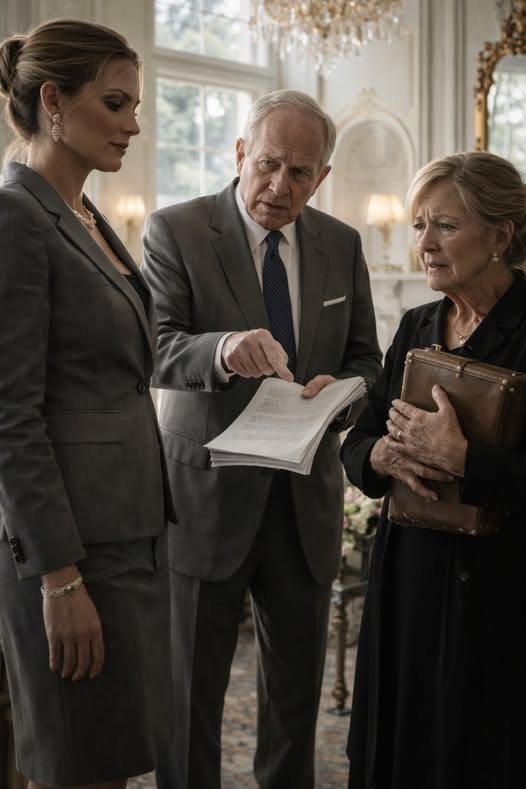
That afternoon, I called Harrison Fitzgerald, Robert’s long-time attorney. His office was a 20-minute bus ride downtown. Harrison was a distinguished man with kind eyes. When I arrived, he looked genuinely surprised.
“Margaret, my dear, I was wondering when you’d come in. I tried calling the house several times, but Victoria said you were traveling.”
“Traveling? Mr. Fitzgerald, I need to ask you about Robert’s will. My daughter told me she inherited everything.”
Harrison looked puzzled. “Didn’t she provide you with your copy? I gave her the original and several copies after the reading.”
My stomach dropped. “There was a reading? I was never told.”
Harrison’s expression shifted to alarm. He reached for a thick file. “Margaret, that’s impossible. The will is very specific.” He pulled out a document I recognized Robert’s neat signature on.
“I, Robert James Sullivan, bequeath to my beloved wife, Margaret Anne Sullivan, our primary residence and 70% of all financial assets—approximately $23 million.”
My head started spinning. Twenty-three million dollars.
Harrison continued reading, his voice serious. “To my daughter, Victoria, I leave $10 million, to be held in trust, contingent upon her treatment of her mother following my death.”
He looked up at me. “The trust provision specifically states that if she fails to treat you with respect and dignity, the entire $10 million reverts to you instead.”
Chapter 4: Operation Justice
“What do I do now?” I asked, my voice barely steady.
Harrison smiled, a genuine warmth I hadn’t felt from anyone besides David since Robert’s death. “Now, my dear, we call the police about the fraud. And then we call Victoria and inform her that she’s about to receive the shock of her life.”
Harrison Fitzgerald’s office became command central. He contacted the banks and a private investigator while I processed the magnitude of the deception.
Within two hours, every account Victoria thought she controlled was frozen. The house utilities, already transferred to her name, were suspended.
My phone rang at 3:47 p.m. Victoria’s name flashed on the screen.
“Mom, where are you? There’s some kind of mix-up with the bank accounts. They’re saying Daddy’s assets are frozen.”
“Hello, Victoria. I’m sitting in Harrison Fitzgerald’s office. The one who read the real will to an empty room while you lied that I was traveling.”
There was silence, then: “Mom, I don’t know what you think you discovered…”
“I discovered that you’re a liar and a thief, sweetheart. I also discovered that your father was much smarter than either of us realized. Not only did you never inherit the house, but your actual inheritance—the 10 million your father left you—is now mine as well, thanks to that lovely contingency clause.”
“That’s impossible.”
“Detective Rodriguez is sitting right here if you’d like to discuss the impossibility of federal fraud charges with her.”
The phone went quiet. Victoria was calculating. “Mom, please. Can we meet and talk about this reasonably? I’m sure we can work something out.”
“Oh, we’ll definitely be meeting soon. At the courthouse, when you’re arraigned.”
“You wouldn’t dare press charges against your own daughter.”
Something cold and final crystallized in my chest. “Watch me.”
Kevin, Victoria’s husband, called twenty minutes later, trying to sound reasonable. “Margaret, surely we can resolve this privately.”
“Kevin, did you help her forge those documents?”
“I… Margaret, you have to understand the pressure Victoria was under. She was worried about your mental state.”
“So, that’s a ‘yes.’ You genuinely believed you were ‘protecting’ me by throwing me out of my house and telling me to find somewhere else to die?”
The police arrested Victoria at 8:30 p.m. while she was having dinner at a lavish restaurant. Kevin was arrested at his office the next morning. It turned out he had a criminal resume for financial fraud that Victoria had ignored.
I spent my first night back in my house, sleeping in the master bedroom. I packed Victoria’s designer clothes into garbage bags and left them on the front porch for her to collect when she made bail.
I decided to make some changes to the house. Victoria had planned to gut the kitchen and convert Robert’s study into a wine cellar. I was going to turn the study into an art studio and the wine cellar plans into a library.
Chapter 5: Long Live the Queen
It was Kevin’s mother, Eleanor Hayes—perfectly coiffed, dripping with jewelry, and radiating entitled wealth.
“Margaret, we need to discuss this situation rationally. prosecuting Kevin seems rather vindictive, don’t you think?”
“Vindictive? Your son helped steal my inheritance and threw me out of my house.”
“Kevin was following Victoria’s lead,” she scoffed. “Kevin’s legal team believes we can reach a settlement. We are prepared to compensate you for your ‘inconvenience.’ Let’s say $2 million, in exchange for dropping the charges against Kevin.”
I had to admire the audacity. “$2 million to forgive the man who helped steal $33 million from me? Mrs. Hayes, your son participated in a scheme that cost me everything I owned. sending him to prison serves justice.”
Eleanor’s facade cracked slightly. “Justice? You’re destroying multiple families over money you’d never have known how to manage anyway.”
There it was—the same condescending attitude I had endured for decades. “Mrs. Hayes, I think we’re done here.”
“Very well. But you should know that Kevin’s legal team has found some… interesting information about your husband’s business practices. It would be unfortunate if that became public during the trial.”
The threat was clear, but I felt no fear. I called Harrison immediately. I wanted to know everything about Robert’s business—every deal, every potential irregularity.
Harrison recommended a sharp financial investigator named Carol Chen. After six hours in Robert’s study, Carol sat back with a heavy sigh.
“Mrs. Sullivan, your husband was running a sophisticated money-laundering operation through his consulting firm. Millions of dollars in illegal transactions over the past decade.”
The revelation hit me like a physical blow. While I was planning dinner parties, my husband was facilitating criminal enterprises.
“There’s more,” Carol continued. “If the FBI discovers this, they’ll seize everything as proceeds of criminal activity. Everything. The house, the investments… unless Victoria and Kevin’s legal team leaks this information strategically to negotiate immunity for themselves.”
My daughter wasn’t just a thief; she was holding a nuclear weapon over my head. Victoria called me later that evening, practically sounding triumphant.
“Mom, Kevin’s lawyers have been in contact with the FBI. They’re willing to let us renegotiate. Kevin gets immunity, you keep $5 million and the house, the fraud charges disappear, and the rest goes to the government. It’s practical, Mom.”
She had turned my moral victory into her strategic advantage.
“I need time to think.”
“The FBI meeting is tomorrow morning, Mom. We need an answer tonight.”
I hung up and sat in the darkness of Robert’s study. Forty-three years of marriage to a stranger. A daughter who had inherited his talent for deception. But she had made one crucial mistake: she underestimated who I was when my back was against the wall.
I picked up the phone and dialed the number Harrison had given me for FBI Agent Sarah Martinez. “I have a story to tell you, and I think you’re going to find it very interesting.”
Three hours later, I was sitting in my living room with a recording device taped to my chest, waiting for Victoria and Kevin to arrive for what they thought was my surrender meeting.
They arrived looking smug. Kevin opened his briefcase. “Margaret, our lawyers have structured this very favorably. You retain the house and $5 million in clean assets.”
“And you two?”
Kevin leaned forward. “We get to put this ‘misunderstanding’ behind us.”
“Kevin, help me understand something. When exactly did you discover Robert’s criminal activities? Did you know when you married Victoria, or did you discover it when you were planning to steal my inheritance?”
They exchanged glances. “Margaret, that isn’t relevant.”
“Actually, it is. Because if you only discovered them while committing your own crimes, that makes you remarkably unlucky. Agent Martinez finds it quite plausible.”
The color drained from their faces.
“Agent Martinez?”
Agent Sarah Martinez and two other federal agents entered the living room. “Victoria Sullivan Hayes and Kevin Hayes, you’re under arrest for conspiracy to commit wire fraud, elder abuse, and attempted extortion of a federal witness.”
As they handcuffed them, Kevin tried one last desperate play. “Margaret, you don’t understand what you’ve done. There are people connected to Robert’s business who won’t appreciate federal attention. You’ve put yourself in danger.”
Agent Martinez paused. “Mr. Hayes, are you threatening a federal witness?”
After they were removed, Agent Martinez sat down. “Mrs. Sullivan. Kevin’s warning might not be entirely empty. Your husband was laundering money for the Torino crime family. But there is one final thing you should know. Your husband wasn’t just laundering money for them; he was a deep-cover FBI informant.”
The world tilted sideways. Robert was working for the FBI.
“The $33 million is legally yours, Mrs. Sullivan. He died before the investigation concluded, but his cooperation directly led to dozens of arrests. Your daughter and son-in-law had no idea. They were planning to blackmail you with information that would have actually exonerated him.”
The irony was poetic. Six months later, I stood in my renovated kitchen. The Margaret Sullivan Foundation for Elder Protection was fully operational, using $15 million of my inheritance to fund legal aid for seniors.
Victoria had written me seventeen letters from federal prison. I hadn’t opened the last fourteen. Some relationships, once broken, can’t be repaired.
I walked into my new art studio, uncovering my latest painting—a self-portrait of a woman standing in bright sunlight, her face turned toward the future. She looked powerful, independent, and unafraid. She looked like someone who had learned that the best revenge isn’t getting even; it’s becoming everything your enemies never thought you could be.
Financial abuse and manipulation don’t always come from strangers; often, they come from the people we trust the most. If Margaret’s story resonated with you, it’s time to take control of your financial future. Don’t wait until crisis strikes. Subscribe for more empowering stories of resilience, and let us know in the comments: have you ever had to draw a hard line with family to protect yourself or your children?
