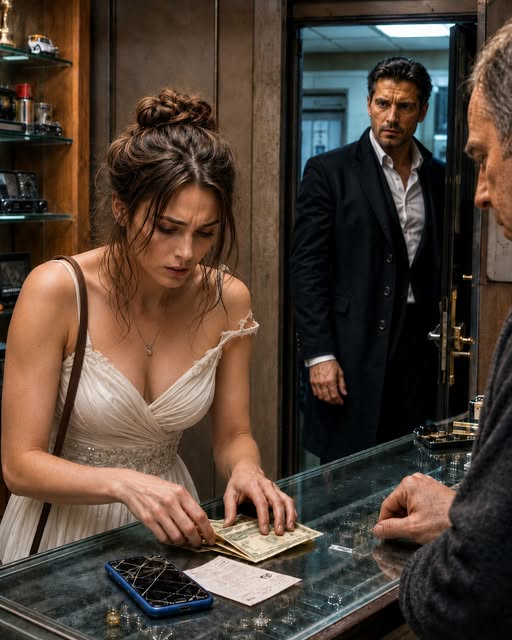
She sold her phone for her son’s medicine, and the mafia boss watching from the doorway broke down before he destroyed the man waiting to evict her
The first time Marco Vitelli saw Jenny Reeves, she was selling the last thing that connected her to the world.
Not jewelry. Not a luxury watch. Not some pretty little emergency fund tucked away in a drawer.
Her phone.
A cracked, tired iPhone with a frayed blue case, the kind a mother grabs at three in the morning when her child can’t breathe. The kind that holds school emails, doctor voicemails, grocery coupons, bus schedules, pictures of birthday candles, and every desperate note a woman writes to herself so she doesn’t fall apart.
Jenny stood at the pawn shop counter on Grover Street and counted the money twice.
“Eighty,” she said quietly. “One hundred. One-forty. One-sixty. One-eighty.”
The man behind the counter slid the bills toward her through the glass tray.
Marco watched from the half-open door of the back office.
He should not have been there. Not at that exact minute. Not in that exact building. He owned the strip, that was all. A pawn shop, a laundromat, a nail salon, a locked storage space in the back. He had come by to speak with his property manager about repairs, tax assessments, and the kind of small business headaches he normally handled with a signature and a look.
Then the bell above the front door chimed.
Jenny walked in.
She was not beautiful in the soft, polished way women became beautiful when life had been kind to them. She was beautiful like a match burning in a dark room. Sharp jaw. Tired eyes. Hair twisted into a knot because she did not have time for vanity. A navy coat buttoned wrong at the middle, as if she had dressed while thinking about something else.
She placed the phone on the counter.
“How much?” she asked.
The clerk turned it over. “Screen’s cracked.”
“I know.”
“Older model.”
“I know.”
“Hundred and eighty.”
Her jaw tightened, but she did not flinch. “Cash?”
“Cash.”
“Now?”
The clerk looked at her for a second. “Yeah. Now.”
Marco did not move.
He had seen men beg with guns pointed at them and keep his pulse steady. He had watched judges, cops, contractors, and cowards lie straight to his face and never once felt his hand tremble. For eleven years, he had trained himself not to react too quickly to human pain. Pain was everywhere. Pain was a currency. Pain was the sound underneath the city.
But this woman counted one hundred and eighty dollars like it was not enough, like she had already known it would not be enough, and somehow that small act cut deeper than any scream.
The clerk filled out the slip.
“Reason for sale?” he asked, bored.
Jenny’s eyes hardened. “Do you need that?”
“For the form.”
She looked away. “Prescription inhaler. My son.”
Marco’s chest tightened.
The clerk wrote it down.
Selling to cover cost of prescription inhaler. Son.
Jenny folded the receipt carefully, slid it into her coat pocket, and walked out.
The bell chimed again.
The shop seemed quieter after she left.
Marco stepped out of the back office.
“The receipt,” he said.
The clerk looked up. “What?”
“The receipt she just signed. Let me see it.”
“Mr. Vitelli—”
“Now.”
The clerk handed it over.
Marco read the name.
Jenny Reeves.
Then the address.
Callaway Street. Second floor.
Then the line in the description field.
Prescription inhaler. Son.
His thumb stopped on one word.
Son.
“How much is the phone worth?” Marco asked.
“Resale? Maybe two hundred and fifty if—”
“Full retail,” Marco said. “Whatever that model was new. Run my card.”
The clerk blinked. “You want to buy it?”
“I want it off your counter.”
“Sir—”
Marco placed his black card on the glass. “Run it.”
Five minutes later, he was in his car with the pawn shop receipt in his hand and Jenny Reeves’s phone sitting beside him in a paper sleeve.
He searched the medication name.
The cash price came up on his screen.
Three hundred and forty dollars.
She had walked out with one hundred and eighty.
She was one hundred and sixty short.
Marco stared through the windshield at the traffic moving along Grover Street, the city rolling on with its ordinary cruelty. People honking. A woman pushing a stroller. A delivery driver shouting into a headset. A man in a suit stepping over a homeless veteran without looking down.
One hundred and sixty dollars.
That was the gap between a child breathing and a mother failing.
Marco put the car in drive.
Ninth Street Pharmacy was three blocks away. He walked in, gave the pharmacist the name of the medication, and bought the maximum amount they were legally allowed to sell.
Three inhalers.
The pharmacist placed them in a brown paper bag and studied him carefully.
“Do you have the patient’s authorization?”
Marco’s expression did not change. “I have the prescription information.”
“This is for a child?”
(I know you’re all very curious about the next part, so if you want to read more, please leave a “GRIPPING” comment below!)
She sold her phone for her son’s medicine, and the mafia boss watching from the doorway broke down before he destroyed the man waiting to evict her