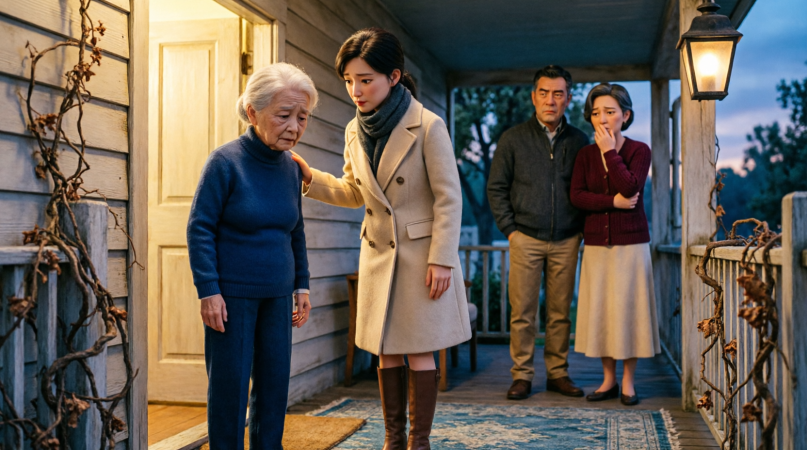
Serena’s hand froze halfway between the brass door knocker and her cream coat.
Wesley saw the folder first.
Not the porch light. Not my face. Not the cup of tea I had set carefully on the little table beside the door.
The folder.
It sat tucked under Lydia’s arm, thick enough to bend the corner of her navy blazer. My son’s name was printed across the tab in my handwriting, the same handwriting that had signed his school permission slips, college checks, car insurance forms, mortgage guarantees, and every rescue he had learned to call temporary.
WESLEY.
Serena’s eyes moved from the folder to Lydia’s face.
“Why is she here?” she asked.
Her voice was low and clean. No panic yet. Serena always reached for control before she reached for truth.
Lydia did not answer. She stood on my porch with rain beading on her shoulders, her gray-streaked hair pinned at the nape of her neck, one hand steady around the file.
Wesley swallowed.
“Mom,” he said, “this got out of hand.”
I looked at him.
At forty-eight, he still had Arthur’s eyes when he was frightened. That was the cruel part. A mother can look at a grown man and still see the child who once cried because his kite tore in the wind.
But that child had become a man who let his wife remove me from a dinner I helped make possible.
I stepped back from the doorway.
“Come in.”
Serena moved first, brushing past the threshold as if accepting an invitation she had been owed all along. Her perfume carried into the hall, sharp and expensive, mixing with the smell of lemon polish and rain-damp wool.
Wesley followed more slowly.
Lydia came last.
I closed the door.
The sound was soft, but Wesley flinched.
In the sitting room, Arthur’s photograph still watched from the mantel. The grandfather clock ticked beside the bookcase. Three wet coats shifted and settled in the quiet.
Serena did not sit.


“This is a family matter,” she said to Lydia.
Lydia placed the folder on my coffee table.
“It became a banking matter at 8:11 this morning.”
Wesley rubbed the back of his neck. “Mom, we were going to call you.”
“At 6:18 last night,” I said, “you did.”
His face tightened.
Serena turned toward him. “You sent the second text?”
He didn’t answer fast enough.
That was answer enough.
Her cream coat looked too bright against my old green chair. One rain droplet slid from her sleeve to the hardwood floor.
I picked up my teacup and set it on a coaster.
No shaking.
No raised voice.
No begging.
That alone seemed to unsettle them.
“Mom,” Wesley said, “Serena was upset. The coworkers came over last minute. It wasn’t personal.”
I nodded once.
“You weren’t invited. My wife doesn’t want you there,” I said.
His mouth opened, then closed.
Serena’s chin lifted. “It was one dinner.”
Lydia opened the folder.
Paper shifted against paper. Receipts. Printed authorizations. Bank summaries. Canceled drafts. Each page made a dry whisper, like leaves scraping concrete.
“It was not one dinner,” Lydia said.
Serena looked at her sharply. “You have no right to discuss our finances.”
“My finances,” I said.
The room stilled.
Outside, a car passed slowly through the wet street. Its tires hissed against the pavement.
Serena turned to me with the small smile she used in restaurants when a server made a mistake.
“Margaret, I understand you’re embarrassed.”
I almost laughed.
Not because it was funny.
Because embarrassment had kept me obedient for years.
Embarrassed to ask why I was never in family photos unless I was holding the camera.
Embarrassed to admit I paid for things no one thanked me for.
Embarrassed to feel hurt by little exclusions dressed up as scheduling conflicts.
Lydia pulled the first page free.
Wesley’s eyes followed it.
“Please,” he said.
That was the first honest sound he had made since entering my house.
Serena glanced at him. “Please what?”
He whispered, “Don’t.”
I sat down in Arthur’s chair.
The leather was cool under my palms.
“Read it,” I said.
Lydia adjusted her glasses.
“Mortgage assistance draft,” she began. “Monthly amount: $4,850. Originating account: Margaret Hale Living Trust. Beneficiary household: Wesley and Serena Hale. Active for thirty-one months.”
Serena blinked.
“That’s not—”
Lydia turned the page.
“Private school tuition support. Monthly amount: $2,800. Active for eighteen months.”
Wesley stared at the carpet.
Serena’s lips parted.
“Wesley told me that was from his bonus structure.”
I watched my son’s shoulders rise, then sink.
Lydia continued.
“Homeowners insurance. Two vehicles. Country club family membership. Emergency repairs listed under residential improvement. Business line tied to an entity called Hale Strategy Group.”
At that, Serena’s face changed.
Not guilt.
Alarm.
“What business line?” she asked.
Wesley pressed his fingers to his forehead.
“Serena,” he said quietly.
“What business line?”
Lydia looked at me for permission.
I gave a small nod.
She slid a page across the coffee table.
Serena snatched it up.
Her manicured thumb trembled against the corner.
The page showed $1,950 a month, withdrawn from my account for twenty-six months, marked as business telecommunications and client management software.
Serena read the company name once.
Then again.
“Hale Strategy Group,” she said.
Her voice had lost its polish.
Wesley looked toward the mantel, not at her.
I had never heard of that company until Lydia turned the screen toward me that morning. It had been one of the lines buried between utilities and membership fees, quiet and patient, waiting for daylight.
Serena lowered the page.
“You told me the firm paid for that.”
Wesley rubbed both hands over his face.
“I was going to fix it.”
“Fix what?”
He said nothing.
The house seemed to grow smaller around us. The clock ticked. Rain tapped the windows. Somewhere in the kitchen, the refrigerator hummed steadily, indifferent to the collapse taking place ten feet away.
Lydia removed another sheet.
“This is the notice generated today when access was revoked. Mr. Hale is no longer authorized to initiate transfers, create payment instructions, or use Margaret Hale’s trust account for any household or business-related charge.”
Serena stared at Wesley.
“You had access?”
His face reddened.
“For emergencies.”
“For years,” I said.
He turned to me. “You gave it to me.”
“I did.”
The words came out calm.
That mattered.
I had given it to him after Arthur died, when Wesley was grieving too, when he said the mortgage company needed a quick bridge and Serena was overwhelmed and the baby’s expenses had doubled.
I gave him access because I mistook trust for closeness.
Then I kept giving because stopping would have forced me to see what I had become to them.
A safety net with a pulse.
Serena folded the page slowly.
Her eyes moved over my sitting room for the first time, really seeing it. The worn rug. The framed photo of Arthur. The quilt over the arm of the sofa. The good porcelain cup beside my chair.
All the things she had dismissed as old.
All the things that had funded her new.
“Wesley,” she said, “how much?”
He shook his head.
Lydia answered because numbers do not protect anyone’s pride.
“In the past calendar year, $93,600.”
Serena took one step back.
Her heel struck the leg of the coffee table.
The folder shifted.
A few papers slid loose, spreading across the table like white cards in a losing hand.
“Mom,” Wesley said, and his voice cracked on that single word.
I waited.
For once, I did not rush to save him from discomfort.
He looked older than he had the night before. The skin beneath his eyes sagged slightly. His expensive sweater was damp at the collar. His phone kept buzzing in his hand.
Declined charge.
Declined charge.
Declined charge.
Each vibration sounded small and ugly in the room.
Serena’s eyes snapped to the phone.
“What is that?”
Wesley looked down.
He did not speak.
She took the phone from his hand.
I saw the screen glow against her face.
The color drained from her cheeks.
“Club dining account declined,” she read. “Preschool payment failed. Auto renewal failed. Mortgage draft returned pending review.”
Her breath came through her nose in sharp little pulls.
Then she looked at me.
Not like a daughter-in-law.
Not like a woman who had excluded an old widow from a dinner.
Like someone seeing the locked door behind the person she had pushed too far.
“You can’t do this,” she said.
I folded my hands in my lap.
“My name is on the accounts.”
“It affects the child.”
There it was.
The word she saved for leverage.
Child.
My granddaughter. The little girl who had texted me at 6:47 p.m. asking if I was still coming. The one who still pressed stickers onto my envelopes and called Arthur’s picture Grandpa Star.
My throat tightened.
But I did not move.
“I have already arranged a separate education account for her,” I said. “One neither of you can touch.”
Wesley lifted his head.
Serena went still.
Lydia placed one final document on top of the folder.
“This was completed at 9:32 this morning,” she said. “A custodial education trust. Direct school payments only. No parental withdrawal access.”
Serena stared at the paper.
For the first time since she entered my house, she had no immediate sentence ready.
The silence was not empty.
It was full of every dinner I had missed, every bill I had paid, every thank-you that had become an expectation.
Wesley stepped toward me.
“Mom, I’m sorry.”
His eyes were wet.
A younger version of me would have stood. Touched his face. Told him we would talk. Told him I understood. Told him Serena pressured him, life was hard, marriage was complicated, money made people afraid.
A younger version of me would have turned his apology into my responsibility.
I stayed seated.
“What are you sorry for?” I asked.
He blinked.
“For the text.”
I waited.
“For letting it happen.”
I waited again.
“For using the accounts.”
Serena made a sound under her breath.
He looked at her then back at me.
“For lying.”
That one landed.
Not beautifully.
Not enough to mend anything.
But it landed.
Serena straightened. “We should discuss this privately.”
“We are,” I said.
Her eyes cut toward Lydia.
“Without the banker.”
Lydia closed the folder with both hands.
“I’m here because Mrs. Hale requested a witness for the receipt of account revocation and notice of independent trust protection.”
Serena’s mouth tightened.
“A witness.”
“Yes,” Lydia said.
Her voice remained even.
That made Serena angrier than shouting would have.
Wesley sank onto the edge of the sofa without asking. His knees looked weak. His wet shoes left dark marks on the rug.
Arthur would have hated that rug being marked.
Then again, Arthur would have hated what his son had become far more.
Serena remained standing.
“You’re punishing us because of one awkward dinner,” she said.
I picked up the townhouse brochure from the side table. I had left it there on purpose.
The pages still showed the brick walkway, the staged lamps, the smiling kind of emptiness real estate photographers sell as home.
I opened to the page with the kitchen.
The one Serena had called perfect.
The one Wesley had said was for me too.
I placed it on top of the folder.
“I paid part of the down payment on a house where I was not welcome for dinner,” I said.
Serena’s gaze dropped to the glossy page.
For a moment, her face looked almost naked.
Not sorry.
Exposed.
Wesley covered his eyes with one hand.
“I didn’t think you’d actually stop everything,” he said.
That sentence told the whole truth.
Not that he loved me.
Not that he forgot.
Not that he was trapped.
He simply believed I would absorb the wound and keep paying.
My fingers tightened once around the armrest.
Then relaxed.
At 77, the body teaches you what the heart refuses. Tightness hurts. Release hurts less.
“I know,” I said.
Serena’s phone rang.
She looked down and silenced it.
It rang again immediately.
Then Wesley’s buzzed.
Then hers again.
Their life, built on automatic yes, had begun asking manual questions.
Serena glanced toward the front door.
“Wesley,” she said, “we need to go.”
But he did not stand.
He looked at me like a boy waiting outside the principal’s office, hoping his mother would come and make the consequences softer.
I had done that too many times.
Lydia gathered the loose pages back into order. Her hands were calm, professional, careful. She clipped the folder shut and passed me a receipt copy.
“The revocations are complete,” she said. “The trust protections are active. The business authorization has been flagged for review.”
Wesley’s head snapped up.
“Flagged?”
Lydia looked at him.
“Mrs. Hale did not recognize the business expenses. That required notation.”
Serena turned slowly toward Wesley.
The room sharpened.
There are moments when a marriage does not break loudly. No thrown glass. No screaming. Just one spouse realizing the other has been lying in a direction they never bothered to check.
“What review?” Serena asked.
Wesley stood.
“Not now.”
“Yes,” she said. “Now.”
I rose from Arthur’s chair.
Not quickly. My knees complained. My hand found the armrest first, then the air, then balance.
All three of them watched me.
I walked to the mantel and touched Arthur’s frame.
The silver was cool.
“You should leave,” I said.
Wesley took one step toward me. “Mom, please.”
I looked at my son.
His face blurred slightly at the edges, but I did not let the tears fall.
“You may call me when you are ready to speak without needing something.”
He stopped.
Serena pulled her coat closed, though the room was warm.
Lydia lifted the folder.
“No,” I said softly.
She paused.
I held out my hand.
She gave it to me.
The folder was heavy.
Heavier than paper should be.
Wesley looked at it as if it were alive.
I walked to the front door and opened it.
Cold damp air slipped into the hall. The porch light caught the rain in thin silver threads.
Serena stepped out first, fast now, her heels sharp against the boards.
Wesley lingered.
“Did you ever love me without the money?” he asked.
The question struck harder than I expected.
I held the folder against my chest.
“Yes,” I said. “That was the problem.”
His face folded.
For one second, I saw the little boy with the torn kite.
Then I saw the man who had written, You weren’t invited.
He stepped onto the porch.
I closed the door.
This time, he was on the other side of it.
The house settled around me.
No applause. No victory music. No clean happiness.
Just the clock, the rain, and my own breathing.
Lydia stood beside the sitting room archway, quiet as a witness in a church.
“Are you all right?” she asked.
I looked at the good teacup on the table. The tea had gone cold.
“I will be.”
Through the window, I saw Serena and Wesley standing beside their car. She was speaking fast. He kept looking back at the house.
Then Serena opened the passenger door and stopped.
Because another car had turned into my driveway.
A small blue sedan.
My granddaughter climbed out holding a backpack against her chest.
Behind her, her teacher stepped into the rain with one hand raised, uncertain.
I moved to the window.
My granddaughter looked past her parents, straight at my door.
Her small face was pale.
Then she lifted her phone.
A message arrived on my screen.
Grandma, Mom said you ruined everything. Can I come inside?
I opened the door before the second buzz.
This time, I did not ask anyone’s permission………………….
PART2: Widowed Mother Cut Off 174 Payments After Her Son Uninvited Her From Dinner-iwachan
PART 6 — “The First Thing To Break”
The first thing to break was not the mortgage.
Not the club membership.
Not the business line.
Not even Serena’s composure.
It was the school pickup schedule.
Three days after the dinner text, Margaret stood in her kitchen spooning marmalade onto toast when her phone rang at 2:14 p.m.
The caller ID read:
ST. AGNES ACADEMY.
Her stomach tightened immediately.
Not fear.
Instinct.
The kind motherhood leaves permanently inside the body.
She answered quietly.
“This is Margaret Hale.”
The receptionist sounded careful.
“Mrs. Hale, we’ve been unable to reach Wesley or Serena regarding Olivia’s pickup authorization.”=
Margaret looked toward the rain-streaked window.

Olivia.
Her granddaughter hated being called Olivia at school.
Preferred Livie.
Only teachers still used the full name.
“She’s alright?” Margaret asked.
“Oh yes.”
A pause.
“There just seems to be an issue with the transportation account.”
Of course there was.
Margaret closed her eyes briefly.
The transportation draft had been one of the 174 payments.
The receptionist continued gently:
“Your name remains listed as emergency guardian.”
That sentence landed softly inside Margaret’s chest.
Not because it felt important.
Because for the first time in years, it felt real.
Emergency guardian.
Not wallet.
Not account holder.
Not silent rescuer.
Guardian.
Margaret set her toast down untouched.
“I’ll come get her.”
The drive to St. Agnes took twenty-three minutes through wet afternoon traffic.
Gray clouds pressed low over the city while windshield wipers moved steadily across the glass.
Margaret parked beside a row of polished SUVs and sat still for a moment before getting out.
Children poured from the academy doors beneath umbrellas and backpacks and tired teachers calling names into the rain.
Then Livie saw her.
“Grandma!”
The little girl ran immediately, braids bouncing against her coat.
Margaret bent carefully as Livie collided against her waist.
Warm.
Small.
Real.
The child smelled faintly like crayons and strawberry shampoo.
“You came.”
Margaret held her tightly.
“Of course I did.”
Livie pulled back slightly.
Her face looked troubled in the way children’s faces do when adults have started lying around them.
“Mom’s mad,” she whispered.
Margaret brushed rainwater gently from the child’s forehead.
“I know.”
Livie lowered her voice further.
“She said not to talk about money because it stresses Daddy.”
There it was.
The beginning.
Children always hear the emotional truth before adults realize they are listening.
Margaret took the backpack carefully.
“Would you like hot chocolate?”
Livie nodded instantly.
By the time they reached the café near the school, rain hammered the windows hard enough to blur the streetlights outside.
Livie sat across from Margaret stirring whipped cream into hot chocolate while Margaret wrapped both hands around untouched tea.
The child looked up suddenly.
“Did you really ruin everything?”
The question arrived softly.
Not accusingly.
Confused.
That hurt worse.
Margaret felt something deep inside her chest tighten painfully.
Because children should never carry adult financial warfare inside their small voices.
She chose her next words carefully.
“No, sweetheart.”
She smiled gently.
“Some things were already broken before I stopped paying for them.”
Livie frowned at the marshmallows floating in her cup.
“But Mom said families help each other.”
Margaret looked toward the rainy windows.
Arthur once said the same thing.
The difference was:
Arthur never confused help with surrender.
Margaret leaned forward slightly.
“Families should help each other,” she said softly.
“But help is supposed to feel like love.”
A pause.
“Not obligation.”
Livie considered that seriously in the way thoughtful children do.
Then quietly asked:
“Are you still my grandma?”
The question nearly shattered her.
Margaret reached across the table immediately and covered the child’s small hand with her own.
“Oh sweetheart.”
Her voice weakened despite herself.
“There is absolutely nothing on earth that could change that.”
Livie relaxed slightly after hearing it.
Then looked down again.
“My dad cried yesterday.”
Margaret blinked.
“What?”
Livie stirred her hot chocolate slowly.
“I heard him in the kitchen after Mom went upstairs.”
Outside, thunder rolled softly across the city.
Margaret stared at the child across from her.
Because suddenly—
for the first time since the folder—
Wesley stopped looking like only a man who had betrayed her.
Now he also looked like someone beginning to understand the size of what he had destroyed.
PART 7 — “The Calls Started First”
The calls started before sunset.
Not emotional calls.
Institutional ones.
The kind that arrive with polite voices and irreversible consequences.
Margaret was watering the small herb boxes outside her kitchen window when the first voicemail appeared.
Missed Call:
Hawthorne Country Club.
Ten minutes later:
BrightStone Mortgage Services.
Then:
St. Agnes Billing Department.
Then another.
And another.
The phone rested quietly on the counter vibrating against old wood while basil leaves trembled beneath the kitchen faucet.
Margaret turned the water off slowly.
For years, those calls would have sent her moving instantly.
Solving.
Transferring.
Rescuing.
Now she simply dried her hands carefully on a dish towel.
The silence afterward felt unnatural.
Not guilt.
Withdrawal.
Like a body finally noticing a weight it had carried too long.
At 5:42 p.m., Wesley finally called directly.
Margaret stared at his name flashing across the screen.
Once upon a time, seeing “Wesley” still made her feel needed.
Now it mostly made her tired.
The phone rang six times before stopping.
Then immediately again.
Margaret answered on the third attempt.
Neither of them spoke first.
Rain drifted softly against the windows while the refrigerator hummed behind her.
Finally Wesley exhaled sharply.
“Mom.”
She waited.
“We need to talk.”
Not:
How are you?
Not:
I’m sorry.
Not:
Are you alright?
Need.
Always need.
Margaret walked slowly toward the sitting room.
Arthur’s photograph watched quietly from the mantel.
“Yes,” she said softly.
“We probably do.”
Wesley sounded exhausted already.
“The mortgage company froze the automatic draft.”
“I know.”
“The school transportation account failed.”
“I know.”
“The club suspended access pending payment review.”
Margaret closed her eyes briefly.
Arthur hated that club.
Said people paid too much money pretending to enjoy chicken salad beside people they secretly disliked.
He would’ve enjoyed this irony immensely.
Wesley’s voice lowered.
“Serena’s furious.”
There it was again.
Not:
I hurt you.
Not:
I was wrong.
Only consequences.
Margaret sat slowly in Arthur’s chair.
The leather creaked softly beneath her.
“What exactly are you calling for, Wesley?”
Silence stretched briefly.
Then finally:
“How long are you planning to do this?”
Margaret frowned slightly.
“Do what?”
“This.”
His voice tightened.
“Punish us.”
The word settled heavily into the room.
Punish.
As though restoring boundaries after fifteen years of financial dependency was cruelty.
Margaret looked toward the rain-dark windows.
“I paid nearly ninety-four thousand dollars toward your household last year.”
“You offered.”
“Yes.”
Her voice remained calm.
“And you accepted.”
Wesley made a frustrated sound under his breath.
“You know things are complicated right now.”
Margaret almost laughed.
Because adulthood always became “complicated” whenever accountability arrived.
Outside, headlights swept briefly across the wet street before disappearing again.
Then Wesley said quietly:
“Livie heard us arguing.”
That pierced deeper than the mortgage ever could.
Margaret’s fingers tightened slightly against the armrest.
“Is she alright?”
A pause.
“She cried.”
Margaret lowered her eyes immediately.
Of course she did.
Children absorb emotional weather before adults notice storms forming.
Wesley continued quietly now.
“She thinks everyone’s angry.”
Margaret stared at Arthur’s photograph.
At seventy-seven, grief had taught her something painful:
love and damage often lived in the same room pretending not to recognize each other.
“What did you tell her?”
Another silence.
Too long.
Finally:
“That things changed.”
Margaret nodded once slowly.
At least that part was true.
Then Wesley whispered something unexpected.
“I didn’t think you’d actually leave us without help.”
The honesty of it hollowed the room instantly.
Not manipulation.
Not even cruelty.
Just genuine belief.
He truly thought she would continue sacrificing herself indefinitely because she always had before.
Margaret suddenly saw the full tragedy clearly:
Wesley had not learned entitlement overnight.
She had taught it slowly through years of unconditional rescue mistaken for love.
The realization hurt.
But strangely—
it also freed something.
Margaret stood and walked toward the kitchen window.
Rainwater slid down the glass in crooked silver lines.
“Wesley,” she said softly,
“do you know why your father handled most of the finances when we were younger?”
He sounded confused.
“What?”
“Because Arthur used to say I gave away pieces of myself too easily.”
Silence.
Then she smiled sadly toward the darkening yard.
“I thought he was talking about money.”
Neither of them spoke after that.
Somewhere across the city, her son breathed unevenly into a phone while overdue notices slowly entered his life for the first time.
And for once—
Margaret did not rush to rescue either of them.
PART 8 — “Serena Hated Supermarkets”
Three days later, Serena went grocery shopping herself for the first time in years.
Margaret only learned this because Livie told her accidentally.
They were sitting together at the library after school coloring paper bookmarks while rain tapped softly against tall windows overlooking the parking lot.
Livie carefully pressed a purple marker against construction paper.
“Mom got mad at the supermarket.”
Margaret looked up slowly.
“Oh?”
Livie nodded seriously.
“She said nobody should charge fourteen dollars for strawberries.”
The child sounded personally offended by the economic injustice.
Margaret almost smiled into her tea.
Serena hated supermarkets.
Not shopping—
supermarkets.
Too bright.
Too crowded.
Too ordinary.
For years groceries arrived neatly at the townhouse door inside insulated bags Margaret quietly paid for through the household account.
Another invisible convenience mistaken for normal life.
Margaret colored the edge of a bookmark slowly.
“What happened after the strawberries?”
Livie sighed dramatically.
“She left the cart in frozen foods.”
That sounded exactly like Serena.
Margaret imagined her daughter-in-law standing beneath fluorescent lights in a cream coat while financial reality slowly introduced itself aisle by aisle.
The image should have felt satisfying.
Instead—
it mostly felt sad.
Not because Serena had excluded her.
Because Serena genuinely built her identity around never appearing financially vulnerable.
And now vulnerability was arriving publicly.
Children notice humiliation quickly.
Especially when adults try hiding it behind perfect lipstick and expensive coats.
Livie lowered her marker.
“Daddy says we might move.”
Margaret’s hand paused.
“Move where?”
The little girl shrugged.
“A smaller house maybe.”
Then quickly:
“But Mom says it’s temporary.”
Temporary.
Margaret closed her eyes briefly.
Every dependency had once been called temporary too.
A temporary tuition payment.
Temporary mortgage support.
Temporary business help.
Fifteen years later, temporary had become architecture.
The librarian passed quietly between tables pushing a cart of returned books while soft rain blurred the city outside.
Livie looked up suddenly.
“Grandma?”
“Yes, sweetheart?”
“Are poor people bad?”
The question struck so hard Margaret physically stopped breathing for a second.
Across the room, a little boy laughed near the picture books while someone’s phone vibrated softly against a wooden table.
Ordinary afternoon sounds.
Meanwhile one small girl sat carrying inherited shame she did not yet understand.
Margaret placed the marker down carefully.
“Who told you that?”
Livie twisted the paper bookmark nervously between small fingers.
“Nobody.”
A pause.
“Mom just says people treat you differently when they know.”
There it was.
Not greed exactly.
Fear.
Serena’s entire life seemed built around outrunning embarrassment.
Margaret leaned closer gently.
“Sweetheart, money only changes what people can buy.”
A soft smile touched her face.
“It doesn’t decide who deserves kindness.”
Livie considered that quietly.
Then whispered:
“Mom cries in the bathroom now.”
Margaret looked away toward the rain-streaked windows immediately.
Because suddenly Serena stopped looking like only a polished manipulator.
Now she also looked frightened.
And frightened people often become cruel trying to protect the version of themselves they worked hardest to build.
That realization complicated everything.
Which usually meant it was true.
As they packed up the coloring supplies, Margaret noticed Livie carefully sliding the purple bookmark into her backpack.
Written across the front in uneven child handwriting were the words:
FOR GRANDMA’S GOOD CUPS.
Margaret stared at it silently.
The good cups.
Even the child remembered them.
Because children always notice which beautiful things adults save for “special occasions” instead of letting themselves enjoy freely.
Margaret suddenly wondered how many years of her own life she had postponed waiting for permission to matter inside it.
PART 9 — “Arthur Tried To Warn Her”
The rain stopped by Sunday.
Cold sunlight spilled weakly through Margaret’s kitchen windows while cinnamon bread warmed slowly in the oven. The house smelled soft and familiar again for the first time in days.
Livie sat at the table drawing horses with serious concentration while Margaret searched the hallway closet for an old photo album.
At least that’s what she thought she was searching for.
Instead, she found Arthur’s handwriting.
The box rested behind winter blankets on the top shelf.
Dark green.
Dust gathered thick along the corners.
Margaret frowned slightly while lowering it carefully onto the hallway floor.
Arthur labeled everything.
Garden receipts.
Tax folders.
Old warranties for appliances that no longer existed.
This box simply read:
MARGARET — IMPORTANT
Her stomach tightened immediately.
Livie looked up from the kitchen table.
“Grandma?”
“I’m alright, sweetheart.”
But she wasn’t.
Not exactly.
Margaret carried the box slowly into the sitting room and lifted the lid.
Inside rested:
- old insurance papers
- Arthur’s pension documents
- handwritten notes
- sealed envelopes
And beneath everything—
a small yellow notebook she recognized instantly.
Arthur’s budgeting notebook.
The one he kept hidden beside the garage workbench for nearly twenty years.
Margaret sat down slowly in his chair.
The leather sighed softly beneath her.
Outside, bare tree branches shifted gently in pale afternoon wind while Livie hummed quietly from the kitchen.
Margaret opened the notebook carefully.
Arthur’s handwriting moved neatly across every page:
mortgage calculations,
retirement projections,
repair estimates.
Practical things.
Arthur trusted numbers more than feelings.
Until the middle section.
There, the notes changed.
Less organized.
More personal.
Margaret frowned slightly.
Then she saw Wesley’s name.
“Wesley asked for another bridge payment.
Margaret says it’s temporary again.”
Her chest tightened.
Another page.
“I worry she mistakes being needed for being loved.”
Margaret physically stopped breathing for a moment.
The room seemed to tilt quietly around her.
Another entry farther down:
“Serena never asks directly.
Smart girl.
Makes Wesley do it.”
Margaret swallowed hard.
Arthur had seen all of this years ago.
And she ignored him.
Because love sometimes prefers comforting lies over painful clarity.
The grandfather clock ticked softly beside the bookshelf while Livie laughed faintly at something in the kitchen.
Ordinary sounds.
Meanwhile an old marriage was still speaking from paper.
Margaret turned another page slowly.
“I asked Margaret today:
if Wesley stopped needing money tomorrow,
would he still call every week?”
Her eyes filled immediately.
Because she remembered that argument.
She had accused Arthur of being cynical.
Cold.
Ungenerous.
Arthur simply looked tired.
Another page waited beneath it.
“I don’t think Wesley is cruel.
I think dependency became normal before he noticed.
That may be worse.”
Margaret pressed trembling fingers against her mouth.
Because yes.
Cruelty at least required intent.
Entitlement often grew quietly inside love until nobody recognized the shape anymore.
Then finally—
near the back—
she found a folded letter.
Her name written carefully across the front.
MARGARET
The handwriting looked shakier there.
Arthur’s final years.
Margaret unfolded it slowly.
Margaret,
If you’re reading this, then I was probably right about Wesley needing a boundary you struggled to give him.
Before you get angry with me again, let me say this carefully:
loving people generously is one of the best things about you.
But generosity without limits eventually teaches others your exhaustion is acceptable.
You keep trying to earn love through sacrifice.
That worries me more than the money ever did.
A tear slipped silently down Margaret’s face.
From the kitchen, Livie called:
“Grandma, where’s the cinnamon?”
Margaret looked toward the doorway but couldn’t answer immediately.
Because suddenly she understood something devastating:
Arthur had not spent years trying to protect the bank account.
He had spent years trying to protect her.
And she had mistaken his warnings for criticism instead of love.
PART 10 — “The First Time Serena Called Alone”
Serena called on Tuesday at 9:16 p.m.
Not Wesley.
Her.
Margaret almost let the phone ring out from pure surprise.
For fifteen years, Serena had perfected indirect communication:
- invitations through Wesley
- requests through Wesley
- apologies through silence
- criticism through politeness
Calling alone meant something had shifted.
Margaret answered on the fourth ring.
“Yes?”
For a moment, neither woman spoke.
Then Serena exhaled slowly.
“I assume Wesley told you the mortgage company called again.”
Straight to logistics.
Of course.
Margaret folded the corner of Arthur’s letter carefully before setting it beside her tea.
“No.”
A pause.
“He didn’t?”
“No.”
The silence afterward felt uneven.
Serena sounded tired in a way Margaret had never heard before.
Not polished-tired.
Not socially exhausted.
Real tired.
Finally Serena spoke again.
“They’re asking for proof of liquidity before refinancing.”
Margaret stared toward the dark kitchen window.
Rain shimmered faintly beneath the porch light outside.
“And?”
“And Wesley doesn’t qualify without…”
She stopped herself.
“…the previous support structure.”
Previous support structure.
Such elegant language for dependency.
Margaret almost admired it.
Almost.
From somewhere deeper inside the townhouse, Margaret heard cabinet doors shutting sharply.
Then Wesley’s muffled voice.
The sound tightened something inside her chest unexpectedly.
Not sympathy exactly.
Recognition.
Marriages under financial pressure begin sounding different.
Shorter.
Harder.
More careful around ordinary sentences.
Arthur once said money was rarely about money.
Usually it was about fear wearing numbers as clothing.
Serena lowered her voice.
“Livie heard us arguing again.”
There it was.
Always the child floating quietly beneath the adults’ damage.
Margaret sat slowly at the kitchen table.
The wood felt cool beneath her wrist.
“What exactly are you calling for, Serena?”
This time the silence stretched longer.
Long enough to become honest.
Then finally:
“I don’t know how bad things actually are.”
Margaret blinked.
That sentence she had not expected.
Because beneath Serena’s perfection lived something Margaret had overlooked:
ignorance.
Not stupidity.
Not innocence.
Trust.
Or perhaps selective trust.
Serena continued quietly.
“Wesley handled most of the financial side after Arthur died.”
A weak bitter laugh escaped her.
“I thought your help was occasional.”
Margaret closed her eyes briefly.
Of course she did.
Wesley hid the scale intentionally.
Not to protect Margaret.
To protect the illusion of himself.
The realization hurt differently than the dinner text.
Less sharp.
More sad.
“You really didn’t know?” Margaret asked softly.
“No.”
For the first time since this began, Serena sounded young.
Not socially polished.
Not controlled.
Just frightened.
Margaret looked toward Arthur’s letter resting beside the tea cup.
“Dependency became normal before he noticed.”
Arthur had been right again.
Serena spoke suddenly.
“He keeps saying he was going to fix it.”
Margaret almost smiled sadly.
Temporary.
Bridge payment.
Just until next quarter.
One more month.
Wesley had spent fifteen years living emotionally inside future tense.
“Do you know what the worst part is?” Serena whispered.
Margaret waited.
“I can’t tell which parts were lies anymore.”
The words settled heavily between them.
Outside, wind pushed rain softly against the windows while the old refrigerator hummed steadily nearby.
Then Serena said something Margaret never expected to hear from her.
“I don’t think he wanted to hurt you.”
Margaret stared at the dark glass above the sink.
“No,” she said quietly.
“I don’t think he did either.”
And somehow—
that made everything even sadder…
PART3: Widowed Mother Cut Off 174 Payments After Her Son Uninvited Her From Dinner-iwachan
PART 11 — “Livie Heard Everything”
Livie stopped talking during dinner Thursday night.
Not completely.
Just enough for Margaret to notice.
Children rarely announce unhappiness directly.
They leak it slowly through silence,
half-finished food,
and eyes that stop lifting toward the adults they trust.
Margaret watched her granddaughter push macaroni gently around the plate while rain whispered against the apartment windows.
“Too much pepper?” Margaret asked softly.
Livie shook her head.
“No thank you.”
The answer sounded rehearsed somehow.
Margaret lowered her fork carefully.
For years she had missed emotional warning signs because motherhood trained her to prioritize keeping peace over noticing discomfort.
She was trying to learn differently now.
“Sweetheart,” she asked gently,
“did something happen at school?”
Livie hesitated.

Then shrugged.
“Not really.”
That meant yes.
Margaret waited quietly.
Across the kitchen, the kettle clicked softly as steam curled upward beneath warm yellow light.
Finally Livie whispered:
“I heard Mom say maybe we should stop coming here.”
The room became very still.
Margaret felt the words land slowly inside her chest.
Not because they surprised her.
Because they hurt the child first.
“Why would she say that?”
Livie looked down immediately.
“She thought I was asleep.”
Children always hear adult truths through walls.
Margaret folded her napkin slowly beside the plate.
“And what exactly did she say?”
Livie twisted the sleeve of her sweater nervously.
“She said you’re trying to turn me against them.”
There it was.
The beginning of the real emotional war.
Not money.
Narrative.
Margaret suddenly understood something terrifying:
Financial dependence had ended.
Now emotional loyalty would become the battlefield instead.
Outside, headlights swept briefly across rain-dark buildings before fading again.
Livie’s voice became smaller.
“Grandma?”
“Yes, sweetheart?”
“Are you?”
The question nearly shattered her.
Margaret moved her chair closer immediately.
“Oh honey.”
She reached gently for the child’s hand.
“No.”
Livie’s eyes filled suddenly.
“Then why does everybody sound angry all the time now?”
Margaret swallowed hard.
Because there was no child-sized explanation for decades of emotional imbalance collapsing all at once.
The kitchen smelled faintly of butter and tea while the clock ticked softly above the refrigerator.
Ordinary room.
Impossible conversation.
Margaret chose her words carefully.
“Sometimes adults build lives around things that aren’t very stable.”
A pause.
“And when those things change… people become frightened.”
Livie stared at the table quietly.
“Mom says you embarrassed Dad.”
Margaret closed her eyes briefly.
Of course Serena framed it that way.
Shame always searches for a cleaner target.
When Margaret opened her eyes again, Livie looked frightened.
Not of Margaret.
Of choosing wrong.
That realization hurt most of all.
Children should never feel responsible for managing adult emotional alliances.
Margaret stood slowly and crossed toward the cabinet above the stove.
The good cups rested inside.
White porcelain.
Blue painted edges.
Arthur bought them in Quebec nearly thirty years ago.
Margaret used to save them for holidays.
Guests.
Special occasions.
Now she reached for two.
Livie looked confused.
“Grandma?”
“Yes?”
“You said those were expensive.”
Margaret smiled softly while setting them carefully onto the table.
“They are.”
“Then why are we using them?”
Margaret poured warm milk gently into both cups.
Because suddenly—
after Arthur’s letter,
after the folder,
after the dinner text—
she finally understood something painfully simple:
waiting for permission to enjoy your own life becomes its own kind of loneliness.
She slid one cup toward Livie.
Then answered quietly:
“Because I’m tired of saving good things for people who only visit when they need something.”
PART 12 — “Wesley Started Visiting Alone”
Wesley began arriving without Serena the following week.
Always after sunset.
Always looking exhausted.
The first time, Margaret almost didn’t answer the door.
Not out of anger.
Out of caution.
Because grief had taught her something difficult:
people often become gentler when they need stability returned.
And she no longer trusted need to mean love automatically.
Still—
when she opened the door and saw her son standing beneath the porch light holding a paper bakery bag dampened by rain—
her chest tightened anyway.
Wesley gave a weak smile.
“Livie said you liked the cinnamon rolls from Harper Street.”
Margaret looked at the bag.
Then at him.
For years he arrived carrying requests.
Documents.
Apologies wrapped around financial emergencies.
This felt different.
Smaller.
More uncertain.
She stepped aside quietly.
“Come in.”
The house smelled faintly of tea leaves and furniture polish while soft jazz drifted from the radio near the kitchen window.
Wesley removed his coat slowly.
Margaret noticed immediately:
- the dark circles beneath his eyes
- the wrinkled collar
- the tension sitting permanently between his shoulders now
Consequences were beginning to age him.
Good.
Not cruelly good.
Reality good.
They sat across from each other at the kitchen table while rain ticked softly against the windows.
Margaret placed two plates down automatically.
Then paused.
For years she served Wesley instinctively before herself.
Now she noticed the habit.
And slowly corrected it.
One cinnamon roll remained on her plate.
One on his.
Balanced.
Wesley watched the movement carefully.
He noticed too.
Neither of them mentioned it.
Finally he looked around the kitchen quietly.
“You changed things.”
Margaret glanced toward the windows.
The herb boxes had moved.
Arthur’s old chair now sat beside the bookshelf instead of facing the television.
Fresh flowers rested near the sink.
Tiny shifts.
But meaningful ones.
“Yes.”
Wesley nodded slowly.
The silence between them no longer felt angry tonight.
Just unfamiliar.
Then he whispered:
“Livie likes the good cups.”
Margaret smiled faintly despite herself.
“She does.”
“She told Serena you use them all the time now.”
Margaret wrapped both hands around her tea.
“For years I kept saving things.”
A small shrug.
“I’m not sure what for anymore.”
Wesley stared down at the cinnamon roll untouched on his plate.
Rain slid softly down the dark kitchen windows.
Finally he said:
“Serena thinks you hate her.”
Margaret almost laughed.
Not because it was funny.
Because hate would actually require emotional energy she no longer had.
“I don’t hate Serena.”
Wesley looked up carefully.
“She doesn’t believe that.”
Margaret stirred her tea once slowly.
“Your wife spent years treating me like an embarrassing relative she couldn’t completely remove because I paid too many bills.”
A pause.
“So I understand why kindness probably feels suspicious to her now.”
Wesley flinched slightly.
Truth always lands differently when spoken quietly.
He rubbed tired fingers across his forehead.
“She grew up with collection notices taped to the refrigerator.”
His voice weakened.
“You know that, right?”
Margaret blinked.
No.
She hadn’t known.
Wesley continued softly:
“Her father disappeared when she was eleven.”
A bitter little laugh escaped him.
“She thinks poverty is something waiting outside every door.”
The room shifted slightly around Margaret then.
Not enough to excuse Serena.
Enough to complicate her.
Which was usually harder emotionally.
Wesley finally picked apart a piece of cinnamon roll between his fingers.
“I kept thinking I could hold everything together long enough to fix it.”
Margaret looked at him quietly.
“And did you?”
His eyes filled immediately.
Not dramatically.
Just exhaustion finally running out of places to hide.
“No.”
The honesty settled softly into the room.
For once,
her son sounded less like a man defending himself—
and more like someone finally tired of pretending.
PART 13 — “Serena Came Without Makeup”
Serena arrived Saturday morning at 8:12.
Margaret knew the exact time because she was still standing at the kitchen counter buttering toast when the knock came.
Not ringing.
Knocking.
Soft.
Careful.
Uncertain.
That alone felt strange.
Rain had not started yet, but the sky hung gray and swollen beyond the windows. The house smelled like coffee and warm bread while the radio murmured low jazz near the sink.
Margaret opened the door expecting Wesley.
Instead—
Serena stood there alone.
No cream coat.
No polished lipstick.
No perfect hair twisted into place.
For the first time in fifteen years, Margaret saw her daughter-in-law looking simply tired.
Human tired.
Serena held a paper folder tightly against her chest.
Not designer.
Not elegant.
A grocery-store folder bent at the corners from nervous hands.
Margaret blinked once slowly.
“Serena.”
Serena swallowed.
“I know this is a bad time.”
Margaret looked at the untouched toast behind her.
“No,” she said quietly.
“It’s breakfast.”
That almost made Serena laugh.
Almost.
Margaret stepped aside.
“Come in.”
Serena entered slowly like someone walking into a church after years away from religion.
The house carried warmth differently than the townhouse.
Not expensive warmth.
Lived-in warmth.
Books.
Tea.
Wood polish.
Old photographs.
Serena looked around carefully.
Margaret suddenly realized something unsettling:
Serena had visited this house dozens of times.
But she had never truly looked at it before.
Margaret gestured toward the kitchen table.
“Coffee?”
Serena hesitated.
Then nodded once.
They sat across from each other while steam curled upward between them.
The silence felt brittle.
Finally Serena placed the folder carefully onto the table.
“I found these.”
Margaret looked down.
Past-due notices.
Mortgage warnings.
Credit extensions.
Business debt summaries.
One red stamp across the top page read:
FINAL REVIEW PENDING.
Margaret lifted her eyes slowly.
“You didn’t know.”
Serena laughed once quietly.
Broken sound.
“No.”
She rubbed tired fingers beneath her eyes.
“I knew things were tight.”
A pause.
“I didn’t know we were drowning.”
The honesty changed the room instantly.
Margaret wrapped both hands around her coffee cup.
Outside, wind pushed dead leaves across the driveway in crooked circles.
Serena stared toward the kitchen window.
“My mother used to hide bills inside cookbooks.”
A weak smile touched her face briefly.
“She said unopened envelopes couldn’t ruin dinner.”
Margaret listened quietly.
“I spent my whole childhood terrified someone would realize we couldn’t afford the life we pretended to have.”
There it was.
Not greed.
Fear wearing polish.
Serena looked down at the notices again.
“When Wesley kept saying your help was temporary…”
Her voice weakened.
“I wanted to believe him.”
Margaret studied the woman across from her carefully.
For years Serena seemed emotionally untouchable.
Perfect posture.
Perfect phrasing.
Perfect image management.
But fear eventually ruins performance.
That was the terrible thing about collapse:
it introduces people to themselves.
Serena suddenly looked toward Margaret directly.
“I need you to know something.”
Margaret waited.
“I never thought you’d actually stop.”
The sentence landed brutally because it matched Wesley’s exactly.
Same entitlement.
Different voice.
Serena noticed the realization crossing Margaret’s face immediately.
And for the first time since this began—
she looked ashamed.
Real shame.
Not embarrassment.
Not social discomfort.
Moral shame.
Her eyes filled suddenly.
“We built our whole life assuming your love would continue absorbing consequences.”
Silence settled heavily across the kitchen.
The refrigerator hummed softly nearby while coffee cooled untouched between them.
Then Serena whispered something Margaret never expected to hear.
“I think Wesley learned that from watching you forgive everything.”
PART 14 — “Arthur Would Have Answered The Door”
After Serena left, the house felt strangely hollow.
Not peaceful.
Disturbed.
Margaret stood alone at the kitchen sink rinsing untouched coffee cups while pale morning light spread slowly across the counters.
Water ran warm across her hands.
Steady.
Predictable.
Unlike people.
Serena’s words kept echoing anyway.
“I think Wesley learned that from watching you forgive everything.”
Margaret dried the cups carefully and placed them back into the cabinet beside the good porcelain set.
Forgive everything.
The sentence hurt because it carried truth inside it.
Arthur used to say forgiveness was only noble if the person apologizing planned to behave differently afterward.
Otherwise it became permission.
At the time, Margaret thought that sounded harsh.
Now she wondered if it simply sounded experienced.
The grandfather clock ticked softly from the sitting room while rain finally began tapping against the windows again.
Margaret moved toward Arthur’s chair almost automatically.
Then stopped halfway there.
For years she had treated his chair like sacred territory.
A grief museum.
Something preserved instead of lived beside.
Today she sat in it fully.
The leather sighed beneath her weight.
Outside, the world blurred silver with rain.
Margaret closed her eyes briefly.
And suddenly remembered a night from nearly twenty years earlier.
Wesley had been twenty-eight then.
Freshly married.
Terrified about money after a failed investment.
He arrived at the house near midnight carrying spreadsheets and panic.
Margaret remembered immediately reaching for the checkbook.
Arthur reached for questions instead.
“How bad is it?”
“What’s the actual number?”
“What changes have you made?”
Wesley hated those questions.
Margaret hated them too.
At the time, Arthur looked cold.
Now she understood:
he was trying to teach accountability before rescue.
But Margaret interrupted after ten minutes and wrote the check anyway.
Arthur said nothing afterward.
That silence suddenly felt enormous now.
Rain streaked softly down the windows while old memory settled heavily around her.
Another moment surfaced.
Wesley calling for help with the townhouse down payment.
Arthur standing beside the sink afterward saying quietly:
“Margaret, someday he’s going to confuse your sacrifice with normal life.”
She remembered becoming angry.
Accusing Arthur of judging their son too harshly.
Arthur simply looked tired.
Not angry.
Tired.
Margaret opened her eyes slowly.
Because now—
years later—
she finally understood something devastating:
Arthur had spent decades trying to protect all three of them.
Wesley from dependence.
Margaret from self-erasure.
The family from imbalance disguised as love.
And nobody listened.
The phone rang suddenly.
Margaret startled slightly before reaching for it.
Lydia.
“Good morning,” Margaret answered softly.
Lydia’s voice sounded careful.
“I thought you should know the mortgage company officially denied the refinance request.”
Margaret looked toward the rain-dark windows.
“I see.”
A pause.
Then Lydia added quietly:
“There’s more.”
Margaret’s stomach tightened.
“The business review flagged several irregular transfers connected to Wesley’s company.”
Another pause.
“Some occurred before Arthur passed away.”
The room went still.
Margaret’s fingers tightened slowly around the phone.
Before Arthur died.
Meaning:
Arthur may have known more than she ever realized.
Lydia’s voice softened further.
“There are documents you probably need to see.”
Rain tapped harder against the windows now.
Margaret stared toward Arthur’s chair beneath her hands.
And for the first time since opening the green box—
she began wondering whether her husband’s warnings had once been much more urgent than she allowed herself to hear.
PART 15 — “Arthur Already Knew”
Margaret did not sleep that night.
Rain moved steadily across the roof while old pipes hummed softly inside the walls. The house carried familiar nighttime sounds:
the grandfather clock,
the refrigerator cycling,
branches brushing gently against the windows.
But underneath all of it—
another sound had returned.
Doubt.
Not doubt about Wesley anymore.
Doubt about how much Arthur had tried to tell her before he died.
At 2:17 a.m., Margaret finally rose from bed and walked barefoot toward the sitting room.
The floorboards creaked softly beneath her weight.
Arthur’s chair waited beside the lamp exactly where it always had.
For years she treated grief like preservation.
Now she was beginning to understand:
love sometimes leaves unfinished instructions behind.
Margaret turned on the lamp.
Warm amber light spread slowly across the room.
Then she opened the green box again.
Paper smelled like dust and old years.
Insurance forms.
Retirement statements.
Arthur’s careful handwriting.
And now—
questions.
Margaret searched more slowly this time.
Not like a wife organizing documents.
Like someone excavating warnings she once refused to hear.
Near the bottom of the box sat another envelope she had overlooked earlier.
No name written outside.
Only one word:
PRIVATE
Her stomach tightened immediately.
Arthur hated secrecy.
Meaning if he labeled something private…
it mattered.
Margaret unfolded the papers carefully.
Bank printouts.
Transfer records.
Highlighted withdrawals.
Most were familiar now:
mortgage help,
school tuition,
insurance support.
Then she saw the dates.
Some transfers happened only days apart.
Repeated.
Escalating.
Hidden beneath ordinary account activity.
And clipped to the final page—
Arthur’s handwriting.
Margaret,
if you’re reading this after I’m gone,
then I failed to make you understand this while I was alive.
Her chest tightened painfully.
Rain streaked silver across the dark windows.
Margaret continued reading slowly.
Wesley has been moving money between accounts for years.
Not illegally.
But carelessly.
He keeps borrowing against future success that never fully arrives.
Every time I confront him, he promises he’s close to fixing it.
Margaret lowered the page slightly.
Because that sentence sounded horribly familiar.
Temporary.
Bridge payment.
Just until next quarter.
Arthur had known.
Maybe not everything.
But enough.
Another note waited beneath it.
I need you to hear this carefully:
helping him is no longer helping him become stable.
It is helping him avoid reality.
Margaret pressed trembling fingers against her lips.
The room blurred softly.
Not because Arthur sounded cruel.
Because he sounded exhausted.
And suddenly she realized:
Arthur spent his final years carrying financial fear alone because Margaret refused to see their son clearly.
The thought hollowed her out.
Another line sat near the bottom of the page.
Smaller handwriting.
Shakier.
Arthur’s late illness.
You think love means never letting people struggle.
I think love sometimes means letting discomfort teach what rescue never will.
Tears slipped silently down Margaret’s face.
The clock ticked steadily beside the bookshelf while rain whispered softly outside.
Then—
one final paragraph.
If Wesley ever truly faces consequences,
do not interrupt them too quickly.
Otherwise he will spend the rest of his life confusing survival with being saved.
Margaret closed her eyes immediately.
Because suddenly the entire tragedy rearranged itself inside her.
This was never about one dinner.
Not really.
The dinner was simply the first moment the emotional imbalance became impossible to ignore.
Arthur knew the foundation had been cracking for years.
And she—
out of love,
fear,
habit,
and guilt—
kept repainting the walls instead of seeing the damage underneath.
Margaret folded the papers carefully back into the envelope.
Then sat alone in Arthur’s chair until dawn slowly began softening the windows gray.
For the first time since Wesley was born—
she wondered whether protecting him had sometimes been the cruelest thing she ever did for him.
PART 16 — “Livie Asked About Arthur”
The rain finally stopped Thursday afternoon.
Cold sunlight spilled across Margaret’s kitchen floor in pale rectangles while Livie sat at the table finishing homework beside a plate of apple slices.
The house smelled faintly of cinnamon and old books.
Margaret stood near the stove stirring soup slowly when Livie suddenly asked:
“Was Grandpa Arthur strict?”
The spoon paused mid-stir.
Margaret looked over carefully.
“Why do you ask?”
Livie shrugged without lifting her eyes from the worksheet.
“Mom said Grandpa Arthur would’ve handled this differently.”
This.
The child had started calling the entire family collapse this.
As if giving it a smaller word might make it easier to carry.
Margaret lowered the heat beneath the soup.
“Your grandfather believed people should take responsibility for things.”
Livie thought about that seriously.
“Even family?”
Especially family.
But Margaret did not say that aloud.
Instead she carried two bowls carefully to the table and sat beside the child.
Outside, weak sunlight glimmered across puddles left from days of rain.
Livie pushed a carrot around the soup bowl.
“Mom cried again this morning.”
Margaret’s chest tightened immediately.
“Did she?”
Livie nodded.
“In the laundry room.”
A pause.
“She didn’t know I heard.”
Children always heard.
That was the terrible thing adults kept forgetting.
Margaret folded her napkin slowly.
“And how did Dad sound?”
Livie shrugged again.
“Tired.”
Yes.
That sounded right.
Wesley had started looking permanently exhausted lately.
Not because of work.
Because consequences require emotional energy people rarely prepare for.
Livie took another bite of soup quietly.
Then whispered:
“Did Grandpa Arthur love Dad?”
The question arrived so softly Margaret almost missed it.
She looked toward Arthur’s photograph on the counter near the recipe books.
Silver frame.
Soft smile.
Kind tired eyes.
“Yes,” Margaret answered immediately.
“Very much.”
Livie frowned slightly.
“Then why didn’t he just help him forever?”
The room became still.
Because there it was again:
the central wound underneath the entire family.
When does helping stop being love and start becoming avoidance?
Margaret wrapped both hands around the warm soup bowl.
“Your grandfather used to say something difficult.”
A pause.
“He believed protecting people from every consequence can sometimes stop them from growing.”
Livie blinked slowly.
“That sounds mean.”
Margaret smiled sadly.
“I thought so too once.”
The child considered this while sunlight shifted softly across the kitchen table.
Then Livie asked:
“Do grown-ups ever know when they’re doing the wrong thing?”
Margaret almost laughed from the pain of it.
Arthur knew.
Lydia knew.
Even Serena had started realizing.
Margaret was the last person to fully understand the shape of the damage.
“Yes,” she said quietly.
“But sometimes they know it so slowly that years pass first.”
Livie stirred the soup carefully.
Then suddenly looked up.
“Grandma?”
“Yes, sweetheart?”
“Are you still sad?”
The question caught her unexpectedly.
Margaret stared down at the steam rising from the bowl.
Was she?
Yes.
No.
Both.
Grief had changed shape so many times now:
humiliation,
anger,
clarity,
loneliness,
understanding.
But beneath all of it—
something steadier had started forming.
Self-respect.
And strangely,
that felt unfamiliar enough to resemble peace sometimes.
Margaret reached gently across the table and fixed one of Livie’s crooked braids.
“A little,” she admitted softly.
“But not in the same way anymore.”
Livie nodded like that answer somehow made sense.
Then she smiled suddenly.
“Mom burned grilled cheese yesterday.”
Margaret blinked.
“What?”
“She forgot to flip it because Dad was yelling at the bank.”
The image arrived so vividly Margaret nearly laughed into her soup.
Serena Hale.
Perfect Serena.
Destroyer of grilled cheese sandwiches.
And somehow—
for the first time since the dinner text—
the thought made the family feel less like villains and more like frightened people collapsing under the weight of years they never learned how to manage honestly.
Which was sadder.
But also more human……….
PART4: Widowed Mother Cut Off 174 Payments After Her Son Uninvited Her From Dinner-iwachan
PART 17 — “Serena Opened The Pantry”
Serena opened the pantry and cried over canned soup.
Not immediately.
First she stood there staring at the shelves like someone looking at a language she suddenly realized she never learned properly.
Three weeks after the dinner text, the townhouse had begun changing in quiet humiliating ways.
Not dramatic collapse.
Adjustment.
The cleaning service stopped coming Tuesdays.
The wine subscription disappeared.
The second vehicle sat unused because Wesley quietly canceled the insurance.
The club membership remained suspended.
And now—
Serena stood barefoot in an expensive kitchen counting pasta boxes beneath recessed lighting she once picked from a designer catalog Margaret helped pay for.
The townhouse still looked beautiful.
That was the cruel part.
Debt often keeps appearances polished long after stability dies underneath.
Wesley sat at the island reviewing bank statements with both hands pressed against his forehead.
Numbers covered the counter now.
Refinance estimates.
Credit restructuring packets.
Business review notices.
Every page looked tired.
Serena pulled a jar from the pantry shelf.
Generic tomato sauce.
She stared at the label with visible resentment.
“You bought store brand?”
Wesley didn’t look up.
“It was cheaper.”
The sentence landed strangely in the kitchen.

Not because of the sauce.
Because “cheaper” had never been a household word before.
Serena closed the pantry slowly.
Rain drifted softly against the townhouse windows while recessed lights reflected across spotless marble counters.
Beautiful kitchen.
Terrified marriage.
Livie sat nearby coloring quietly at the table.
Too quietly.
Children adapt to emotional weather faster than adults realize.
Serena noticed suddenly.
“What are you drawing?”
Livie slid the paper halfway under her workbook.
“Nothing.”
Serena frowned slightly.
“Livie.”
Reluctantly, the child pulled the page back out.
Margaret’s house.
Crayon flowers.
The old green chair.
Two teacups beside the kitchen window.
And written across the top in uneven purple letters:
GRANDMA’S SAFE HOUSE
The room went still.
Wesley looked up slowly from the paperwork.
Serena stared at the drawing for several long seconds.
Then quietly asked:
“Safe from what?”
Livie blinked immediately.
Not expecting emotional landmines hidden inside crayons.
“I don’t know.”
A pause.
“It just feels calm there.”
The sentence sliced through the kitchen softly.
Because calm had become rare inside the townhouse lately.
Wesley lowered his eyes toward the paperwork again.
Ashamed.
Serena stood motionless beside the pantry.
And suddenly—
for the first time in years—
she saw Margaret differently.
Not as:
old-fashioned
emotional
over-involved
But stable.
The realization unsettled her deeply.
Because Serena had spent years quietly believing Margaret needed them emotionally more than they needed her.
Now the opposite possibility stood naked inside the kitchen.
Wesley rubbed both hands slowly over his face.
“The mortgage company called again.”
Serena looked toward him immediately.
“And?”
“We have sixty days.”
The words dropped heavily into the room.
Livie kept coloring silently beside them.
Tiny purple flowers blooming safely around Margaret’s drawn kitchen window.
Serena stared toward the child.
Then toward the pantry.
Then toward the stack of financial papers swallowing the marble island.
And finally—
very quietly—
she asked the question she had been avoiding since the folder appeared.
“What happens if your mother never rescues us again?”
PART 18 — “Wesley Finally Looked At The Numbers”
Wesley stayed awake until 3:11 a.m. staring at spreadsheets.
Not fixing them.
Just staring.
The townhouse sat unnaturally quiet around him while rain drifted softly against the tall windows overlooking the empty street outside.
For years, numbers had felt flexible.
Temporary.
Manageable.
Future solvable.
That illusion died slowly beneath the kitchen lights.
Mortgage balance.
Business debt.
Credit obligations.
Deferred payments.
Interest increases.
And beneath all of it—
absence.
No emergency transfer arriving quietly overnight.
No hidden safety net absorbing impact before consequences became visible.
Just numbers finally behaving honestly.
Wesley rubbed tired hands across his face.
The kitchen still smelled faintly of burned grilled cheese from earlier.
That small detail somehow made everything feel worse.
Because collapse had started entering ordinary moments now.
Not dramatic failure.
Daily erosion.
Behind him, soft footsteps crossed the hallway.
Serena appeared wearing one of his old university sweatshirts instead of silk pajamas.
Another quiet change.
She looked at the paperwork spread across the island.
Then at him.
“You haven’t slept.”
Wesley laughed once weakly.
“Apparently financial ruin is energizing.”
Serena did not smile.
She moved slowly toward the refrigerator, poured water into a glass, then leaned against the counter silently.
For several minutes neither of them spoke.
The silence no longer felt polished between them.
It felt exhausted.
Finally Serena asked:
“How bad is it really?”
Wesley stared down at the paperwork.
Then—
for the first time since this began—
he answered honestly.
“I don’t know if we can keep the house.”
The sentence settled heavily into the kitchen.
Not dramatic.
Worse.
Real.
Serena closed her eyes briefly.
The townhouse brochure still sat folded inside a junk drawer somewhere.
The one with staged lamps and promises.
The one Margaret helped turn into reality.
Now even the walls felt borrowed.
Serena lowered herself slowly into a chair.
Rain slid softly across the dark windows.
“When did it start?”
Wesley frowned.
“What?”
“All of this.”
She gestured vaguely toward the paperwork.
“The lying.”
The word landed hard.
Because that’s what it had become now.
Not management.
Not temporary help.
Lying.
Wesley leaned back slowly.
“I don’t know.”
A pause.
“After Dad died maybe.”
Serena stared at him quietly.
Wesley swallowed hard.
“The business was already struggling.”
His voice weakened.
“And Mom kept helping.”
Another pause.
“So every time something went wrong…”
He looked away.
“…I told myself I’d fix it before it mattered.”
Temporary.
Always temporary.
Serena rubbed tired fingers against her temple.
“You let me believe we were stable.”
“I wanted us to be.”
“That isn’t the same thing.”
No anger.
No screaming.
Just truth finally entering the marriage without makeup on.
The refrigerator hummed softly behind them.
Then Serena whispered something that hollowed him instantly.
“I defended you to her.”
Wesley looked up.
“She thought you depended on her too much.”
Serena’s eyes filled slightly.
“And I told her she didn’t understand how hard you worked.”
The shame hit physically.
Because he HAD worked hard.
That was the tragedy.
Wesley wasn’t lazy.
Or evil.
Or calculating.
Just terrified of failure and addicted to postponing reality long enough to preserve the image of success.
Exactly the kind of man Arthur feared he was becoming.
Serena looked toward the dark staircase leading upstairs.
“Livie asked if we were poor.”
Wesley closed his eyes immediately.
God.
The child was hearing everything now.
Serena’s voice cracked softly for the first time in years.
“I grew up promising myself my children would never feel this kind of fear.”
Wesley stared at the woman across from him.
And suddenly understood something devastating:
Serena’s obsession with appearances was never vanity alone.
It was survival dressed elegantly enough to avoid humiliation.
The realization hurt.
Because understanding someone after they collapse always arrives too late to prevent damage already done.
Then Serena asked quietly:
“Did you ever plan to tell your mother the truth?”
Wesley looked down at the paperwork covering the counter.
At the debt.
The transfers.
The years.
And finally whispered:
“No.”
Outside, rain continued falling softly against the townhouse windows while the life Margaret had financed for fifteen years slowly learned how expensive honesty actually was.
PART 19 — “Margaret Heard The Fear”
Margaret heard Serena crying before she heard the knock.
It was nearly dusk when the townhouse called.
Not Wesley.
Not Livie.
Serena.
Margaret almost ignored it.
Not from cruelty.
From exhaustion.
But something in her chest tightened anyway, and she answered softly:
“Yes?”
For several seconds, all she heard was breathing.
Uneven.
Shaky.
Then Serena whispered:
“Can you come get Livie?”
Margaret stood immediately.
“What happened?”
Another silence.
Then:
“She heard us talking about selling the house.”
The words landed heavily.
Not because of the house.
Because children always translate financial instability into emotional instability.
Sell the house often becomes:
Are we losing our family?
Margaret grabbed her coat from the hallway chair.
“I’m coming.”
The drive across town felt longer in evening traffic.
Streetlights glowed weakly against wet pavement while cold wind pushed dead leaves through intersections.
By the time Margaret reached the townhouse, every light inside blazed unnaturally bright.
Like the house itself was trying to convince someone it remained stable.
Serena opened the door before Margaret knocked.
And for the first time since knowing her—
Serena looked completely undone.
Mascara smudged.
Hair loose.
Face pale from crying.
Not polished grief.
Real fear.
Margaret stepped inside quietly.
The townhouse smelled faintly of wine and stress.
Somewhere upstairs, a cabinet door slammed.
Wesley.
Margaret’s chest tightened.
“Where’s Livie?”
Serena pointed weakly toward the staircase.
“She locked herself in her room.”
The sentence hollowed the air immediately.
Because Livie never locked doors.
Margaret removed her coat slowly.
“What happened?”
Serena wrapped both arms tightly around herself.
“We were arguing.”
A breath.
“She heard Wesley say we might lose the house.”
Margaret closed her eyes briefly.
Children hear the sentence underneath the sentence.
Lose the house becomes:
Lose safety.
From upstairs came muffled crying.
Margaret moved toward the staircase immediately.
But halfway up—
she stopped.
Because below her, Serena suddenly whispered:
“I think she’s afraid of us.”
The words shattered something invisible in the room.
Not because they sounded dramatic.
Because Serena sounded honest.
Margaret turned slowly.
The woman standing beneath the expensive chandelier looked smaller somehow.
Not physically.
Emotionally.
Like years of perfect posture had finally collapsed under invisible weight.
Margaret studied her quietly.
“You’re frightened too.”
Serena laughed once brokenly.
“Yes.”
No defense.
No manipulation.
No performance.
Just truth.
Margaret suddenly remembered the grocery store strawberries.
The hidden bills in cookbooks.
The collection notices Serena grew up with taped to refrigerators.
Fear repeating itself across generations dressed in different kitchens.
From upstairs came another muffled sob.
Margaret climbed the stairs slowly and stopped outside Livie’s bedroom door.
Purple stickers still covered the frame.
A stuffed rabbit rested beside the hallway wall where it had fallen.
Margaret knocked gently.
“Livie?”
No answer.
“Sweetheart, it’s Grandma.”
Silence.
Then finally:
“Are we poor now?”
Margaret closed her eyes.
There it was again.
Not:
Are we okay?
Not:
Are Mom and Dad fighting?
Money had already transformed itself into identity inside the child’s mind.
Margaret leaned gently against the door.
“No, sweetheart.”
A small voice answered immediately:
“But Mom said everything’s changing.”
Margaret looked down the hallway.
At family photos.
Perfect frames.
Perfect smiles.
Years of borrowed stability hanging neatly on painted walls.
Then softly she answered:
“Yes.”
A pause.
“But changing and ending are not always the same thing.”
Behind the door, Livie’s crying quieted slightly.
And downstairs—
for the first time since the dinner text—
Margaret heard something unfamiliar inside the townhouse.
Not anger.
Not entitlement.
Fear.
Real fear.
And somehow that made the whole tragedy feel heavier than before.
PART 20 — “The House Started Sounding Different”
By the second month, the townhouse no longer sounded wealthy.
Margaret noticed it immediately.
Not visually.
The marble counters still gleamed.
The staged lamps still glowed warm at night.
The framed photographs still smiled from polished shelves.
But the sounds had changed.
No cleaning crew vacuuming Tuesdays.
No grocery deliveries arriving in insulated bags.
No second television murmuring upstairs.
No soft jazz from hidden speakers Serena once kept playing constantly “for atmosphere.”
Now the house sounded tense.
Cabinets closing too hard.
Phones buzzing late at night.
Whispers stopping when Livie entered rooms.
Fear has acoustics.
Margaret heard it clearly the evening she brought soup over after Livie’s piano recital.
Rain dripped softly from her umbrella as Serena opened the front door.
“Thank you for coming,” Serena said quietly.
No performance anymore.
Just tiredness.
Margaret stepped inside slowly.
The townhouse smelled faintly of reheated pasta and candle wax instead of catered food and expensive coffee.
Another quiet change.
Livie ran toward her immediately holding recital flowers crushed slightly in small hands.
“Grandma! I messed up one note but Mrs. Keller said nobody noticed.”
Margaret smiled warmly.
“Then Mrs. Keller has clearly never met grandmothers.”
Livie laughed.
Good.
The child needed laughter desperately now.
From the kitchen came the sound of papers shifting.
Wesley sat surrounded by open envelopes at the island.
Not hiding them anymore.
Margaret noticed that too.
Debt loses secrecy once exhaustion becomes stronger than pride.
Wesley looked up slowly.
“Hey, Mom.”
His voice sounded rough.
Like sleep had stopped visiting regularly.
Margaret placed the soup container on the counter.
“You’ve lost weight.”
A weak smile crossed his face.
“Apparently financial collapse is cardio.”
Livie giggled immediately.
Serena did not.
Margaret glanced between them carefully.
The marriage now moved like a house after a storm:
still standing,
but every room aware something structural cracked.
Livie skipped upstairs carrying recital flowers while Serena quietly reheated soup near the stove.
For several minutes, only ordinary kitchen sounds filled the room:
spoons,
microwave hum,
rain tapping windows.
Then Wesley suddenly asked:
“Did Dad ever get this disappointed in me before he died?”
The question landed heavily.
Margaret looked toward him slowly.
Arthur’s warnings echoed softly through memory.
Temporary.
Bridge payment.
One more quarter.
Disappointed.
Yes.
But disappointment had never canceled love.
Margaret chose her words carefully.
“Your father worried.”
A pause.
“He thought you confused being rescued with being stable.”
Wesley lowered his eyes immediately.
Truth hurt differently now.
Not defensively.
Deeply.
Serena stirred soup quietly at the stove.
Then softly said:
“He wasn’t wrong.”
The room became still.
Because for months, Serena defended Wesley instinctively.
Now even she sounded tired of protecting illusions.
Rain streaked silver across the dark townhouse windows.
Wesley rubbed tired hands across his face.
“I really thought I’d fix everything before it became real.”
Margaret stared at her son.
And suddenly saw the entire tragedy clearly:
Wesley spent years living emotionally one successful month away from honesty.
But life kept arriving before the future version of himself ever did.
Serena carried bowls carefully to the table.
Simple dinner.
Store-brand crackers.
Microwaved soup.
Ordinary meal.
Yet somehow Margaret sensed:
this was the first honest dinner the townhouse had hosted in years.
No pretending.
No polished image.
No invisible financial scaffolding hidden beneath expensive plates.
Just three exhausted adults and one frightened child slowly learning what remained after illusion stopped paying the bills.
And strangely—
that reality sounded quieter than wealth ever had.
PART 21 — “Lydia Stopped Calling It Help”
Lydia arrived carrying two banker’s boxes and a bottle of cheap wine.
Margaret blinked the moment she opened the door.
“Cheap wine?”
Lydia walked inside without waiting.
“Your family lost the privilege of expensive wine somewhere around the second hidden transfer account.”
Margaret almost smiled despite herself.
That was the thing about Lydia:
she delivered emotional devastation with accountant-level efficiency.
Rain drifted softly outside while the house filled with the smell of roasted chicken and old paperwork.
Livie sat upstairs finishing homework.
Wesley and Serena were supposed to arrive later for dinner.
Margaret already regretted agreeing to that.
Lydia placed the boxes carefully onto the dining table.
“These are Arthur’s archived business copies.”
Margaret’s stomach tightened immediately.
“Do I want to read them?”
“No.”
Lydia removed her coat calmly.
“But you probably should.”
The boxes looked heavier than paper should.
Margaret stared at them while Lydia poured wine into two ordinary glasses instead of the good cups.
Interesting.
Even Lydia understood some evenings required different rituals.
They sat quietly for several moments while rain tapped softly against the windows.
Finally Lydia opened the first box.
Inside:
- account summaries
- handwritten notes
- flagged business reports
- printed emails
Every folder carried Arthur’s precise labels.
Margaret touched one carefully.
WESLEY — REVIEW
The words alone felt exhausting.
Lydia leaned back in her chair.
“You know what Arthur’s biggest frustration was?”
Margaret looked down.
“He thought Wesley was irresponsible.”
Lydia shook her head slowly.
“No.”
A pause.
“He thought you kept protecting Wesley from becoming responsible.”
The sentence landed brutally because it sounded exactly like Arthur.
Not cruel.
Direct.
Margaret stared toward the dark kitchen windows.
“For years I thought I was helping hold the family together.”
Lydia gave a tired little laugh.
“You were.”
Then quietly:
“Just not in a healthy way.”
The refrigerator hummed softly nearby while rain blurred the porch light outside.
Margaret opened one of the folders slowly.
Bank transfers.
Dozens.
Some small.
Some enormous.
One highlighted note from Arthur sat clipped near the top.
Lydia,
if Margaret asks about these transfers again,
please tell her the truth even if she gets angry with both of us.
Margaret physically stopped moving.
Both of us.
Meaning Lydia knew too.
For years.
Margaret looked up slowly.
“You knew?”
Lydia held her gaze calmly.
“Yes.”
The betrayal hurt instantly.
Not Wesley-level hurt.
Different.
Older.
Margaret set the papers down carefully.
“How long?”
“Long enough to know Arthur was scared.”
Silence settled heavily across the dining room.
Margaret wrapped both hands tightly around the wine glass.
“Why didn’t you tell me?”
Lydia’s expression softened sadly.
“Because every time Arthur tried…”
She hesitated.
“…you defended Wesley before the conversation even finished.”
The truth entered quietly.
That somehow made it worse.
Margaret looked down at the paperwork scattered across the table.
Years of rescue hidden neatly inside spreadsheets and polite family dinners.
Lydia spoke gently now.
“You kept calling it support.”
A pause.
“But Arthur stopped calling it help a long time ago.”
Margaret closed her eyes briefly.
Because suddenly she understood:
the language itself had protected her from reality.
Help sounded loving.
Dependency sounded dangerous.
And she chose the softer word for years because mothers often confuse sacrifice with safety.
Then Lydia reached into the second box and removed a sealed envelope.
Arthur’s handwriting again.
Margaret’s chest tightened instantly.
Lydia placed it carefully beside the wine glass.
“This one,” she said softly,
“he asked me not to give you unless things got bad enough that Wesley finally had to face consequences.”
Margaret stared at the envelope silently.
Outside, rain continued falling against the windows while upstairs Livie hummed faintly through the floorboards.
Ordinary sounds.
Meanwhile downstairs, Margaret slowly realized the people who loved her most had spent years trying to save her from the exact heartbreak now sitting at her dining room table.
PART 22 — “Arthur’s Last Boundary”
Wesley arrived before Serena that evening.
Margaret heard his car door close outside just as Lydia finished sealing the banker’s boxes again.
Rain still drifted softly against the windows while the dining room smelled faintly of roasted chicken, wine, and old paper.
Lydia looked toward the front hallway.
“Do you want me to leave?”
Margaret stared at Arthur’s envelope resting beside her untouched wine glass.
No.
Yes.
Maybe.
“I don’t know yet.”
The knock came softly.
Not the old Wesley knock.
Not rushed.
Not distracted.
Careful.
Margaret opened the door slowly.
Her son stood beneath the porch light holding grocery flowers from the gas station down the street.
Cheap carnations.
Slightly crooked.
Margaret almost cried from the sadness of it.
Because this was what collapse looked like sometimes:
not ruin,
not explosions,
just a grown man suddenly buying flowers according to what remained in his checking account.
Wesley noticed Lydia immediately inside the dining room.
His shoulders tightened.
“Lydia.”
“Wesley.”
The tension entered the house quietly.
Old.
Financial.
Exhausted.
Margaret stepped aside.
“Come in.”
Wesley carried the flowers awkwardly into the kitchen.
For years Serena handled every social detail beautifully:
candles,
hosting,
wine,
presentation.
Without her nearby, Wesley looked strangely unfinished inside domestic spaces.
Margaret accepted the carnations gently.
“Thank you.”
He nodded once.
Then his eyes landed on the envelope beside Lydia’s wine glass.
Arthur’s handwriting.
Everything inside him seemed to freeze instantly.
“What is that?”
Lydia answered before Margaret could.
“Your father’s final instructions.”
The room went still.
Rain tapped softly against the windows while footsteps sounded upstairs where Livie moved between rooms humming quietly to herself.
Normal child sounds.
Meanwhile downstairs, three adults stood around years of hidden emotional architecture finally collapsing into visibility.
Wesley stared at the envelope.
“He left instructions about me?”
Margaret’s chest tightened at the wording.
Not:
for me.
About me.
Lydia folded her hands calmly.
“Arthur left instructions about everyone.”
Wesley laughed once weakly.
“That sounds terrifying.”
No one disagreed.
Margaret slowly picked up the envelope.
The paper felt heavier than it should.
Arthur’s handwriting looked shakier there than on the earlier notes.
Final illness.
Final clarity.
She opened it carefully.
Inside rested only one handwritten page.
Short.
Margaret began reading silently at first.
Then stopped halfway.
Wesley noticed immediately.
“What?”
Margaret lowered the paper slowly.
Her eyes filled.
Lydia looked worried now.
“What did he say?”
Margaret swallowed hard before finally reading aloud.
Margaret,
if this letter is open,
then Wesley has probably reached the point I feared most:
the point where consequences finally arrive all at once instead of gradually enough to ignore.
Wesley lowered his eyes immediately.
Margaret continued softly.
Before you rescue him again,
I need you to understand something difficult:
our son is not weak.
He is afraid.
And every time we protected him from discomfort,
we accidentally taught him fear could be postponed instead of faced.
The kitchen became completely silent.
Even the rain seemed distant now.
Margaret’s voice weakened slightly as she continued.
You keep seeing rescue as love.
But Margaret,
there comes a point where saving someone from consequences only guarantees they will meet larger ones later.
Wesley sat down slowly at the kitchen table.
Like the strength left his knees all at once.
Margaret looked at him briefly before continuing the final paragraph.
This may sound cruel,
but if Wesley ever truly wants peace,
he must survive honesty without someone softening it first.
Otherwise he will spend his entire life emotionally borrowing from the future the same way he borrowed financially from us.
Silence swallowed the room.
Lydia looked down at her wine glass quietly.
Wesley stared at the floor.
And Margaret—
for the first time since Arthur died—
finally understood the full shape of her husband’s fear.
Arthur was never trying to punish their son.
He was trying to prepare him for adulthood before life eventually did it without mercy……
PART5: Widowed Mother Cut Off 174 Payments After Her Son Uninvited Her From Dinner-iwachan
PART 23 — “Serena Finally Got Angry”
Serena arrived an hour late to dinner carrying grocery bags and contained fury.
Margaret knew immediately.
Not because Serena raised her voice.
Because she became quieter than usual.
The dangerous kind of quiet.
Rain still streaked softly against the townhouse windows while Livie sat upstairs watching cartoons with headphones on.
Arthur’s letter remained folded beside Margaret’s plate.
Wesley had not looked at it again.
Probably couldn’t.
Serena entered the kitchen, noticed Lydia immediately, then the open wine bottle, then Wesley’s face.
And instantly understood:
something important had happened without her.
“What did I miss?”
Nobody answered fast enough.
That was answer enough.
Serena slowly placed the grocery bags onto the counter.
Cheap pasta.
Discount bread.
Store-brand cereal.
The bags themselves looked humiliating in her hands somehow.
Then her eyes landed on Arthur’s letter.
Her posture changed instantly.
“What is that?”
Wesley rubbed tired hands across his face.
“Dad left instructions.”


Serena gave a short bitter laugh.
“Of course he did.”
Margaret looked up sharply.
Something inside Serena had finally cracked open.
Not elegance.
Not composure.
Resentment.
Years of it.
Serena leaned against the counter tightly gripping the grocery receipt in one hand.
“You know what’s incredible?”
Her voice remained calm.
“Everyone keeps talking about responsibility like Wesley built this situation alone.”
The kitchen went still.
Lydia lowered her wine glass carefully.
Wesley whispered:
“Serena—”
“No.”
She looked directly at Margaret now.
“We’re going to stop pretending.”
Margaret felt her stomach tighten.
Because truth had entered the room wearing anger now.
Serena laughed once softly.
“You paid for the schools.
The vacations.
The house upgrades.”
A pause.
“The entire lifestyle.”
Margaret answered quietly:
“Yes.”
“And nobody stopped you.”
There it was.
Not accusation exactly.
Something uglier.
Mutual participation.
Rain tapped harder against the windows while upstairs Livie’s cartoon laughter drifted faintly through the ceiling.
Ordinary child sounds beneath generational collapse.
Serena crossed her arms tightly.
“You know what Wesley learned growing up?”
Her eyes filled suddenly.
“That love arrived fastest when something was wrong.”
Wesley looked shattered hearing it aloud.
But Serena continued anyway.
“Every crisis got solved.”
A bitter laugh escaped her.
“Every mistake survived.”
Margaret stared at the woman across from her.
Because painfully—
terribly—
parts of it were true.
Serena pointed toward Arthur’s folded letter.
“And Arthur knew it.”
A pause.
“He saw this years ago.”
Then quietly:
“But none of you actually changed anything.”
The sentence landed brutally because it implicated everyone.
Not just Wesley.
Margaret sat slowly at the table.
The room suddenly felt exhausted instead of angry.
Serena’s voice weakened now.
“My father disappeared when bills got too heavy.”
She looked down.
“So when Wesley kept saying things were temporary…”
A tear slipped free.
“I chose to believe him because the alternative terrified me.”
Lydia watched silently.
Even she looked softer now.
Wesley whispered hoarsely:
“I’m sorry.”
Serena closed her eyes briefly.
“That’s the first honest thing you’ve said in months.”
Silence swallowed the kitchen afterward.
No one defended themselves anymore.
Because the truth had finally become too visible:
this family was not built by one villain.
It was built by years of fear,
avoidance,
rescue,
silence,
and love expressed badly by almost everyone involved.
And somehow—
that made the tragedy feel much harder to escape emotionally.
PART 24 — “The First Thing Wesley Sold”
Wesley sold the watch on Monday.
Not the house.
Not the car.
The watch.
Margaret only learned because Livie mentioned it accidentally while helping fold laundry after school.
“Daddy’s silver watch is gone.”
Margaret looked up from the towel in her hands.
“The one Grandpa Arthur gave him?”
Livie nodded sadly.
“He said somebody else needed it more now.”
The sentence hollowed something quietly inside Margaret’s chest.
Arthur’s watch.
The graduation gift.
Heavy silver.
Navy face.
Tiny scratch near the clasp from the camping trip in Wisconsin twenty years earlier.
Arthur used to say:
“A good watch reminds you time keeps moving whether you’re ready or not.”
Wesley loved that watch.
Or maybe—
Margaret realized suddenly—
he loved what it represented:
stability,
adulthood,
his father’s approval.
Now it was gone.
Not because he wanted luxury.
Because consequences had finally reached the level where sentiment became currency.
The laundry room smelled faintly of detergent and warm cotton while rain drifted softly against the basement windows.
Livie folded towels carefully beside her.
“Mom cried after he left.”
Margaret nodded quietly.
That sounded right.
The family had entered the stage of collapse where objects started disappearing.
First luxury.
Then sentiment.
Then denial.
Margaret finished folding another towel slowly.
“Did your father say where he sold it?”
“The jewelry place near the bakery.”
Of course.
Margaret knew the shop.
Arthur once bought her sapphire earrings there for their twentieth anniversary after saving quietly for months.
Now their son sold pieces of inheritance beneath the same lights.
Time moved strangely through families.
Upstairs, the front door opened and closed heavily.
Wesley.
Livie immediately brightened.
“Dad!”
The child ran upstairs carrying folded towels while Margaret remained still beside the laundry basket.
A moment later she heard Wesley laughing softly upstairs.
Tired laugh.
But real.
Good.
At least some things still survived.
Margaret carried the towels slowly toward the kitchen.
Wesley stood near the counter helping Livie put groceries away.
Not expensive groceries anymore.
Generic cereal.
Discount pasta.
Store-brand soup.
Ordinary food.
Yet Wesley handled each bag carefully now.
Like money finally had physical weight attached to it.
He noticed Margaret watching.
Their eyes met briefly.
Then Wesley looked away first.
Shame.
Not defensive shame anymore.
Adult shame.
Margaret moved quietly toward the sink.
“You didn’t have to sell the watch.”
The room stilled immediately.
Livie froze beside the pantry.
Wesley lowered another grocery bag onto the counter slowly.
“Yes,” he said quietly.
“I did.”
No excuses.
No future tense.
Just reality.
Rain streaked softly down the kitchen windows while canned soup clicked gently onto pantry shelves.
Margaret studied her son carefully.
For the first time in months—
he looked emotionally present.
Exhausted.
Embarrassed.
But present.
Wesley rubbed the back of his neck awkwardly.
“The bank wanted another payment.”
A weak laugh escaped him.
“And apparently sentimental value has terrible market performance.”
Livie frowned immediately.
“That’s not funny.”
Wesley looked at his daughter.
And suddenly his expression broke slightly.
Not dramatically.
Just enough.
He crossed the kitchen slowly and knelt beside her.
“I know, bug.”
Bug.
Arthur used to call him that too.
The generational echo hit Margaret unexpectedly hard.
Wesley brushed a loose braid gently away from Livie’s face.
“I’m trying to fix things.”
The child looked at him quietly.
Then softly asked:
“Without Grandma rescuing us?”
The question entered the kitchen like truth itself.
Small.
Direct.
Impossible to avoid.
Wesley closed his eyes briefly.
And for the first time—
Margaret saw her son answer fear honestly instead of escaping it.
“Yes,” he whispered.
Then after a long pause:
“I think that’s the only way this ever actually changes.”
PART 25 — “Serena Saw The Receipt”
Serena found the pawn receipt two days later.
Not hidden carefully.
Just folded once inside Wesley’s jacket pocket beside old gum wrappers and a grocery list.
That somehow made it worse.
The townhouse sat quiet except for the dishwasher humming softly in the kitchen while evening rain blurred the windows silver-gray.
Serena stood alone in the laundry room holding the receipt beneath fluorescent light.
HARPER & SONS JEWELRY EXCHANGE
ITEM: MEN’S SILVER WATCH
AMOUNT ISSUED: $1,850
Arthur’s watch.
She stared at the paper for a long time.
Then slowly sat down on the edge of the dryer.
Because suddenly the collapse stopped feeling theoretical.
Not numbers anymore.
Not notices.
Not overdue warnings.
Inheritance.
Memory.
Family history turning into emergency liquidity.
The townhouse smelled faintly of detergent and tomato sauce while rain tapped softly against the basement windows.
Upstairs, Livie laughed at something on television.
Normal child laughter.
Meanwhile Serena sat staring at proof that survival had finally become more expensive than pride.
The front door opened upstairs.
Wesley.
Serena folded the receipt carefully and walked toward the kitchen.
He stood unloading groceries:
cheap bread,
boxed pasta,
discount cereal.
Ordinary life arranged inside plastic bags.
Wesley looked up.
“Hey.”
Serena placed the receipt silently on the counter between them.
The room became still immediately.
Wesley stared at it.
Then lowered his eyes.
No denial.
That frightened Serena more somehow.
“You sold it.”
His voice stayed quiet.
“Yes.”
Serena crossed her arms tightly.
“That was your father’s watch.”
“I know.”
The answer cracked slightly.
Good.
It should hurt.
Rain slid down the dark windows while the refrigerator hummed softly nearby.
Serena leaned against the counter.
“For years I thought your mother was dramatic.”
A weak laugh escaped her.
“She kept talking about sacrifice and family and emotional distance.”
Her eyes filled suddenly.
“I didn’t understand she was slowly watching pieces of herself disappear.”
Wesley stared downward silently.
Because now he could see it too.
The transfers.
The rescue.
The normalization.
The years.
All of it built quietly enough to resemble love instead of erosion.
Serena rubbed tired fingers beneath her eyes.
“My mother used to sell jewelry after my father left.”
A pause.
“She called it temporary every single time.”
Wesley looked up slowly.
The shame in his face looked almost unbearable now.
Not because he sold the watch.
Because somewhere deep down—
he finally understood he had recreated the exact instability Serena spent her whole life trying to escape.
Serena laughed softly through tears.
“Do you know what’s cruel?”
She looked around the kitchen.
“We still look successful.”
And they did.
The townhouse remained beautiful.
The counters gleamed.
The lighting stayed warm.
The furniture still matched.
Collapse often hides inside aesthetically pleasing rooms.
Wesley sat down slowly at the island.
“I never meant for it to become this.”
Serena nodded sadly.
“I know.”
That was the terrible thing.
Intentions no longer mattered much once consequences matured fully.
From upstairs came Livie’s footsteps racing toward the kitchen.
“Dad! Grandma says she’s making cinnamon cake Friday!”
Wesley looked toward his daughter.
And suddenly—
for one painful second—
Serena saw the exact little boy Arthur once tried to prepare for adulthood before life did it brutally instead.
The realization hollowed her quietly.
Because now even her anger had started turning into grief.
PART 26 — “Lydia Asked The Wrong Question”
Lydia arrived Friday evening carrying legal folders and lemon cake.
Margaret opened the door and immediately frowned.
“You brought work and dessert together.”
A pause.
“That feels threatening.”
Lydia walked inside calmly.
“It is.”
The house smelled warm already.
Cinnamon cake cooled near the stove while rain drifted softly outside the windows.
Livie sat at the kitchen table drawing tiny blue flowers across scrap paper.
Wesley arrived twenty minutes earlier carrying coffee instead of excuses.
Another quiet change.
Serena followed shortly after.
No designer coat tonight.
No polished perfection.
Just tiredness.
Real tiredness had become strangely democratic lately.
Margaret poured tea while Lydia spread folders across the dining table.
“Please tell me none of those contain more emotional devastation from my dead husband.”
Lydia looked up dryly.
“Oh no.”
A pause.
“They contain financial devastation.”
Wesley actually laughed softly.
Good.
The family needed laughter surviving inside the wreckage.
Rain tapped gently against the windows while the kitchen filled with warm tea steam and cinnamon.
For one strange moment—
they almost looked normal.
Then Lydia opened the folder.
The atmosphere changed immediately.
Highlighted transfers.
Business statements.
Projected debt exposure.
Every page looked heavy.
Wesley leaned forward slowly.
“I didn’t realize it stacked this badly.”
Lydia adjusted her glasses.
“That’s because you kept measuring survival month-to-month instead of structurally.”
Arthur used to speak exactly like that.
Wesley noticed too.
Margaret saw it in his face immediately.
Lydia continued calmly:
“You weren’t managing debt.”
A pause.
“You were delaying visibility.”
The sentence settled hard into the room.
Because yes.
That was the whole family pattern, wasn’t it?
Delay visibility.
Delay discomfort.
Delay truth.
Until reality finally arrived all at once.
Serena stared down at the paperwork silently.
Then suddenly asked:
“How long would we have lasted if Margaret never stopped helping?”
Lydia answered instantly.
“Forever.”
The room went still.
Wesley frowned.
“What?”
Lydia folded her hands carefully.
“You would’ve survived indefinitely.”
A pause.
“But not honestly.”
Silence swallowed the kitchen softly.
Rain streaked silver down the dark windows while Livie hummed quietly over flower drawings nearby.
Ordinary child sounds beneath generational reckoning.
Then Lydia asked the question that changed the entire room.
Not loudly.
Not dramatically.
Simply:
“Wesley… when was the last time you visited your mother without needing something?”
The air disappeared.
Margaret physically looked away immediately.
Because suddenly she did not want the answer either.
Wesley opened his mouth once.
Closed it.
Tried again.
Nothing came.
That silence lasted too long.
And in that terrible quiet—
everyone finally understood the full emotional cost of fifteen years.
Not just money.
Relationship erosion.
Love slowly reorganized around dependency until nobody could fully separate affection from rescue anymore.
Serena lowered her eyes first.
Margaret wrapped trembling fingers around her tea cup.
And Wesley—
for the first time since childhood—
looked completely lost.
PART 27 — “Margaret Realized The House Was Quiet”
The strange thing was—
the house no longer felt lonely.
Margaret noticed it Saturday morning while watering the herb boxes beside the kitchen window.
Rain had finally stopped overnight.
Soft sunlight spilled across the counters while the kettle hummed gently behind her.
For years, silence inside the house felt heavy.
Arthur gone.
Wesley distant.
Phone calls increasingly transactional.
But now—
the quiet felt different.
Not abandonment.
Rest.
The realization unsettled her slightly.
Because she had spent so many years confusing being needed with being loved that peace itself now felt unfamiliar.
The doorbell rang at 10:14.
Not Wesley.
Livie.
The child burst inside carrying a backpack and too much emotional energy for one small body.
“Grandma! Dad burned eggs again!”
Margaret laughed before she could stop herself.
“Again?”
“He said scrambled eggs are emotionally aggressive.”
That sounded absurd enough to be true.
Livie dropped her backpack near the stairs and immediately moved toward the good cups cabinet without asking anymore.
Another quiet change.
Margaret watched the child carefully select two porcelain cups with serious concentration.
“You’re getting brave with those.”
Livie grinned.
“You said beautiful things shouldn’t wait for special occasions.”
The sentence landed softly inside Margaret’s chest.
Because children absorb healing too.
Not just damage.
Margaret poured warm tea carefully while sunlight drifted across the kitchen floor.
“Where’s your father?”
“Parking.”
A pause.
“He had to answer a bank call and then said a bad word in the car.”
Fair enough.
A few minutes later Wesley entered looking tired but oddly lighter than before.
Not happy.
Just… less performative.
He carried a paper bag from the bakery.
Margaret noticed immediately:
store bakery now.
Not the expensive French place Serena used to insist tasted “more refined.”
Another quiet adjustment.
Wesley held up the bag weakly.
“I brought cinnamon rolls.”
A pause.
“The affordable kind.”
Margaret smiled faintly.
“The affordable kind usually taste more honest anyway.”
Livie giggled into her tea.
Wesley sat slowly at the kitchen table while morning sunlight warmed the room around them.
For a while nobody discussed:
- debt
- refinancing
- the house
- Arthur’s letters
They simply ate breakfast.
Ordinary.
Simple.
Real.
And strangely—
Margaret could not remember the last time family time felt this unmanufactured.
No polished dinner reservation.
No expensive wine.
No hidden resentment beneath social performance.
Just people.
Messy,
frightened,
trying.
Wesley stared quietly into his coffee for several moments.
Then finally said:
“I used to think Dad judged me.”
Margaret looked up carefully.
“He worried about you.”
“I know that now.”
A weak laugh escaped him.
“Which honestly feels worse.”
The honesty sat gently between them.
Not defensive anymore.
Mature.
Livie slid half a cinnamon roll onto Margaret’s plate.
“Grandmas need carbs too.”
Margaret smiled despite herself.
“Yes, apparently we do.”
Wesley watched the interaction quietly.
Then suddenly whispered:
“I don’t think I knew how tense I was all the time.”
Margaret frowned slightly.
“What do you mean?”
He looked around the kitchen.
“At the townhouse.”
A pause.
“Everything had to keep looking successful.”
His eyes lowered.
“And I spent years terrified one bad month would expose everything.”
There it was.
The real emotional cost.
Not just debt.
Performance exhaustion.
Margaret wrapped both hands around her tea cup slowly.
Arthur understood this years ago.
The constant emotional borrowing from the future.
The pressure.
The image maintenance.
Wesley looked toward the window sunlight.
“I think I forgot what normal was supposed to feel like.”
Silence settled softly afterward.
Not painful silence.
Thinking silence.
Then Livie looked up suddenly.
“Grandma?”
“Yes, sweetheart?”
“Can we plant strawberries in spring?”
Margaret blinked.
“Why strawberries?”
Livie grinned mischievously.
“So Mom can see they don’t cost fourteen dollars.”
The kitchen exploded into laughter.
Even Wesley laughed hard enough to wipe tears from his eyes.
And for one brief fragile moment—
the family sounded less like people collapsing…
and more like people finally beginning to tell the truth out loud…….
PART6: Widowed Mother Cut Off 174 Payments After Her Son Uninvited Her From Dinner-iwachan
PART 28 — “Serena Stayed After Dinner”
Serena started lingering after dinner.
Not intentionally at first.
She would stand near the kitchen doorway holding an empty wine glass while Wesley loaded leftovers into containers and Livie chased the cat through the hallway.
Then somehow—
without anybody planning it—
another hour passed.
Margaret noticed the change quietly.
Before the collapse, Serena treated family dinners like carefully timed social obligations:
arrive polished,
stay pleasant,
leave early.
Now she sat at the kitchen table long after plates emptied.
Like exhaustion had finally become stronger than performance.
Rain drifted softly outside the windows while the house filled with warm evening light and the smell of cinnamon tea.|
Livie sat cross-legged on the floor coloring beside Arthur’s old armchair.
Wesley had stepped outside to take another call from the bank.


The silence between Margaret and Serena settled gently tonight.
Not hostile.
Careful.
Serena traced one finger slowly along the rim of her cup.
“My mother used to iron pillowcases.”
Margaret looked up slightly.
“What?”
Serena gave a weak embarrassed laugh.
“She said poor people always looked poor in the details.”
A pause.
“So even when we couldn’t afford groceries…”
She stared toward the kitchen window.
“…our pillowcases looked immaculate.”
The sadness of it entered the room softly.
Because suddenly Margaret could picture it:
a frightened woman trying to press dignity into fabric while overdue bills waited somewhere nearby.
Serena continued quietly.
“I spent my whole childhood believing appearances kept disaster away.”
Margaret wrapped both hands around her tea.
“And did they?”
Serena laughed once softly.
“No.”
Outside, headlights drifted slowly across the rain-dark street before disappearing again.
Livie hummed quietly while drawing flowers around another sketch of the kitchen.
Margaret studied Serena carefully.
For years she assumed Serena’s perfection came from arrogance.
Now she understood:
it came from fear of humiliation calcified into identity.
That realization complicated forgiveness again.
Which usually meant it was honest.
Serena suddenly whispered:
“I think I resented you.”
Margaret blinked slowly.
“For helping?”
“No.”
Serena lowered her eyes.
“For making it look easy.”
The sentence settled heavily between them.
Margaret stared toward Arthur’s chair silently.
Easy.
Nobody ever saw the exhaustion underneath constant rescue.
Only the stability created afterward.
Serena rubbed tired fingers together.
“You always looked calm.”
A weak breath escaped her.
“Meanwhile I spent years terrified someone would realize we couldn’t actually afford the life we were living.”
Margaret looked toward the family photographs lining the hallway wall.
Perfect smiles.
Vacation lighting.
Beautiful lies hiding inside ordinary happiness.
Then quietly she said:
“I don’t think Wesley knew how scared you were.”
Serena’s eyes filled immediately.
“I didn’t let him.”
A pause.
“I thought if I stayed composed enough…”
She swallowed hard.
“…maybe reality would stay embarrassed to enter the room.”
Margaret almost smiled sadly.
That sounded painfully familiar.
Different generation.
Different fear.
Same strategy.
Delay visibility.
The front door opened then.
Wesley returned slowly from the porch carrying visible exhaustion back into the kitchen with him.
He looked between the two women immediately.
Suspicious.
“You’re both being emotionally quiet.”
A weak frown.
“That usually means I’m in danger.”
Serena actually laughed.
A real laugh.
Small.
But real.
Margaret stood to refill the tea kettle.
And suddenly realized something unexpected:
The family was beginning to sound less like people defending themselves…
and more like people finally admitting who they had been afraid of becoming all along.
PART 29 — “Wesley Opened Arthur’s Garage”
The garage still smelled like motor oil and cedarwood.
Margaret noticed it the moment Wesley lifted the old side door Saturday afternoon.
Cold autumn air drifted inside carrying dead leaves across the concrete floor while weak sunlight filtered through dusty windows near the ceiling.
Nothing had changed much since Arthur died.
The workbench remained organized with impossible precision.
Tools hung in perfect outlines along the wall.
Old jazz CDs sat stacked beside the radio Arthur always played too loudly while fixing things.
For years, Margaret avoided the garage unless absolutely necessary.
Too much of Arthur still lived there.
Wesley stood silently near the doorway.
Almost nervous.
“Mom said I should clean some of this out.”
Margaret folded her arms lightly against the cold.
“And do you want to?”
Wesley looked around slowly.
“No.”
Honest answer.
Good.
The garage felt less like storage and more like paused time.
Livie wandered between shelves examining fishing gear and labeled jars of screws while Serena stood quietly near the workbench.
Margaret noticed immediately:
Serena looked strangely comfortable here.
Not emotionally.
Visually.
Like practical spaces made more sense to her lately than polished ones.
Wesley picked up one of Arthur’s old screwdrivers slowly.
The handle looked worn smooth from decades of use.
“He used this thing for everything.”
Margaret smiled faintly.
“Your father believed expensive tools were a scam invented by insecure men.”
That made Serena laugh softly.
Even Wesley smiled.
Small moments.
But real.
Then Livie spotted the old radio.
“Can I turn it on?”
Wesley shrugged.
“If it still works.”
The child pressed the button carefully.
Static crackled loudly.
Then—
warm jazz flooded softly through the garage.
Arthur’s music.
Margaret physically stopped moving for a second.
Because suddenly it felt like he had simply stepped outside for coffee and might return any minute complaining about weather or gas prices.
Wesley lowered his eyes immediately.
He felt it too.
The grief.
The memory.
The unfinished conversations.
Livie wandered toward the workbench.
“Grandpa labeled everything.”
“Yes,” Margaret said softly.
“He trusted labels more than people.”
That earned a quiet laugh from Serena.
Then Wesley noticed something taped beneath the cabinet shelf.
A folded piece of paper.
Arthur’s handwriting.
Of course.
Wesley carefully pulled it free.
The room went still instantly.
Even Livie noticed.
“What does it say?”
Wesley unfolded the note slowly.
Then stared.
Margaret watched his face change:
confusion,
recognition,
pain.
“What?”
Wesley swallowed hard before reading aloud.
Wesley —
if you’re reading this,
then you’re probably finally standing still long enough to notice your life honestly.
The garage became completely silent except for soft jazz drifting from the old radio.
Wesley continued shakily.
I know you think I judged you harshly.
Truthfully, I was mostly frightened for you.
Margaret closed her eyes briefly.
Arthur again.
Always fear beneath the sternness.
Wesley’s voice weakened further.
You keep trying to become successful enough to finally relax.
But son, peace does not arrive after enough pretending.
It arrives after honesty.
Serena lowered her gaze immediately.
Livie looked quietly between the adults without fully understanding.
And Wesley—
for the first time since Arthur died—
looked like a man finally hearing his father clearly instead of defensively.
Another line waited beneath it.
Smaller handwriting.
Arthur’s later years.
Your mother spent years protecting you from discomfort because she loved you deeply.
I spent years trying to prepare you for discomfort because I loved you deeply too.
Neither of us realized life would eventually force both lessons on you at the same time.
Wesley stopped reading.
His eyes filled suddenly.
Not dramatic tears.
The exhausted kind grief pulls out quietly once denial becomes too heavy to carry anymore.
Outside, wind rattled softly against the garage door while old jazz drifted through dusty afternoon light.
And for the first time—
Margaret saw her son standing inside inheritance honestly instead of merely spending it.
PART 30 — “Serena Finally Entered The Kitchen Honestly”
The townhouse kitchen looked smaller without performance inside it.
Margaret noticed that Sunday evening while helping Serena unpack groceries.
No candles burned.
No expensive music floated softly from hidden speakers.
No untouched decorative fruit arranged carefully in bowls.
Just:
fluorescent light,
store-brand pasta,
and two tired women standing beside a refrigerator covered in overdue school notices and Livie’s drawings.
Real kitchen now.
Rain tapped softly against the windows while Wesley took Livie upstairs to finish homework.
For several minutes, only grocery sounds filled the room:
plastic bags,
canned soup,
cabinet doors.
Then Serena suddenly held up a box of generic crackers and laughed quietly.
“I used to judge people for buying these.”
Margaret smiled faintly.
“They taste exactly the same.”
“I know that now.”
A pause.
“That somehow feels offensive.”
The honesty made Margaret laugh softly despite herself.
Small moment.
But human.
Serena slid cereal boxes carefully into the pantry.
Noticed the empty spaces.
Paused.
For years the shelves stayed overfilled constantly:
specialty snacks,
imported tea,
expensive oils,
beautifully packaged things nobody actually needed.
Now the pantry looked ordinary.
And strangely—
less anxious.
Serena stared at it quietly.
“My mother used to panic if food shelves looked empty.”
A weak breath escaped her.
“She said visible scarcity invites humiliation.”
Margaret leaned lightly against the counter.
“And did it?”
Serena thought about that seriously.
“No.”
A pause.
“But fear doesn’t care whether logic agrees with it.”
That sounded wiser than anything Serena would have admitted six months ago.
Outside, headlights drifted slowly across rain-dark windows before disappearing again.
The townhouse no longer felt impressive tonight.
It felt tired.
And somehow—
that made it feel more truthful.
Serena opened the refrigerator.
Then froze.
Margaret noticed immediately.
“What?”
Serena stared at the inside door shelf silently.
There—
tucked awkwardly beside mustard bottles—
sat one of the good porcelain cups.
Margaret blinked.
“What is that doing here?”
Serena looked genuinely confused.
“Livie brought tea upstairs yesterday.”
A small embarrassed laugh escaped her.
“I guess we forgot.”
Margaret walked closer slowly.
Arthur’s Quebec porcelain sitting beside supermarket ketchup.
The image should have horrified her.
Instead—
it moved her strangely.
Because for years the good cups represented preservation.
Protection.
Specialness postponed indefinitely.
Now one sat inside a chaotic refrigerator in a financially collapsing townhouse.
Used.
Unprotected.
Alive inside ordinary life.
Margaret smiled softly.
“Well.”
She reached carefully for the cup.
“I suppose that means they’re officially part of the family now.”
Serena watched her quietly.
Then suddenly whispered:
“I think I spent years believing your kindness made me look weak.”
Margaret looked up slowly.
Serena’s eyes filled immediately.
“Every time you paid for something…”
Her voice trembled.
“…I felt grateful and ashamed at the same time.”
There it was.
The emotional contradiction underneath everything.
Margaret rested the porcelain cup gently on the counter.
“You know,” she said softly,
“I don’t think I understood that.”
Serena laughed once brokenly.
“I didn’t understand it either.”
Silence settled gently between them afterward.
Not hostile.
Not defensive.
Just two women finally standing inside truth without trying to decorate it first.
Upstairs, Livie laughed loudly at something Wesley said.
The sound drifted warmly through the house.
Serena looked toward the ceiling.
Then quietly admitted:
“I think this is the first time our family has actually sounded real.”
Margaret stared at the chipped porcelain cup beside the mustard bottle.
And realized something unexpected:
Sometimes collapse does not destroy a family.
Sometimes it removes the performance that prevented anyone from knowing each other honestly in the first place.
PART 31 — “Wesley Heard Livie Apologizing”
Wesley heard Livie apologizing to the cashier before he reached the checkout lane.
The grocery store smelled faintly of wet coats and overripe bananas while fluorescent lights buzzed softly overhead.
Rain hammered against the windows outside as shoppers pushed carts through crowded aisles pretending not to notice inflation quietly rearranging everyone’s dignity.
Wesley stood frozen beside the cereal display.
Because his daughter’s voice sounded small.
Embarrassed.
“I’m sorry,” Livie whispered to the cashier.
“We have to put some things back.”
The cashier smiled gently.
“That’s alright, sweetheart.”
But Livie still looked ashamed.
Wesley’s chest tightened painfully.
The cart beside her held:
- generic pasta
- milk
- canned soup
- discounted chicken
- strawberries
The strawberries sat alone near the front.
Fourteen dollars.
Serena froze beside the cart too.
Nobody moved for a moment.
Then Wesley walked forward quietly.
“What happened?”
Livie immediately lowered her eyes.
“We went over.”
Serena held the folded grocery list tightly in one hand.
“We miscalculated.”
Miscalculated.
Such a clean word for humiliation.
The cashier waited politely while other shoppers shifted impatiently behind them.
Wesley looked down at the strawberries.
Then at Livie.
And suddenly remembered:
Arthur once skipped lunches for two weeks after the factory slowdown in 1989 because he didn’t want Margaret noticing money had become tight.
Families repeat fear in different forms.
Wesley swallowed hard.
“We’re keeping the strawberries.”
Serena looked at him sharply.
“Wesley—”
“We’re keeping them.”
His voice stayed calm.
But firm.
Livie stared up at him uncertainly.
“The card might decline.”
The sentence nearly destroyed him.
Because children should never know what card decline anxiety feels like.
Not this young.
Wesley crouched slowly beside the cart.
“Then we’ll figure it out.”
A pause.
“But you do not apologize for existing because groceries cost money.”
The cashier looked away respectfully.
Serena’s eyes filled immediately.
Rain thundered softly against the store windows while fluorescent light reflected off polished floors.
Wesley removed two frozen pizzas from the cart instead.
“See?”
A weak smile.
“Now we’re financially responsible and nutritionally questionable.”
Livie laughed despite herself.
Good.
That laugh mattered.
At the register, Wesley slid the debit card carefully into the machine.
For one terrible second—
processing.
The old fear returned instantly.
Hot.
Sharp.
Humiliating.
Declined.
The word he spent years financially outrunning.
Then—
APPROVED.
Wesley exhaled slowly.
Too slowly.
Because Serena noticed.
And suddenly her expression broke open with understanding.
Not about the card.
About him.
The constant tension.
The endless future-planning.
The exhaustion.
The emotional borrowing from tomorrow.
He had been living like this privately for years.
The cashier handed Livie the strawberries separately in a small paper bag.
“Special cargo,” she whispered kindly.
Livie smiled proudly while carrying them toward the parking lot.
Outside, rain soaked the city silver beneath glowing streetlights.
Serena stood beside Wesley loading groceries into the trunk.
Then quietly said:
“I think I finally understand why your mother looked tired all the time.”
Wesley closed the trunk slowly.
Because yes.
Carrying an entire family’s emotional stability eventually exhausts whoever keeps pretending they’re strong enough to hold it alone forever.
PART 32 — “Margaret Stopped Apologizing”
Margaret realized she had stopped apologizing sometime in November.
Not intentionally.
It simply… disappeared.
The habit.
For years, apologies slipped automatically into her sentences like breathing.
Sorry I’m late.
Sorry the roast is dry.
Sorry to bother you.
Sorry I can help this month but not next month.
Sorry I said no.
Sorry you’re disappointed.
Sorry for existing with boundaries.
Now the word arrived less often.
And the silence it left behind felt enormous.
Margaret noticed it while standing at the bakery counter Saturday morning beside Livie.
The young cashier accidentally dropped one of the cinnamon cakes while boxing it.
“Oh my God, I’m so sorry,” the girl blurted instantly.
Cake frosting smeared across the counter.
Livie looked horrified.
Margaret simply smiled gently.
“It’s alright.”
A pause.
“It’s only cake.”
The cashier looked visibly relieved.
Such a small interaction.
Yet afterward, walking through cold autumn air carrying the replacement box, Margaret felt strangely emotional.
Because Arthur used to say:
“You apologize like people charge rent for taking up space.”
At the time she laughed.
Now she wondered how many women spent entire lives shrinking themselves politely enough to remain lovable.
Beside her, Livie carried strawberries carefully inside a paper bag like sacred treasure.
“Dad says we’re budgeting now.”
Margaret smiled faintly.
“And how does he feel about that?”
Livie considered seriously.
“Confused by coupons.”
Fair enough.
The city smelled like rain and chimney smoke while wind pushed dead leaves across sidewalks.
As they reached Margaret’s apartment building, Livie suddenly asked:
“Grandma?”
“Yes, sweetheart?”
“Why did you always help everybody so much?”
The question settled softly between them.
Margaret unlocked the lobby door slowly.
For years she would’ve answered automatically:
Because that’s what mothers do.
But now—
that answer felt incomplete.
Upstairs, the apartment glowed warm with soft afternoon light and the smell of cinnamon tea.
Margaret removed her coat carefully.
Then finally answered honestly.
“I think…”
She paused.
“I thought being useful made people less likely to leave.”
Livie frowned slightly.
“That’s sad.”
Margaret laughed quietly from the pain of hearing truth spoken so simply.
“Yes,” she admitted softly.
“I think it was.”
Livie sat at the kitchen table swinging her legs while Margaret prepared tea in the good cups again.
No hesitation anymore.
No saving beautiful things for future versions of happiness.
The child watched her carefully.
“But Grandpa Arthur stayed.”
Margaret stopped pouring for a moment.
Yes.
He did.
Even while frustrated.
Even while worried.
Even while watching her slowly disappear beneath everyone else’s needs.
Arthur stayed.
The realization moved quietly through her chest.
Not guilt.
Gratitude.
Margaret carried the cups carefully to the table.
“Your grandfather loved me very well.”
A small smile touched her face.
“I just didn’t always love myself very well back then.”
Livie thought about that while stirring too much sugar into her tea.
Then quietly asked:
“Can people learn later?”
Margaret looked around the kitchen:
- sunlight warming the counters
- Arthur’s chair beside the bookshelf
- the good porcelain cups sitting beside grocery-store strawberries
- peace entering the room slowly instead of dramatically
And for the first time in years—
the answer felt possible.
“Yes,” she whispered.
“I think they can.”
PART 33 — “Wesley Finally Told The Truth First”
The bank meeting lasted forty-three minutes.
Wesley knew because he watched the clock obsessively the entire time.
Rain streaked softly down the glass office windows while a young financial advisor in a navy tie explained restructuring options using phrases like:
temporary hardship,
asset liquidation,
modified repayment pathways.
Polite language for collapse.
Serena sat beside him holding a notebook she never actually wrote in.
For years she attended charity boards,
school committees,
gallery events.
Now she sat inside a beige office discussing whether they could keep their house through winter.
Life rearranged status very quickly sometimes.
The advisor folded his hands carefully.
“The biggest issue is credibility.”
Wesley looked up slowly.
“What does that mean?”
The man hesitated professionally.
“It means the previous financial picture presented to lenders doesn’t fully match the actual dependency structure.”
Dependency structure.
There it was again.
Another elegant phrase hiding emotional truth inside financial vocabulary.
Serena stared down at the untouched notebook in her lap.
The advisor continued gently.
“If your mother is no longer acting as a support guarantor, we need to rebuild projections based entirely on earned income.”
For one terrible second—
Wesley almost lied again.
The instinct arrived automatically.
Maybe another investor.
Maybe future expansion.
Maybe temporary recovery.
The old reflex.
Emotional borrowing from tomorrow.
Then he thought about:
- Arthur’s garage note
- the sold watch
- Livie apologizing for groceries
- Margaret saying she stopped abandoning herself
And suddenly—
he felt exhausted by performance.
Completely exhausted.
Wesley looked directly at the advisor.
“My business is weaker than the paperwork says.”
Serena turned toward him immediately.
The room became very still.
Wesley swallowed hard.
“I kept assuming future growth would repair current debt.”
A pause.
“It didn’t.”
The honesty sounded ugly aloud.
Good.
Truth usually does before relief enters afterward.
The advisor nodded slowly.
“Thank you for being direct.”
Direct.
Such a simple word.
Yet Wesley realized:
he had spent years avoiding it.
Rain tapped softly against the windows while fluorescent lights hummed overhead.
Then Wesley said something even harder.
“My mother has been financially stabilizing us for years.”
His voice weakened slightly.
“And I kept pretending that support was temporary because admitting otherwise made me feel like a failure.”
Serena closed her eyes briefly.
Not from anger.
Recognition.
The advisor typed notes quietly into the computer.
No judgment.
No shock.
Just reality finally written correctly.
And strangely—
Wesley felt lighter.
Not safe.
Not fixed.
But lighter.
Because lies require constant maintenance.
Truth simply exists.
When the meeting ended, the advisor handed them a folder of revised restructuring options.
Smaller house possibilities.
Debt timelines.
Business limitations.
Realistic life.
Outside, cold wind rushed through the parking garage while rainwater glimmered beneath overhead lights.
Serena stood beside the car silently for a long moment.
Then softly asked:
“How do you feel?”
Wesley laughed once weakly.
“Terrified.”
Fair answer.
Serena nodded slowly.
Then after a pause:
“But different terrified.”
He looked at her carefully.
And realized she understood exactly what he meant.
Not the old fear anymore—
the fear of exposure,
collapse,
being discovered.
This fear felt cleaner somehow.
Reality-based.
Adult.
Wesley unlocked the car slowly.
Then admitted something he had never said aloud before.
“I think I spent most of my life trying to become successful enough to deserve the life Mom kept giving me.”
Rain drifted softly across the windshield.
Serena looked at him quietly.
Then answered with devastating gentleness:
“You already deserved love.”
A pause.
“You just didn’t believe stability counted unless you earned it alone.”
The words hollowed him out.
Because suddenly he understood the terrible inheritance beneath everything:
Margaret gave love through sacrifice.
Arthur gave love through preparation.
And Wesley—
spent years believing he had to secretly become extraordinary before he deserved either fully…………….
PART7: (END) Widowed Mother Cut Off 174 Payments After Her Son Uninvited Her From Dinner-iwachan
PART 34 — “The House Finally Went Quiet”
The townhouse sold in February.
Not dramatically.
No foreclosure signs.
No moving trucks in the night.
No shouting.
Just paperwork.
A quiet legal ending to years of emotional overextension disguised as success.
Margaret stood in the empty dining room three days before closing while winter sunlight stretched pale across hardwood floors.
The house echoed now.
That surprised her most.
Wealth had once filled these rooms with sound:
music,
guests,
performances,
carefully managed appearances.
Now every footstep carried honesty instead.
Livie sat cross-legged on the floor beside packed boxes drawing hearts on cardboard labels.
Serena stood near the kitchen island wrapping glasses carefully in newspaper.
No designer storage company.
No luxury movers.

Just family.
Real family this time.
Wesley carried another box toward the garage.
Sweating despite the cold.
Margaret watched him quietly.
Six months ago he would’ve hidden this kind of labor behind hired help and polished scheduling.
Now he simply lifted heavy things because they needed lifting.
Strange how honesty simplified people.
Serena folded another dish towel slowly.
“You know what’s embarrassing?”
Margaret looked up.
“I actually like the smaller rental house.”
The confession sounded almost scandalized.
Margaret smiled faintly.
“Why?”
Serena laughed softly.
“Because nothing inside it needs pretending.”
The sentence settled warmly into the room.
Not happiness exactly.
Relief.
Outside, cold wind rattled bare branches while moving boxes crowded the hallway.
Livie looked up suddenly.
“Can Grandma come over whenever she wants now?”
Serena blinked.
Then quietly answered:
“Yes.”
No hesitation.
Margaret noticed that immediately.
Another small shift.
For years invitations carried invisible negotiations beneath them:
money,
status,
dependence,
performance.
Now affection sounded simpler.
Wesley returned carrying empty hangers from the upstairs closets.
He looked around the half-empty dining room slowly.
“This place always felt temporary to me.”
Margaret frowned slightly.
“What do you mean?”
He shrugged tiredly.
“Like if I stopped succeeding for one second…”
A weak laugh escaped him.
“…everything would disappear.”
And eventually it had.
Not because failure arrived suddenly.
Because truth finally stopped waiting outside the door politely.
Serena taped another moving box shut.
“I used to think your mother judged me.”
Margaret looked up carefully.
Serena smiled sadly.
“Now I think she just saw how exhausted we were before we admitted it ourselves.”
Silence settled softly afterward.
Not painful silence.
Reflective silence.
Then Livie wandered toward the kitchen carrying one of the good porcelain cups carefully in both hands.
“Grandma?”
Margaret’s heart nearly stopped.
“Yes, sweetheart?”
“Which box should this go in?”
Margaret stared at the cup.
White porcelain.
Blue painted edge.
Tiny chip near the handle from Thanksgiving years ago.
The good cups.
Once protected like sacred objects waiting for worthy moments.
Now carried openly through a collapsing townhouse by a child who used them for ordinary tea after school.
Margaret smiled slowly.
“None.”
Livie blinked.
“What?”
Margaret walked toward the child carefully and took the cup gently from her hands.
Then quietly said:
“They’re not decorations anymore.”
The words hung softly inside the half-empty house.
And suddenly Margaret realized:
neither was she.
PART 35 — “Margaret Forgot To Feel Guilty”
The strange thing about peace was how quietly it arrived.
No dramatic breakthrough.
No cinematic moment.
No sudden emotional music swelling inside the soul.
Just ordinary mornings becoming lighter.
Margaret noticed it in March while sitting beside the apartment window drinking tea from one of the good cups.
Rain drifted softly outside.
The city looked gray and tired.
Traffic moved lazily beneath low clouds.
And yet—
she felt calm.
Not temporarily distracted.
Actually calm.
The realization unsettled her enough that she nearly laughed aloud.
Because for decades, calm usually meant:
someone needed something less urgently for a few hours.
Now nobody was calling for rescue.
No emergency transfer.
No emotional crisis disguised as responsibility.
And strangely—
the world had not collapsed without her carrying it constantly.
Arthur would have enjoyed that irony immensely.
Margaret smiled faintly into her tea.
The apartment smelled faintly of lavender cleaner and cinnamon toast while soft jazz drifted from the old radio near the bookshelf.
Arthur’s chair sat beside the window now instead of hidden in the corner.
Used.
Lived beside.
No longer preserved like grief furniture.
The phone buzzed softly against the table.
A text from Serena.
Livie got accepted into spring art camp.
We can actually afford it ourselves this time.
I cried in the parking lot afterward.
Don’t tell anyone.
Margaret stared at the message for several seconds.
Then laughed quietly.
Not mocking laughter.
Warm laughter.
Because Serena had finally begun speaking honestly without perfection wrapped around every sentence.
Another quiet transformation.
Margaret typed slowly:
Your secret is safe with me.
Although emotional crying over children is apparently hereditary in this family.
Three dots appeared immediately.
Then:
I used to think needing help meant failure.
I think maybe lying about needing help is the actual dangerous part.
Margaret leaned back slowly in Arthur’s chair.
Rain slid gently down the windows.
There it was again.
Truth.
Not polished.
Not elegant.
But real.
The buzzer sounded downstairs thirty minutes later.
Livie.
The child burst into the apartment carrying paint-stained sleeves and too much energy.
“Grandma! Mom burned soup but nobody cried!”
Margaret laughed immediately.
“Progress.”
Livie dropped her backpack beside the couch.
Then froze dramatically.
“Oh no.”
Margaret frowned.
“What?”
“The good cups.”
Livie pointed toward the sink.
“I forgot I used one yesterday.”
Margaret looked toward the porcelain cup resting beside the drying rack.
For years that sight would’ve triggered anxiety instantly:
carelessness,
damage,
special things treated too casually.
Now—
she simply shrugged.
“That’s alright.”
Livie blinked.
“Really?”
Margaret walked toward the sink slowly.
Picked up the cup.
Tiny chip near the rim now.
Probably from ordinary use.
Probably from living.
And suddenly Margaret understood something beautiful:
Objects survive life best when they participate in it.
Not when they wait untouched for perfect moments that never fully arrive.
She poured fresh tea into the chipped porcelain cup anyway.
Then handed it gently to Livie.
“Beautiful things are supposed to be used, sweetheart.”
The child smiled.
And for the first time in years—
Margaret realized she had stopped feeling guilty for existing comfortably inside her own life.
PART 36 — “Wesley Stopped Defending Himself”
The strange thing about honesty was how quiet it became after enough practice.
Wesley noticed it during dinner at the rental house in early April.
No performance.
No future promises.
No frantic optimism dressed like confidence.
Just truth sitting openly at the table beside reheated lasagna and grocery-store salad.
The rental house was small.
Not depressing.
Just ordinary.
The dining room chairs didn’t match perfectly.
The kitchen drawers stuck sometimes.
The upstairs bathroom made a strange noise whenever someone flushed too quickly.
And somehow—
everyone breathed easier there.
Rain tapped softly against the windows while Livie colored at the end of the table using too many purple markers again.
Serena stood near the stove pouring wine into inexpensive glasses.
No crystal anymore.
Nobody cared.
Margaret watched her son carefully across the table.
Wesley looked different now.
Not financially fixed.
Emotionally visible.
The exhaustion remained.
The stress remained.
But the pretending had finally started disappearing.
That changed his whole face somehow.
Livie held up another drawing proudly.
“Grandma, look.”
Margaret smiled immediately.
The picture showed:
- the rental house
- the apartment
- strawberries growing outside both windows
- tiny blue teacups floating everywhere like balloons
At the top, Livie had written:
REAL HOME
Serena noticed too.
Her eyes filled briefly before she looked away toward the sink.
Wesley smiled softly at the drawing.
Then quietly admitted:
“I used to think smaller life meant failure.”
Margaret stirred tea slowly.
“And now?”
He looked around the room.
At:
- Serena barefoot in the kitchen
- Livie laughing at marker stains on her hands
- ordinary plates
- chipped furniture
- peace
Then answered honestly:
“I think fear made me build a life I couldn’t emotionally survive maintaining.”
The sentence settled heavily but gently across the room.
Not devastating anymore.
Mature.
Serena carried wine glasses toward the table.
“You know what I realized?”
She sat beside him quietly.
“I haven’t checked whether anyone notices our clothes or car in weeks.”
Margaret smiled faintly.
“And?”
Serena laughed softly.
“It turns out most people are too busy worrying about themselves.”
Fair enough.
Rain slid silver down the dark windows while warm kitchen light wrapped softly around the smaller room.
Then Wesley looked toward Margaret carefully.
The old version of him would have:
- apologized too dramatically
- promised future success
- tried emotionally fixing everything instantly
Instead he simply said:
“I’m sorry you carried us for so long.”
Margaret looked at him quietly.
No defense.
No excuse.
No emotional manipulation attached.
Just accountability finally standing on its own feet.
And somehow—
that mattered more than dramatic regret ever could.
Margaret reached for her tea slowly.
“For a long time,” she admitted,
“I thought being needed meant I mattered.”
Wesley lowered his eyes.
“I know.”
The honesty hurt both of them.
Good.
Some truths should.
Then Livie suddenly asked:
“Are we still rich?”
The room froze briefly.
Serena almost laughed from exhaustion.
Wesley looked toward his daughter carefully.
Then—
for the first time in his entire life—
answered without performance.
“We have enough.”
A pause.
“And we have each other.”
Another pause.
“I think that’s different from rich.”
Livie considered that seriously.
Then nodded once.
“Okay.”
And immediately returned to coloring.
Children adapt to emotional truth faster than adults once someone finally stops lying around them.
Margaret leaned back quietly in her chair.
Outside, rain continued falling softly against the rental house windows.
Inside—
for the first time in years—
nobody at the table seemed afraid of being fully seen anymore.
PART 37 — “Serena Visited Her Mother”
Serena visited her mother alone on a rainy Tuesday afternoon.
She almost turned the car around twice before arriving.
The apartment building looked smaller than she remembered.
Older too.
Or maybe adulthood simply changed the scale of childhood places.
Rain drifted softly against the windshield while Serena sat gripping the steering wheel for several extra minutes before finally stepping outside.
The hallway smelled faintly of dust and boiled cabbage.
Nothing changed there either.
Apartment 4B.
Same peeling paint near the doorframe.
Same crooked brass numbers.
Serena knocked softly.
Her mother answered wearing slippers and suspicion.
“Well.”
The older woman blinked.
“This is unexpected.”
Serena almost laughed from the accuracy of it.
“Yes.”
The apartment looked exactly like memory:
plastic-covered furniture,
carefully folded blankets,
old fear disguised as cleanliness.
Even now,
forty years later,
her mother still ironed pillowcases.
Some habits survive poverty long after the bills disappear.
Rain tapped gently against the apartment windows while Serena sat stiffly at the tiny kitchen table drinking overly sweet coffee.
Her mother studied her carefully.
“You look tired.”
There was no point pretending anymore.
“I am.”
The older woman nodded once.
Not unkindly.
Not warmly either.
Just recognition.
Then she asked the question Serena spent months avoiding emotionally:
“How bad is it?”
Serena stared into the coffee cup.
“The house sold.”
A pause.
“We moved.”
Another pause.
“We were living on money that wasn’t really ours.”
Silence settled heavily across the tiny kitchen.
Outside, tires hissed across wet streets below.
Finally her mother leaned back slowly in the chair.
“I wondered.”
Serena looked up sharply.
“What?”
The older woman shrugged lightly.
“Nobody works normal jobs and lives like that forever without pressure somewhere.”
The sentence landed brutally because it was so simple.
Serena laughed once weakly.
“Apparently everyone understood except me.”
“No.”
Her mother stirred sugar quietly into coffee.
“You understood.”
A pause.
“You were just afraid.”
Fear.
Always fear underneath everything.
Serena stared around the apartment slowly.
Childhood lived here:
- collection notices hidden inside drawers
- power shutoff warnings
- quiet panic during grocery shopping
- pretending not to need things at school
Then suddenly she whispered:
“I think I became cruel trying not to become this again.”
The older woman looked toward her carefully.
Not offended.
Just sad.
“You became ashamed.”
A pause.
“That’s different.”
Rain slid softly down the windows while old refrigerator motors hummed in the background.
Serena rubbed tired fingers together.
“I judged Margaret constantly.”
Her voice weakened.
“She helped us and I still resented her.”
Her mother nodded immediately.
“Because dependence humiliates people.”
A small shrug.
“Even when the help comes from love.”
The truth hollowed Serena quietly.
Margaret carried the family financially for years.
And instead of gratitude,
Serena often responded with distance,
control,
politeness sharp enough to wound.
Because every gift reminded her subconsciously:
they were not stable alone.
Tears filled Serena’s eyes suddenly.
“I think I confused needing help with becoming weak.”
Her mother looked at her for several long seconds.
Then softly answered:
“That’s because nobody ever taught you the difference.”
The apartment fell quiet afterward.
No dramatic reconciliation.
No emotional breakthrough.
Just two women sitting inside generational fear finally speaking honestly about it aloud.
And for the first time since the townhouse collapsed—
Serena realized she was no longer terrified of looking ordinary.
PART 38 — “Margaret Stopped Waiting”
Spring arrived quietly that year.
Not dramatic warmth.
Not sudden transformation.
Just small signs:
open windows,
longer evenings,
strawberry seedlings appearing in ceramic pots outside both homes.
Margaret noticed the season changing while standing beside her apartment window one Thursday morning holding tea in the chipped good cup.
The city below looked softer somehow.
Or maybe she did.
For years her life revolved around anticipation:
waiting for phone calls,
waiting for emergencies,
waiting for appreciation,
waiting for family harmony,
waiting for proof that sacrifice eventually became security.
Now—
she simply lived inside her days.
And strangely,
that felt radical.
The apartment smelled faintly of soil and lemon soap while jazz drifted quietly through open windows.
Arthur’s chair sat in sunlight beside the bookshelf.
Used often now.
No longer a memorial.
Just a chair.
Margaret smiled softly at that.
The phone buzzed against the kitchen counter.
A text from Wesley.
Livie planted the strawberries upside down.
We may have raised a tiny agricultural criminal.
Margaret laughed immediately.
Then another message arrived:
Also…
thank you for not rescuing me this year.
The words hollowed her quietly.
Because six months ago,
that sentence would have sounded cruel.
Now it sounded honest.
Margaret typed slowly:
Your father tried telling me the same thing for years.
I was stubborn.
Three dots appeared.
Then:
You were loving.
I just didn’t know how to survive love without leaning on it completely.
Margaret stared at the message for a long moment.
Outside, wind moved softly through tree branches beginning to turn green again.
There it was.
The thing she waited her whole life to hear:
not gratitude for money,
not obligation,
not dependence—
understanding.
Real understanding.
The buzzer sounded downstairs twenty minutes later.
Livie again.
The child burst inside carrying dirt-covered gardening gloves and emotional urgency.
“Grandma! Dad says strawberries need sunlight and responsibility!”
Margaret blinked.
“That sounds suspiciously philosophical for gardening advice.”
Livie grinned.
“He says Grandpa Arthur probably said it once.”
Honestly?
Arthur probably did.
Margaret helped the child wash dirt from her hands at the sink.
Then noticed something quietly extraordinary:
Livie moved through the apartment without tension now.
No fear.
No listening for arguments.
No emotional weather-checking.
Children bloom quickly once honesty replaces instability.
Margaret dried the child’s hands gently.
“Want tea?”
“In the good cups?”
“Of course.”
No hesitation anymore.
Livie climbed into the kitchen chair while afternoon sunlight warmed the room softly.
Margaret poured tea carefully into porcelain cups chipped by ordinary life and constant use.
Beautiful things surviving because they were finally allowed to participate in living.
Not waiting.
Never waiting again.
Livie stirred too much sugar into the tea.
Then suddenly asked:
“Grandma?”
“Yes, sweetheart?”
“Are you happier now?”
The question settled quietly between them.
Margaret looked around the apartment:
- sunlight
- jazz
- Arthur’s chair
- growing strawberries
- chipped good cups
- peace no longer borrowed from sacrifice
Then she answered honestly.
“Yes.”
Livie smiled immediately.
Simple.
Certain.
Satisfied by truth.
Children really did adapt faster than adults once someone finally stopped pretending.
Margaret lifted the porcelain cup slowly toward the window sunlight.
And realized something beautiful:
She had spent most of her life waiting for permission to enjoy what she already survived to have.
PART 39 — “The Granddaughter Remembered Everything”
Years later, Livie would remember the tea first.
Not the debt.
Not the house sale.
Not the arguments muffled through walls.
The tea.
Warm afternoons beside Margaret’s apartment window while jazz drifted softly through old speakers and sunlight gathered across chipped porcelain cups.
That was the strange thing about childhood:
memory often preserved emotional atmosphere more than events.
And by June,
the atmosphere had finally changed completely.
The strawberries survived.
Barely.
Half the plants leaned sideways because Livie still watered emotionally instead of scientifically.
But tiny red berries now grew in ceramic pots outside both Margaret’s apartment and the rental house.
Visible proof that some things continued after collapse.
Margaret sat outside one warm evening watching Livie carefully pick strawberries into a blue plastic bowl.
The city glowed gold beneath early summer light while distant traffic hummed softly below.
Arthur would have loved this weather.
The thought arrived gently now.
No longer sharp enough to wound immediately.
Just love continuing its quiet existence beside absence.
Inside the apartment, Serena laughed at something Wesley burned in the kitchen again.
Another ordinary sound.
Margaret smiled faintly into her tea.
Years ago,
she believed family stability depended entirely on her sacrifice.
Now she understood:
peace actually required truth more than rescue.
Livie carried the bowl proudly onto the balcony.
“Only three survived.”
Margaret examined the tiny strawberries seriously.
“A historic agricultural achievement.”
Livie giggled and climbed into the chair beside her.
For a while they sat quietly together watching warm evening light move slowly across the city.
Then Livie asked softly:
“Grandma?”
“Yes, sweetheart?”
“Were you lonely before?”
The question settled carefully between them.
Margaret looked down at the chipped good cup resting between her hands.
Once upon a time,
she would have answered automatically:
No.
Protective lie.
Polite lie.
Maternal lie.
Now she answered honestly.
“Yes.”
A pause.
“Very.”
Livie frowned slightly.
“But everybody loved you.”
Margaret smiled sadly.
“Yes.”
Another pause.
“But sometimes people love what you give them more than they notice what it costs you to keep giving it.”
The child considered that quietly.
Not fully understanding yet.
But listening.
That mattered too.
Inside the apartment, Serena called:
“Who taught your granddaughter to plant strawberries upside down?”
Wesley answered immediately:
“Genetics.”
Margaret laughed softly.
Real laughter.
Unforced.
Peaceful.
Livie leaned gently against her shoulder.
“Mom says you changed everybody.”
Margaret looked toward the sunset glowing softly across the buildings.
“No,” she whispered.
“I think we all just stopped pretending at the same time.”
The evening air smelled faintly of summer rain and growing things.
Inside:
laughter,
burned food,
ordinary life.
Outside:
sunset,
tea,
strawberries surviving imperfectly in crooked pots.
And suddenly Margaret understood something that took her nearly an entire lifetime to learn:
Dignity was never about becoming untouchable.
It was about finally believing your life deserved gentleness too.
The realization settled quietly inside her.
Not dramatic.
Just true.
And for the first time in decades—
Margaret stopped waiting for happiness to feel temporary.
PART 40 — “The Good Cups”
Years later, the apartment still smelled like tea and cinnamon.
Some things survived time gently.
The jazz radio still played too softly near the bookshelf.
Arthur’s chair still sat beside the window where afternoon sunlight gathered warmly across worn leather.
And the good cups—
the white porcelain set with blue painted edges—
still rested inside the kitchen cabinet.
Except now they were chipped.
Used.
Loved.
Alive with history.
Margaret preferred them that way.
Outside, late autumn rain drifted softly across Chicago while evening settled gold against the windows.
Margaret moved slowly through the kitchen preparing tea for two.
Not because guests were coming.
Because Livie was.
Twenty-three now.
Older somehow all at once.
The knock came softly at 6:12.
Margaret opened the door smiling before the second knock arrived.
“There you are.”
Livie laughed quietly and stepped inside carrying cold air and rainwater with her.
“You still answer the door too fast.”
“At my age, efficiency becomes thrilling.”
That earned the exact laugh Margaret hoped for.
Good.
The apartment glowed warm around them while rain whispered gently outside.
Livie removed her coat and looked around the familiar kitchen.
Nothing expensive.
Nothing performative.
Just peace lived in honestly.
Margaret reached into the cabinet automatically.
The good cups.
Always the good cups now.
Livie noticed immediately.
“You still use those every day.”
Margaret smiled softly while pouring tea.
“Beautiful things should participate in life.”
The sentence settled warmly between them.
For a while they spoke about ordinary things:
- Livie’s graduate classes
- the tiny apartment she rented nearby
- Wesley learning gardening too aggressively after retirement
- Serena finally admitting store-brand crackers tasted identical
Small family stories softened by time.
Not perfect family stories.
Real ones.
Rain streaked silver down the windows while evening darkened slowly around the apartment.
Then eventually—
the conversation quieted.
Margaret noticed the shift immediately.
Livie turned the porcelain cup slowly between her hands.
Nervous.
Thoughtful.
Finally she spoke softly.
“Mom still says you abandoned us.”
There it was.
Not accusation.
Inheritance.
The old family wound surviving one final generation looking for understanding.
Margaret looked at her granddaughter carefully.
At the kind eyes.
Arthur’s patience.
Serena’s intelligence.
Wesley’s softness finally healed into steadiness.
Then Margaret smiled gently.
Not bitter.
Not defensive.
Just honest.
“No, sweetheart.”
She wrapped both hands around the chipped porcelain cup.
And quietly answered:
“I just stopped abandoning myself.”
